Showing posts with label NASA. Show all posts

Friday, December 14, 2012

Apollo 17 - 40 years, and still waiting

Colleagues,

40 years ago today, Gene Cernan was the last human to walk on another planet.


It had only been 11 years since Alan Sheppard had flown into space for a grand total of five minutes, atop a glorified bottle rocket. Cernan and his crewmates Ron Evans and Harrison Schmitt spent three days on the Moon.

To quote Tom Hanks (as Apollo 13 commander Jim Lovell), "It's not a miracle.  We just decided to go."

Man's reach must exceed his grasp, else what's a heaven for?

Tuesday, December 4, 2012

3 February 2012 – That’s no moon…

Colleagues,

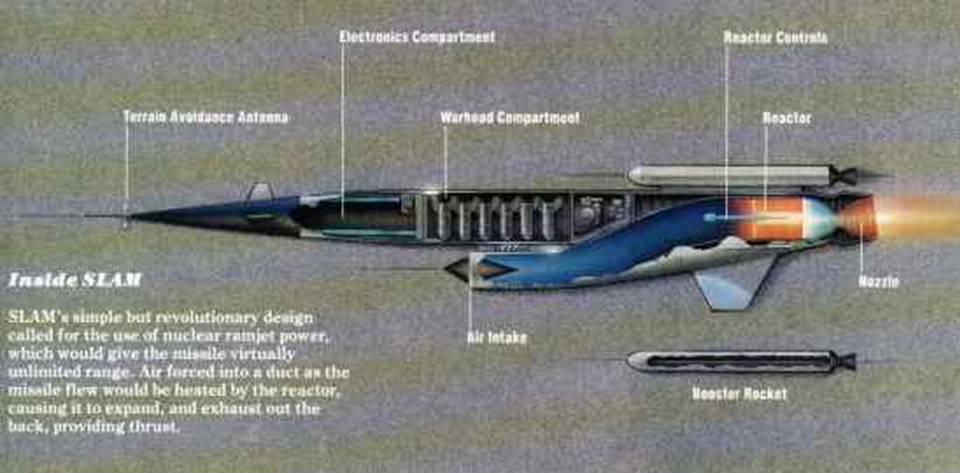
You may recall that shortly before Christmas I sent around a message in which I discussed the design, developmental work and testing that had been done on the Vought SLAM - the nuclear ramjet-powered, H-bomb sowing flying leviathan that was one of many unbelievable but terrifyingly realistic weapons systems dreamed up by atomic eggheads in the 1950s and 1960s.  Not surprisingly, this little trot down memory lane sparked a good many comments, most of them concerning the sheer lunacy of creating something that carried a belly-full of nuclear weapons, irradiated anything it flew over, and had a virtually unlimited range.  In one subsequent conversation, however, the point came up that, with such maniacal inventions cluttering up our collective history, there didn't seem to be much point in unleashing speculation in an attempt to posit the sorts of innovations ("disruptive technologies", if you like) that might pop up in the future.  This is not to suggest that speculation isn't fun, just that there isn't much point in it - particularly when there's no way to predict where technology will go, and especially when we're so woefully ignorant about our own past, and haven't figured out how to deal with things that we ourselves invented half a century ago, but just somehow didn't get around to putting into production.  We don't have to go to the history of the space race for such examples; we only need to look into our own archives.

For example, we're all familiar with HEAT rounds - they've been around since WWII, and are fairly simple in concept.

The British PIAT - Projector, Infantry, Anti-Tank - relied on a HEAT warhead to (occasionally) penetrate enemy armour.  A HEAT warhead consists of an explosive charge with a conical well in the centre, lined with metal (usually copper).  The charge is initiated by a base fuze.  In the case of the PIAT warhead (below), the projectile is fired at a target; the extended probe on the nose fuze ("transit plug") transmits the shock of impact to the fuze at the base of the HE charge.  When the HE charge detonates, the shock wave compresses the copper cone into a jet of molten metal travelling at the speed of the explosion - roughly 7000 m/s in the case of a conventional TNT or Composition B fill.  The liquid metal jet penetrates the armour of the target and does corresponding damage to the interior of the vehicle, and its crew.  HEAT rounds are very effective, which is probably why they continue to constitute part of the basic load (along with kinetic penetration munitions, like APFSDS) of main battle tanks and armoured fighting vehicles even today.  They also continue to make fantastic infantry AT weapons; virtually all current light, medium and heavy AT missiles and rockets, from the venerable RPG-7 to the modern TOW2 missile use HEAT warheads.


Defending against HEAT rounds requires different strategies.  First, you can keep the jet away from your armour plate.  That means hanging something on your vehicle to make the incoming round detonate further away.  Second, you can keep the jet from forming; one way of doing so being explosive reactive armour panels, which detonate when the HEAT round strikes them, destroying the round as the jet is forming.  Third, you can thicken up your armour (bearing in mind the requirement that the vehicle still has to be able to move and carry stuff).  And fourth, you can try to disrupt the jet and prevent it from penetrating all the way through to the interior of the vehicle (which led to layered armour, with various materials sandwiched between plates to disperse the jet horizontally).
Research in the 1980s and later on took the HEAT concept somewhat further, into explosively formed projectiles (EFPs, also known as self-forging fragment projectiles).  During my first visit to Suffield as a staff officer back in the early 90's, I was shown test fragments and videos from trials on a new type of experimental munition: a scaled-up version of an EFP.  By thickening the conical well liner in the explosive charge, or by changing to a different, tougher metal than copper (e.g., iron), the charge, when detonated, would - instead of forming a liquid metal jet - compress the metal cone into a slug moving at very high speed.  The slug would not be affected by stand-off detonation mechanisms or explosive-reactive armour panels, and layering armour to disperse a metal jet horizontally wouldn't be much help. 
Moreover, you could make the slug big.  Really, really big.
 

THIS big.  That's from a test at Suffield back in the 90's.  I recall handling something like this during a visit.  It was more than a foot long and weighed about 30 pounds.  Imagine that thing coming at you at several thousand metres per second.  And the creation of them, by the way, is an exercise in perfect machining backed up by mathematics.  Here's an image from a DRES paper from 1995 (by one of our own colleagues - see note A) on modelling EFPs:

Note the similarities - and the caption which states that the mathematical models were confirmed by experimentation.  That hunk of metal started out looking like a wok about an inch thick, and after being whapped with a couple dozen kilos of HE, ended up looking like the lawn dart from Hell.  Math is awesome.
There's no point in going into too much more detail on EFPs, because that isn't what I really wanted to talk about in this message anyway.  I simply wanted to emphasize the fact that this technology is now old - so old that the Iraqi insurgents, al Qaeda, and other jihadist adversaries have adapted self-forging fragment technology to off-road mines and IEDs, and we're still having a heck of a time dealing with it.  What I'm getting at is that we don't need to invent science-fictiony "future" threats like "tunable weapons" and "gray goo nanobots" and "hyper-empowered individuals" if we're already facing things invented decades ago, but that have got us completely boggled.
Which takes me to today's topic - the Death Star.  Or at least the Soviet equivalent, Polyus. 
 

A few years back I penned a tech note looking at the arms control implications of space testing missions, specifically the October 2009 LCROSS experiment in which NASA slammed a rocket body into the Moon as part of its search for water on the lunar surface. The paper attracted its fair share of mocking laughter due to the title, which I wrote in jest ("Bombing the Moon"), but anyone who'd taken a moment to read the thing - it wasn't long - would have realized that I was trying to point out the implications of arms control treaties, agreements and regimes for otherwise legitimate space exploration and testing exercises, and vice versa. More knowledgable individuals with a higher security clearance who read that note would have recognized that I was trying to discuss in synecdoche a much more profound incident with significant legislative implications.

Of course, these days most folks don't seem to go in for specialized knowledge, and those who do often seem to lack the security clearance (or the simple interest) to delve deeper into important, paradigm-altering problems that actually impact us on a daily basis. People styling themselves "scientists" seem to prefer to fiddle with models rather than data and evidence, blathering on in bland, meaningless generalities devoid of any linkage to the real world rather than grappling with current problems. I guess that's easier and safer. Whether it's anything more than a complete and utter waste of time and taxpayer money, on the other hand...that's for other folks to decide.

But I digress. In the course of that tech note, I discussed the arms control prohibitions against space-based weapons, briefly mentioning the 1987 launch of an 80-tonne orbital object by the USSR.  This vehicle, it has been suggested, was to have been the forerunner of a series of orbital battle platforms intended to neutralize the US Strategic Defence Initiative systems (which of course were never deployed). 

Polyus failed to achieve orbit and ended up in the Pacific Ocean, and the Soviets never tried again - but the point is, they tried once.  Polyus wasn't some postulated "disruptive technology" or theorized "future threat". It was very real. 

And yes, I know the above picture has "MIR" on the side of the big black thing; according to the official article on Polyus from the Buran website, MIR space station modules were used in its construction.  Here's a pic of the vehicle on the launch pad at Baikonur in 1987; the "Polyus" name is clearly visible on the side (you can sort of see it in the colour pic above, too):


For the sake of reference, the Polyus vehicle in the image above is 40 m long, about 4 m in diameter, and weighed 80 tons.  The Space Shuttle Orbiter is 37 m long, and weighs about 70 tons empty (its gross liftoff weight is about 109 tons).  So this was no mere firecracker.

How real was all this?  Well, real enough that Mikhail Gorbachev showed up at Baikonur on 11 May 1987 to see the thing shortly before it was launched.


According to one news report, one of the purposes of Gorby's visit was to confirm that Polyus was not carrying any weapons.  Did it, or didn't it?  The actual story is a little hard to get a grip on; there are numerous pictures available from different archives, and various articles published by project personnel over the years tell different stories.  Schematics abound on the innerwebz:


 If your Russian is as good as mine, you won't have gotten any of that.  Here's an alleged translation, according to an article penned by one Ed Grondine:

There isn't much in the way of empirical support for Grondine's assertions.  Most of what is available in the public domain about Polyus comes from official websites (for example, Buran), which don't mention self-defence armaments, much less "nuclear space mines".  A lot of the funkier stuff comes from a 2005 article by Konstantin Lantratov, a former press officer in the Russian space industry, entitled "Star Wars That Didn't Happen".  According to the Buran website, for example, the Polyus vehicle carried ten separate scientific experiments - the first of which was testing the USSR's ability to orbit super-heavy packages...like Polyus.  Interestingly, the site contains dozens of photos of the spacecraft in the assembly stages; it appears to have been cobbled together out of spare parts:

The service block looked like a "Salyut" slightly modified for this task and was made up from parts of the ships "Cosmos-929, -1267, -1443, -1668" and from modules of MIR-2 station. In this block took place the management systems and on-board displacement, the telemetric control, the radiocommunication, the heating system, the antennas and finally the scientific installations. All the apparatuses wich not supporting the vacuum were installed in the hermetic section. The part of the engines made up of 4 propulsion engines, 20 auxiliary engines for stabilization and the orientation, 16 precision engines, as well as tanks and pneumo-hydraulics conduits. Lastly, the production of electricity was made by solar panels which were spread when Polyus was into working orbit. (Note B)

The size, design and components of the vehicle - not to mention the secrecy with which it was fabricated and launched (which was not at all uncommon during the Cold War, remember) - would naturally spark all manner of conspiracy theories.  The vehicle according to Buran contained large quantities (420 kg) of xenon and krypton in 42 cylinders of 32 L capacity, with an injector to squirt the gas into the upper atmosphere to "generate ionized signals with long waves".  Grondine argues that the purpose of this was to produce light by fluorescence, in order to signify that a container (possibly holding a nuclear space mine?) had been launched without generating radio energy, which could be tracked.  According to other sources (e.g., the always infallible Wikipedia), the gases were intended to be used to test, with the appearance of innocence, the venting apparatus for a zero-torque exhaust system for a 1 megawatt carbon dioxide laser intended to damage Strategic Defence Initiative satellites.
Grondine also commented, as many others did, on the "optically black shroud" covering the whole thing.  Painting a space object black is one way to make it more difficult to see via reflected light - although the point of doing so when you've got huge solar panels sticking out of the sides of the thing escapes me.  Also, painting it black would tend to make it hot, as it would absorb rather than reflect solar radiation; and unless the thing incorporated stealth technology, it would still be easily visible by radar, which is how SpaceCom tracks large orbital objects anyway.
The fate of Polyus was in any event not a happy one.  It was launched on 15 May 1987, two days after Gorby's visit to Baikonur ended.  The Buran website has a comical description of why the GenSec missed the launch:

The first launch of Energia and Polyus was so important for the direction of the party that the General Secretary of the Central Committee of the Communist Party itself, Mikhaïl Sergeevich Gorbatchev, went. However, it is well-known that any apparatus, so simple is it, have a strong probability of breaking down during a demonstration or in the presence of VIPs, this is why the Management committee had decided (on May 8) to delay the departure on May 15, under pretext of technical problems, knowing that M.S. Gorbatchev could not remain because it had a voyage to the head office of UNO at New York.(Note B)

Their precautions turned out to be well-founded.  Because the Energiya had been designed with hang-points for the Buran space shuttle system, Polyus had to use the same connection mechanisms.  This led to it being mounted backwards, i.e. with the main thruster engines facing forward, resulting in a complicated mission profile.  In order to achieve orbit, after about 8 minutes into the flight program, at an altitude of about 110 km, the Polyus would jettison its engine shroud, separate from the Energiya booster, and execute a 180 degree turn using its thrusters.  Once this was complete, about 15 minutes into the flight and at an altitude of about 155 km, it would fire its main engines periodically to level the craft, and eventually achieve a stable orbit at 280 km altitude, by about 30 minutes after launch.
That's not what happened.  Only one of the positioning thrusters functioned, and the Polyus, instead of making a 180 degree rotation, made a full 360, leaving the main engines pointing forward.  Instead of accelerating the craft into orbit, the engines decelerated it, and Polyus deorbited into the Pacific Ocean, reportedly landing in water that was several kilometres deep.  According to open sources, the spacecraft was never retrieved.
So, Polyus was real.  The Soviets really built it, and they really launched it.  Did they arm it? Was it supposed to be the first real space battle station?  Would it have worked?  A 1-megawatt laser isn't much in atmosphere, where blooming and attenuation quickly destroy beam coherence; but in space, it might be fairly effective over a reasonably long range.  Could it also have carried "nuclear space mines", presumably for use against US orbital assets?  I think a more important question is, could it have carried nuclear warheads as part of a fractional orbital bombardment system, or FOBS?  That was one of the big worries of the 1960s, and it was one of the key reasons that the US and USSR negotiated the 1967 Outer Space Treaty, which prohibited placing "nuclear weapons or other weapons of mass destruction" either in orbit or on celestial bodies.(Note C - and here we are back at the "Bombing the Moon" technical note again. Funny how this arms control nonsense keeps coming back to haunt us. Almost like it was relevant or something.) 
Would the Soviets have broken the OST? Well, when you can't figure out why somebody's doing what they're doing, or whether they're likely to be doing something they shouldn't, you've got two choices: pull a guess out of your nether regions (the preferred option for "analysts" who don't know anything about anything and think that history is "stuff that's in books"); or use actual evidence. In such cases, the only evidence we have to go on is historical precedent - i.e., what have the suspects done in the past, and why.  Would the USSR have abrogated the 1967 OST by placing nuclear weapons in orbit?  Well, they signed the 1972 Biological and Toxin Weapons Convention, which prohibited producing biological weapons...and then went on to build the biggest biological weapons complex in the world, churning out weaponized anthrax, smallpox, and a host of other pathogens literally by the metric tonne.  By the late 1970s, the USSR was consuming 400,000 fresh eggs per week simply to incubate the weaponized India-1 strain of Variola Major, and had developed refrigerated, heat-dissipating ICBM warheads specifically designed to keep viral and bacterial agents alive during re-entry.
So you could say that, when it comes to the former USSR and its adherence to non-proliferation, arms control and disarmament conventions, there are some legitimate trust issues.
 
Soviet-era fermenters in Building 221 at Stepnogorsk, Kazak SSR.  Fool me once, shame on you.  Fool me twice...

I guess the final take-away from this is that when it comes to trying to figure out what a potential enemy might be able to do in the near future, one of the best guides is knowing what they've done to you in the near past.  If nothing else, the existence of things like the Vought SLAM and the Polyus Space Battle Station should give us a smidgeon of perspective on some of the prerequisites and challenges involved in creating massive and potentially threatening items of military hardware.  In other words, if we want to figure out whether somebody might put an orbital battle station in Low Earth Orbit and use it to dazzle or destroy our satellites or FOB a nuke onto one of our cities, the first thing we should do is make a list of folks who (a) can build space stations, (b) have a heavy-lift rocket capability, and (c) don't like us.  The intersection in that Venn diagram is where we ought to start looking. 
And if the intersection is empty, maybe we shouldn't waste our time making up non-existant things to fill it.
Anyway, if anyone wants to read Lantratov's article and feels like slogging through 28 pages of "Google-translated" grammar, just let me know.  He gives all the details about cannons, targets, gas generators, and mentions that the black finish on the vehicle was to help maintain working temperature by absorbing solar energy.  It's a cornucopia of awesome, and by the time you're finished reading it you'll be muttering "Commence primary ignition!" under your breath.
Cheers - and may the farce be with you!

//Don//

Notes
A) The paper is available from the DRDC online archive.
B) http://www.buran-energia.com/polious/polious-desc.php
C) http://www.unoosa.org/oosa/SpaceLaw/outerspt.html.  The OST also prohibits laying claim to celestial terrain. 

Thursday, October 11, 2012

21 December 2011 – H-bombs, Santa, and the Poop Spiral of Doom

Colleagues,

The Yuletide season is upon us, and with comes the annual ritual of NORAD tracking the big guy in the red suit.  If you're so inclined, you can follow his progress here, on NORAD's on-line Santa Tracker:


As I write, we're currently 3 days and 17 hours (and some assorted minutes) away from launch.  As an Air Force brat, I've been familiar with NORAD's tracking efforts for most of my life, and I recall wondering whether Santa, like the Tu-4s that drop by from time to time, ever merited an escort.  You sort of had to be concerned about whether his IFF transponder was operating, and whether he had the right codes (which in turn makes me wonder whether Santa has to wait three years to get his security clearance updated like the rest of us so he can even be ISSUED the codes); because if he didn't, well, in an era of AIM-120s, a pilot might be cleared to engage from beyond visual range, and then it'd be Run, Run Rudolph! for real.

In today's world, however, an air-breathing intercept seems somewhat less likely.  After all, with the ground-based interceptors of the BMD system in place and operational, it might - given how fast Santa would have to be travelling in order to get through his assigned duties in the allotted time - be more realistic to forego the F-22s and simply send an exo-atmospheric kill vehicle his way.  It's worth working through the intercept from an air defence perspective, if only to get a better grasp of the nature of the problem.

Well, what are the capabilities of the system?  Assuming Santa's sleigh operates on a cold launch system (which is not necessarily true, but more about that later), his take-off probably wouldn't be detected by the Defense Support Program (DSP) satellites that watch missile fields for the thermal signature, or bloom, of an ICBM launch.  On a southbound trajectory from the North Pole, the first piece of equipment to pick up Dasher, Dancer and the rest would be the Ballistic Missile Early Warning System, from one of two stations: Clear, Alaska, or Thule, Greenland. 

Ballistic Missile Early Warning System Sites

Clear has a PAVE PAWS phased array radar system that operates in the UHF band, with two faces each giving 120 degree coverage, with elevation coverage from 3 to 85 degrees above horizontal.  At peak power (about 500 kW for the main beam) it can detect an object the size of a small car at a range of 5550 km (3000 NM).  Since that accords pretty much with a large sleigh, it's the figure we'll use.  Even if Santa has adopted stealth technology, we can assess 8 "tiny reindeer" as adding up to the radar cross-section of a small car - or 9, if it's a foggy Christmas Eve and Rudolph's on duty.

PAVE PAWS phased array radar system at Clear, Alaska

The problem, of course, is that Santa's flight profile doesn't come close to that of a ballistic missile launched from the Asian heartland, or of a SLBM launched from a sub lurking in the - let's face it - totally ice-covered Arctic Ocean.  There's never been any indication that the sleigh is pressurized, so unless he's wearing breathing apparatus, the old guy's going to have to keep it below 10,000 feet ASL.   That poses some horizon issues, but solving them is a relatively straightforward problem in geometry:

If the PAVE PAWS was capable of detection at the visual horizon, calculating its detection range D for a target at altitude X is simple.  Knowing that the polar radius of the Earth R is 6,356,752 m, and that R1 is therefore R+3077 or 6,359,829 m, then D would simply be the square root of R1 squared minus R squared, or 197,810 m - or about 197.8 km from the radar station.  However, the PAVE PAWS has a minimum detection altitude of 3 degrees above horizontal, so detection would be a little later, when the bogey was closer to the site.  I'd recalculate that for you but I don't feel that into trigonometry this morning.

With a detection range of only 200 km or so for a target at an altitude of 10,000', would there be enough time for the warning system to react?  Maybe; depends on how fast the sleigh is travelling.  From Santa's perspective, he could vastly improve his survivability by flying lower and faster.  That's the same conclusion that was reached by the designers of the B-1 Lancer bomber, the performance of which I've had occasion to witness.  It's true; the lower and faster you fly, the less time anyone watching has to find you, fix you, and intercept you.

Which brings me, in a roundabout way, to the topic of this week's message.  You think the B-1 is low, fast, and nasty?  Well, amigos, you ain't seen nothing yet.  A colleague who is also an aficionado of all things ancient and atomic brought to my attention the other day one of the historical gems from America's glorious nuclear past.  Back in the halcyon days of the late 1950s - the era that brought us the Pentomic Army and such weapons systems as Atomic Annie, the 280-mm nuclear howitzer, and the Davy Crockett, the A-bomb-firing recoilless rifle - there were no problems that couldn't be solved by judicious application of the Mighty Atom.

The Davy Crockett nuclear recoilless rifle; and the Atomic Annie 280-mm nuclear howitzer

Thing is, those weapons, crazy as they might have been (and the Davy Crockett was crazy enough that, under certain firing conditions and selected yields, its lethal radius exceeded its range), those weapons were actually deployed.  The ones that fascinate me are the ones that did make it off the drawing board, but only as far as proof-of-concept and test and evaluation stages.  The most infamous one is probably one that, although it was closely connected to military weapons research, wasn't really a Defense programme at all: Project Orion.

 Project Orion - MY kind of crazy

In a nutshell (ahem), Project Orion was a spaceship designed to be propelled by the explosion of nuclear bombs fired out of its base.  The force of the explosion against a pusher plate (equipped with, shall we say, "powerful" shock absorbing systems) would drive the ship forward.  Thousands of bombs would be needed to reach planets throughout our solar system, which required miniaturizing the weapons as much as possible.  The research aimed at miniaturizing nuclear weapons - remember, this was the late 1950s and early 1960s, when much research was put into making bombs as big and destructive as possible, leading to monstrosities like the boxcar-sized B-17 - eventually led to the nuclear artillery rounds small enough to be put into 155mm and 203mm projectiles - and to the enhanced radiation weapon or 'neutron bomb' that bedevilled the Carter Administration, and was responsible for so much Euro-angst in the late 1970s.

In between the Davy Crockett and the Orion spaceship, though, were a good many 'almost-rans.'  One of those was the Convair X-6.  Based on the Convair B-36 bomber, the X-6 was to have been propelled by nuclear reactor-driven engines.  The idea was that the plane would carry a 3 MW air-cooled nuclear reactor in the bomb bay - and a 12-tonne lead and rubber shield to protect the crew from the otherwise unshielded powerplant.  A testbed aircraft - the XB-36H - was built to trial the shielding requirements, and logged 215 hours of flight time, during 89 of which the on-board reactor was operated. 

 
Based on the results of the testing, the Convair X-6 project was scrapped in 1961.  Had the thing gone to trials, a number of problems would have had to have been overcome.  One was the weight.  The takeoff weight of the beast was expected to be 363,000 pounds - roughly the same as a 747, but decades before the 747 became a reality.  The testing facility was on the point of building a 15,000-foot runway when the programme was cancelled.  Also, there was the small matter that only the aircrew were protected against the radiation of the reactor; everything else, including the plane body and everyone around it on the tarmac, wasn't.  The nature of the problem might have been telegraphed just a little when the Air Force started advertising for pilots who were past child-bearing age.

The biggest problem with the plane, though, was the fact that the aircraft engines weren't...err...well, you couldn't really shut them off.  You see, in a real jet turbine, propulsive force is achieved by superheated exhaust expanding out the back end of the engine.  The heat is provided by burning fuel.  Turn off the fuel flow, the engines shut down.  In the X-6 concept, however, there was no fuel; the heat was supplied by the nuclear reactor.  Airflow over the reactor elements superheated the air, and the efflux from that drove the aircraft.  It also cooled the reactor, as there was no space in the plane for the hundreds of tonnes of water and other assorted cooling media associated with terrestrial or naval reactors.  The cooling provided by air rushing over the reactor elements at hundreds of miles per hour would still be needed even when the aircraft was on the ground and parked. 
 
Something of a poser, as they say.

Well, put all of these problems and capabilities together, and what do you get?  Think about it: a plane powered by a nuclear reactor doesn't really need fuel, so it can fly pretty much forever, except that it produces so much radiation that nobody wants to get near it.  You can't shut it off, so it's pretty much a one-shot deal.  And it can go really fast.  REALLY fast, in fact, once you realize that the reactor can produce so much heat that the rate-limiting factor, really, is how fast you can get the air into the core to be superheated.  And once you realize THAT, you start thinking about something that the scientists had only just begun talking about after the X-15 programme was under way, which was...ramjets.  In a jet turbine engine, air is compressed to the necessary density by compressor blades (hence the name).  But if you get an air-breathing vehicle up to a high enough speed, you can do away with the compressor blades, and simply shape the intake to force the incoming air to the right density. 
 
Put all of these factors together, add a monocle and a white Persian cat, and what do you get?  That's right: a doomsday machine. 
 
Enter the Vought SLAM.

 
Imagine a cruise missile the size of a railway locomotive.  It's powered by a nuclear reactor similar to the one designed for the Convair X-6, but reconfigured a little.  It doesn't heat air for individual engines; it's the engine itself.  It has a big ramjet intake and is designed to heat compressed air so hot - 2330 degrees - that it needs no fuel at all.  It just blasts the superheated air out the tailpipe. 

Is this for real, you ask?  Well, for starters, they built the aerial reactor (amusingly nicknamed the 'Tory' Reactor), as part of Project Pluto, which eventually became the nickname for the whole project, including the airframe:


They also built (at the unbelievably appropriately-named Jackass Flats) the 25 miles of oil well pipe casing needed to contain enough compressed air to test the ramjet capacity of the engine...


...and they also built the Tory IIC engine, and tested it in 1964.


At full power, the Tory IIC engine produced 35,000 pounds of thrust and 513 MW of power.  For the sake of comparison, that's roughly the same as the reactor in a large nuclear generating station - except that the Tory IIC was only the size of a railcar.  Amazing what you can achieve when you do away with all of that pesky radiation shielding (although according to the test results, the engine produced less radiation than expected).  As an article about the SLAM project noted, the May 1964 test was observed by "dozens of admiring AEC officials and Air Force Generals"...all from "a safe distance".  Yeah, I'll bet. Like Tasmania.

Of course, to make the missile work you first have to get it up to ramjet speeds - well over Mach 3 - before the nuclear engine starts operating properly, so to do that you strap a few solid rocket boosters onto the thing.  Stick an inertial guidance system into it, like the one used by the infamous Snark cruise missile (and like the first-generation ALCMs would get about 10 years later) and you could program it to follow a preset course.  It can fly for so long (estimates put its range at an incredible 100,000 km, or two and a half times around the planet) that you could launch it and let it loiter, flying figure eights over an ocean for hours or even days before sending it a command to penetrate enemy territory.  It's virtually indestructible because compared to a manned bomber it has only a fraction of the moving parts; remember, it's really nothing more than an aerodynamic teakettle (the project manager dubbed it "the flying crowbar").  It'll fly so low that Soviet radars will never spot it; so fast that Soviet fighters (and SAMs) will never catch it (so fast, in fact, that the 150 DB of the shock wave was expected to smash windows and rupture eardrums all along its flight path); and it will never run out of fuel.  Awesome, eh? 
 
But wait...there's more! 

Now you turn it into a one-shot disposable aerial SSBN!

 File under "Seriously, who thought this was a good idea?"

You install a dozen vertical-deployment tubes, each carrying a one-megaton thermonuclear warhead equipped with an ejection mechanism and a parachute.  So now your low, fast, 100,000 km-range, unstoppable, nuclear-powered flying freight train can follow a pre-programmed course across the Soviet Union, 500 feet off the ground, at Mach 3, excreting H-bombs at predetermined deployment sites. 

 
Good freaking lord.

And did I mention that it would be spewing radiation all the way?

Yeah, no need for pilots means no need for shielding other than the minimum necessary to protect the electronics.  Given the amount of radiation the lightly-built, almost totally unshielded reactor would be producing, burst eardrums and broken windows would be the least of the problems afflicting anyone under the missile's flight path.  The intake would be sucking in dust, debris, water droplets and all manner of aerosolized contaminants, cooking them to a turn in a 600-MW reactor running at full power, and blasting them back out the tailpipe as, let's face it, fallout.  According to project reports, this was regarded as a bonus.  There were discussions during the project as to whether the missile, having discharged a dozen buckets of sunshine onto the heads of unsuspecting kulaks, should be programmed to then add insult to injury by flying back and forth over Soviet territory, sowing neutrons until it eventually melted down and crashed into Comrade Sergey's potato field.  Alternatively, it could be programmed to crash itself and its screaming hot reactor into a 13th target, sort of as an added treat.  An apocalyptic baker's dozen, if you will.

Just how serious was the SLAM project?  Well, as noted above, serious enough that they built the engine, tested it, and were working on a Mach 4+ version when the plug was pulled on 1 July 1964.  A number of factors contributed to the decision to kill the project.  One was the cost; each missile was expected to run about $50 million, an exorbitant figure at the time.  The Navy was preparing to deploy the Polaris SLBM, and the Air Force had ICBMs, both of which were totally invulnerable to the SAMs of the time, and both of which arrived at their targets much faster than the SLAM (which one critic redubbed 'Slow, Low And Messy').  There were other problems, too.  Which ally would be crazy enough to allow a SLAM to overfly their territory en route the USSR?  And for that matter, how could you test the thing?  One proposal was to have it fly lazy figure-eights near Wake Island in the Pacific - and, once the test was complete, to ditch the missile, with its red-hot reactor, into the ocean.  Another (hilarious) proposal was to test it in Nevada using a long tether.  One project expert remarked rather drily, "That would have been some tether."  And what if one got away, either during testing, or in some sort of operational scenario?  After all, a SM-62 Snark cruise missile test-fired in 1956 using a similar inertial navigation system had been aimed at Puerto Rico, and was last seen on radar heading into the Amazon.(Note A)  What if that Snark had been carrying 12 thermonuclear warheads and a blazing hot, neutron-spewing reactor?

Worse, what if it didn't crash?  Remember, it didn't need fuel, and didn't have a whole lot of moving parts.  How long could such a thing stay up?  How would you bring it down?  For that matter, where would you bring it down?

Good lord, why hasn't somebody made a movie about this thing?  Oh, wait, they did:

 
Except that the SLAM moved a thousand times faster than any Terminator.  Plus it flew, spewed radioactivity, and was stuffed full of H-bombs.

Bottom line, beyond the sheer horrifying craziness of the concept, the SLAM was inferior to ballistic missiles in every conceivable way, and so it ended up on the chopping block.  The USN and USAF went on to deploy thousands of SLBMs and ICBMs which, for all their faults, were at least cheaper and faster; and while SSBNs were driven by nuclear reactors, none of the missiles were themselves nuclear-propelled.  When cruise missiles eventually were deployed a decade or so later, they were much smaller, carried only one warhead, and required fuel to fly.  Quite a different concept from the invulnerable, unstoppable "flying Chernobyl" dreamed up by the USAF, AEC, and the frighteningly innovative wrench-benders at Vought.

For those of you interested in reading more about the SLAM, you can find fascinating articles at the following websites:


A final thought about the discussion that sparked this whole line of investigation in the first place.  If you're Santa, then you're looking for something that can travel very low, very fast, for very long distances without refuelling, and that is capable of delivering packages at predetermined sites. If Santa were looking to upgrade the old sleigh to something a lot more capable, the SLAM would be a fantastic choice.  The hazard to the big guy himself shouldn't be too much of a worry, because let's face it, he's a long way past child-bearing age.  Like the Project Pluto folks, the radiation should be considered a bonus.  There'd be no need to drag Rudolph along to provide additional illumination: 
"Mommy, why is Rudolph's nose blue?" 
"Actually, sweetums, that's called the Cherenkov effect..."

And on that happy note, dear colleagues, Merry Christmas to all - and to all, a good night!  See you next year.

//Don//
 
P.S. As a contemporary note, nearly a year later, here's an example of why I think creating a nuclear-propelled autonomous flying H-bomb delivery truck might be a bad idea:

(Source: Failbook)

You see, I don't think the robot apocalypse is going to be the result of our preprogrammed servants freaking out or conspiring to destroy us all in some sort of Skynet Götterdämmerung.  I think we're in much more potential danger from a combination of our own laziness and our chronic lack of imagination about the potential consequences of robots doing exactly what we built them to do. 

"Judgement Day" is a whole lot cooler and much less embarassing as an explanation for the demise of humanity than "The Poop Spiral of Doom".


Notes:
A) http://www.airforce-magazine.com/MagazineArchive/Documents/2004/December%202004/1204snark.pdf

Saturday, September 29, 2012

Impossible things

Colleagues,

For years now, I've been a fan of Failblog. With the possible exception of Mark Steyn's punditry, it does a better job of blending the sublime with the ridiculous than just about any other site out there.

But I had to take issue with this photo:


Actually, not so much with the photo as with where it was posted: under "Win".

It's not a "win", people. Sure, it's a great picture of SST ENDEAVOR...but it's a picture of America's last operational space shuttle being delivered to a museum.  To put it another way, a couple of weeks after Neil Armstrong died, and 40 years after a human being last walked on another planet, America parked its last manned space launch vehicle forever.  The US government couldn't build a Saturn V rocket right now if it tried.  Think about that; it's like saying Chrysler couldn't build a 1968 Plymouth Fury.

Okay...maybe that's a bad example. They probably couldn't.

What that picture really signifies is that America is out of the manned space travel business, which - given that every other space programme in the world has only ever been a half-arsed attempt to copy America - is pretty much the same as saying that mankind is out of the manned space travel business.  Sure, there are robots on Mars, and lots of stuff like Cassini flying around the solar system (and out of it) - but even in the unmanned realm, the most extraordinary successes, like Voyager, are decades in America's past.

Maybe the death of manned space travel was inevitable. Is exploration really a necessity, or is it a luxury? Should the brokest nation in the history of human civilization not place its priorities elsewhere - like, for example, getting its fiscal house in order before spending billions to shoot a select few to tromp around Mare Tranquilitatis again (or, heaven forfend, Olympus Mons)?

Or is manned space travel one of those activities the ancillary civilizational benefits of which outweigh the costs? Is it le beau geste - the technological, the emotional, the moral equivalent of Caesar standing alongside the Rubicon and saying Alea iacta est? Is it a challenge that draws us onwards? Do we need a destiny to strive for?

I don't mean to suggest that we should aim for L5 colonies and lunar settlement and Martian terraforming; not just now, anyway.  But we need that challenge. Carl Sagan, a prisoner of the Cold War, used to say that a human future in space was our only defence against the possibility that we might destroy ourselves. I'm not that apocalyptic about it; I simply think that we need a challenge. Without a challenge, a civilization stagnates and festers. From a challenge comes shared purpose, and from shared purpose comes a sense of destiny.  For England, it was Empire; for America, it was serving as the democratic ideal. Hell, for the Soviets it was world socialism (at least until the West's economic karma ran over their dogma).  Bottom line, we need a goal; something unusual, something glorious even, to strive for. We need something inspiring to work towards. Not a mishmash of feel-good sociocultural gobbledegook of the sort peddled by Obama and his band of free-spending vandals and wastrels; not pastel sunshine, happy unicorns, or (as Steyn puts it) a "far distant horizon where educated women and fire-breathing Imams frolic and gambol side by side around their Chevy Volts". That's an image of America as a low-rent rest home, where the disabled half of the population squats in cheap wheelchairs staring blankly at Honey Boo-Boo while the other half spoons pabulum into their mouths.  That's not a vision, but a nightmare; a purgatory of cultural senescence that is far more destructive (and, terrifyingly, far more likely) than the shower of plasma and neutrons that had Sagan quaking in his boots.

No, we need something more than that, a greater purpose to draw us onwards; something grander and more inspiring to work towards than the vital goal of sacrificing the livelihood of the present to achieve a statistically immeasurable decline in the rate of increase in sea levels. We need something to struggle for that's not merely difficult, but that's impossible.  Why impossible? Because we're humans, that's why. Isn't "you can't do that" the most annoying thing you've ever been told? Doesn't it make you want to head right out and do "that", whatever "that" might be?  Doesn't the word "impossible" just...well, doesn't it just piss you off?

The White Queen famously told Alice that she sometimes believed six impossible things before breakfast.  When Rev. Dodgson wrote those words, balloons were common, but human flight was an impossibility.  Half a century later, courtesy the Wright brothers, it was not only possible, but routine; but rocket-powered flight was impossible.  Ten years after that, thanks to Robert Goddard, rockets weren't impossible anymore, and ten years later they were being used as weapons of war; but pushing a human past the speed of sound certainly was. Twenty-two years after Goddard, the sound barrier was broken by Chuck Yeager, but putting a man into space and bringing him back was impossible.  Fourteen years after Yeager, man was exceeding the sound barrier by several factors, and Yuri Gagarin went up and came back; but it seemed impossible that man would ever walk on the Moon.  Only eight years after Gagarin, Neil Armstrong took that first historic step.  That was forty-three years ago.

That's five impossible things, and we're just getting started.  We've visited every planet in our neighbourhood and our robot servants are patrolling the most promising one, looking for signs of water and life. Our emissaries, bearing our greetings, are on their way out of the solar system - the most primitive and inefficient form of interstellar communication imaginable, but the first one we could achieve, and so we did it.  We did it.

The shuttles were great, but enshrining them is like enshrining a bus or a dumptruck. They were not the tools of glory. Those will be the next ship - the one that takes humans to Mars, or to the asteroids, or to Ganymede or Europea or Titan. Or somewhere else.

So yeah, it's a nice picture of Endeavor.  But Endeavor was a UPS truck. It was a service van.  I want to see the next Flyer, the next X-1, the next Saturn V.  I want to see the next Nina, Pinta, and Santa Maria.

Endeavor is what was.

I want to know what's next.

//Don//

Tuesday, September 18, 2012

We just decided to go

I was three when Neil Armstrong walked on the Moon.  My grandmother went to Cape Kennedy in 1970, and amongst other things, she brought back a set of mission photographs - 8"x10" prints of the best photos taken during the Apollo 11 launch, the mission, the Moon walk, and the return to Earth.  I remember looking at them as a kid, certain and sure that one day I would walk on Mars.  Sure enough, in fact, that I entered a contest in 1977 sponsored by the Ontario Science Centre to design a spaceship to travel to Mars. I won a couple of free passes.  I was eleven, Star Wars had just been released, and it was less than five years since the last man had walked on the Moon.

In December, it will have been 40 years since the Apollo 17 astronauts came home.

I still have those pictures. This has always been my favourite one:


Why, you ask? Simple - because although we know that it's Neil Armstrong in the suit, we can't see his face. I kind of like that anonymity; the fact that all we know is that there's a human being walking on another planet (and of course, thanks to the shoulder patch, that it's an American). Neil Armstrong, who may be the most self-effacing celebrity humanity has ever known, lived his whole post-Apollo life that way. While everybody else in the world looked at him, he seemed to spend his time trying to highlight the half-million or so folks who enabled him to walk on the Moon.

And that's why my favourite line about the Apollo program has never been any of the factual stuff that anyone said - Armstrong's quote, or the line on the plaque that says "We came in peace for all mankind."  My favourite line comes from the movie Apollo 13, where Tom Hanks, playing Jim Lovell, is talking to his wife while Armstrong is hopping around the lunar surface:

From now on, we live in a world where man has walked on the Moon.  It's not a miracle; we just decided to go.

We just decided to go.

Monday, August 6, 2012

NASA: Real science, and that other stuff

This past week gave us a graphic illustration of the difference between what you can predict in a linear system vs. what you can predict in a non-linear system - and both examples came from NASA.

First up: NASA GISS, under the inimitable and oft-manacled James "Death Trains" Hansen:


...we have this:

(Source: From Hansen's website, reproduced by Steve Goddard at Real Science)

The black line is measured temperatures (with Hansen's manual upwards data alterations applied, of course).  The green line is where Hansen says they should be.  The purple line is where he said they would be if humans had stopped emitting carbon dioxide twelve years ago.  So even by cheating - even by adding corrections to increase recent temperatures and cool older temperature records, contrary to all science and logic - Hansen can't beat the data hard enough to validate his nonsense models.

Now look what else NASA did this week:


That's right.  They flew a spaceship on a 9-month, 567,000,000 kilometre journey.  The ship hit the Martian atmosphere at 13,000 mph, slowed by aerobraking to 1000 mph, popped the biggest supersonic parachute ever made, slowed to 200 mph, ditched the chute (and the 1600-degree heat shield), deployed rockets, maneuvred drastically to get out from under the chute, dropped to an altitude of 20 metres, then lowered a Volkswagon-sized robotic rover on a cabled skycrane - and then, once the rover touched down, it cut the cables and flew away (if somebody wrote that landing mechanism into a sci-fi movie plot, no audience would believe it).  And the thing did it all on its own, because the entire landing process - 7 minutes long - is half the time it takes for a radio signal to get from Mars to Earth.  By the time NASA scientists received word that the vehicle had touched the top of the atmosphere, the Curiosity lander had already been on the surface for 7 minutes.

That was about three hours ago.  It's already started sending us photos...


...starting with a picture of its own shadow.

So there you have it, folks.  In a linear system like orbital mechanics, you can fling thousands of kilograms of metal and plastic into space and hit a landing target a few kilometres square at a range of half a billion kilometres.  That's like threading a needle if the needle were so small that you needed a microscope to see it.  It's like throwing a golf ball from Los Angeles through a garage door in New York.  But in a non-linear system like climate, you can't even make predictions with the right sign, let alone of anything even approaching the right magnitude.  If NASA's ballistic modelling was as good as its climate modelling, Curiosity would've ended up plunging into the Sun. 

It didn't.  It's on Mars.  It's on FREAKING MARS.  You can go to Google Earth, select Mars, and check out Gale Crater, where Curiosity landed last night.  There are a few overhead snaps from various orbiters.  Pretty soon there are going to be many more pictures there.  I cannot wait.

Curiosity is expected to operate for two years.  That's conservative.  Its older brother, Opportunity, lasted 40 times longer than it was designed to.  Spirit is still going, an interplanetary Energizer Bunny if there ever was one. 

And their great-grandfater, Voyager 1, is eighteen billion km from the Sun, moving at 17 km/second (the fastest thing ever made by a bunch of jumped-up monkeys, whizzing along three times faster than Curiosity was going when it hit the Martian atmosphere), and is on its way out of the Solar system.  That's how fast Voyager's going.  It'll be sending us data for another 13 years or so, before its power finally runs out, and then it'll be nothing more than a message in a bottle - a greeting card from the monkeys to whomever might be out there.  It's beyond our reach.  Whatever happens on Earth, whatever happens to humanity, it'll keep going, zipping along - plodding along - at one-eighteen-thousandth the speed of light.  In 40,000 years it'll only be as far away as the closest star is to our own Sun. Before it gets there, radio signals sent this century (badly attenuated by distance and dust, natch) will be approaching the centre of the galaxy.  That's how slow Voyager's going. But the grandest thing about it is that no matter what becomes of us, the Voyagers are concrete proof that we once tried to do something grand.

When my son was just a toddler, he had a playpen stuffed with toys.  For some reason they were never as interesting as what lay just outside the mesh walls.  Eventually, he got tall enough to chin himself, throw a leg over, climb out and drop to the floor. I remember watching him do that with a mixture of pride and dismay: pride, because he'd managed to exceed his limits; and dismay, because I knew one part of his life was over.  And then pride again, because the next part - the really fun part - was just beginning. Whenever he did it, he always hesitated before exploring, hanging onto the sides and looking around - not because he was scared, but because there were so many places to go and so much to see that he couldn't decide where to totter off to first.

We're just starting to crawl out of the playpen. There're so many places to go, so much to see! If achievements like Curiosity don't give you goosebumps, if they don't make you proud to be a human being, then you need to find another species to belong to.  Sloths, maybe. Or cockroaches.

And as for NASA - well, thanks for reminding us all once again that you're still capable of blowing our freaking minds.

Not bad for a bunch of jumped-up monkeys.  Not bad at all.

Cheers,

//Don//

P.S.  If only it were this easy (from Cyanide & Happiness):