Showing posts with label Miscellaneous. Show all posts

Tuesday, December 4, 2012

3 February 2012 – That’s no moon…

Colleagues,

You may recall that shortly before Christmas I sent around a message in which I discussed the design, developmental work and testing that had been done on the Vought SLAM - the nuclear ramjet-powered, H-bomb sowing flying leviathan that was one of many unbelievable but terrifyingly realistic weapons systems dreamed up by atomic eggheads in the 1950s and 1960s.  Not surprisingly, this little trot down memory lane sparked a good many comments, most of them concerning the sheer lunacy of creating something that carried a belly-full of nuclear weapons, irradiated anything it flew over, and had a virtually unlimited range.  In one subsequent conversation, however, the point came up that, with such maniacal inventions cluttering up our collective history, there didn't seem to be much point in unleashing speculation in an attempt to posit the sorts of innovations ("disruptive technologies", if you like) that might pop up in the future.  This is not to suggest that speculation isn't fun, just that there isn't much point in it - particularly when there's no way to predict where technology will go, and especially when we're so woefully ignorant about our own past, and haven't figured out how to deal with things that we ourselves invented half a century ago, but just somehow didn't get around to putting into production.  We don't have to go to the history of the space race for such examples; we only need to look into our own archives.

For example, we're all familiar with HEAT rounds - they've been around since WWII, and are fairly simple in concept.

The British PIAT - Projector, Infantry, Anti-Tank - relied on a HEAT warhead to (occasionally) penetrate enemy armour.  A HEAT warhead consists of an explosive charge with a conical well in the centre, lined with metal (usually copper).  The charge is initiated by a base fuze.  In the case of the PIAT warhead (below), the projectile is fired at a target; the extended probe on the nose fuze ("transit plug") transmits the shock of impact to the fuze at the base of the HE charge.  When the HE charge detonates, the shock wave compresses the copper cone into a jet of molten metal travelling at the speed of the explosion - roughly 7000 m/s in the case of a conventional TNT or Composition B fill.  The liquid metal jet penetrates the armour of the target and does corresponding damage to the interior of the vehicle, and its crew.  HEAT rounds are very effective, which is probably why they continue to constitute part of the basic load (along with kinetic penetration munitions, like APFSDS) of main battle tanks and armoured fighting vehicles even today.  They also continue to make fantastic infantry AT weapons; virtually all current light, medium and heavy AT missiles and rockets, from the venerable RPG-7 to the modern TOW2 missile use HEAT warheads.


Defending against HEAT rounds requires different strategies.  First, you can keep the jet away from your armour plate.  That means hanging something on your vehicle to make the incoming round detonate further away.  Second, you can keep the jet from forming; one way of doing so being explosive reactive armour panels, which detonate when the HEAT round strikes them, destroying the round as the jet is forming.  Third, you can thicken up your armour (bearing in mind the requirement that the vehicle still has to be able to move and carry stuff).  And fourth, you can try to disrupt the jet and prevent it from penetrating all the way through to the interior of the vehicle (which led to layered armour, with various materials sandwiched between plates to disperse the jet horizontally).
Research in the 1980s and later on took the HEAT concept somewhat further, into explosively formed projectiles (EFPs, also known as self-forging fragment projectiles).  During my first visit to Suffield as a staff officer back in the early 90's, I was shown test fragments and videos from trials on a new type of experimental munition: a scaled-up version of an EFP.  By thickening the conical well liner in the explosive charge, or by changing to a different, tougher metal than copper (e.g., iron), the charge, when detonated, would - instead of forming a liquid metal jet - compress the metal cone into a slug moving at very high speed.  The slug would not be affected by stand-off detonation mechanisms or explosive-reactive armour panels, and layering armour to disperse a metal jet horizontally wouldn't be much help. 
Moreover, you could make the slug big.  Really, really big.
 

THIS big.  That's from a test at Suffield back in the 90's.  I recall handling something like this during a visit.  It was more than a foot long and weighed about 30 pounds.  Imagine that thing coming at you at several thousand metres per second.  And the creation of them, by the way, is an exercise in perfect machining backed up by mathematics.  Here's an image from a DRES paper from 1995 (by one of our own colleagues - see note A) on modelling EFPs:

Note the similarities - and the caption which states that the mathematical models were confirmed by experimentation.  That hunk of metal started out looking like a wok about an inch thick, and after being whapped with a couple dozen kilos of HE, ended up looking like the lawn dart from Hell.  Math is awesome.
There's no point in going into too much more detail on EFPs, because that isn't what I really wanted to talk about in this message anyway.  I simply wanted to emphasize the fact that this technology is now old - so old that the Iraqi insurgents, al Qaeda, and other jihadist adversaries have adapted self-forging fragment technology to off-road mines and IEDs, and we're still having a heck of a time dealing with it.  What I'm getting at is that we don't need to invent science-fictiony "future" threats like "tunable weapons" and "gray goo nanobots" and "hyper-empowered individuals" if we're already facing things invented decades ago, but that have got us completely boggled.
Which takes me to today's topic - the Death Star.  Or at least the Soviet equivalent, Polyus. 
 

A few years back I penned a tech note looking at the arms control implications of space testing missions, specifically the October 2009 LCROSS experiment in which NASA slammed a rocket body into the Moon as part of its search for water on the lunar surface. The paper attracted its fair share of mocking laughter due to the title, which I wrote in jest ("Bombing the Moon"), but anyone who'd taken a moment to read the thing - it wasn't long - would have realized that I was trying to point out the implications of arms control treaties, agreements and regimes for otherwise legitimate space exploration and testing exercises, and vice versa. More knowledgable individuals with a higher security clearance who read that note would have recognized that I was trying to discuss in synecdoche a much more profound incident with significant legislative implications.

Of course, these days most folks don't seem to go in for specialized knowledge, and those who do often seem to lack the security clearance (or the simple interest) to delve deeper into important, paradigm-altering problems that actually impact us on a daily basis. People styling themselves "scientists" seem to prefer to fiddle with models rather than data and evidence, blathering on in bland, meaningless generalities devoid of any linkage to the real world rather than grappling with current problems. I guess that's easier and safer. Whether it's anything more than a complete and utter waste of time and taxpayer money, on the other hand...that's for other folks to decide.

But I digress. In the course of that tech note, I discussed the arms control prohibitions against space-based weapons, briefly mentioning the 1987 launch of an 80-tonne orbital object by the USSR.  This vehicle, it has been suggested, was to have been the forerunner of a series of orbital battle platforms intended to neutralize the US Strategic Defence Initiative systems (which of course were never deployed). 

Polyus failed to achieve orbit and ended up in the Pacific Ocean, and the Soviets never tried again - but the point is, they tried once.  Polyus wasn't some postulated "disruptive technology" or theorized "future threat". It was very real. 

And yes, I know the above picture has "MIR" on the side of the big black thing; according to the official article on Polyus from the Buran website, MIR space station modules were used in its construction.  Here's a pic of the vehicle on the launch pad at Baikonur in 1987; the "Polyus" name is clearly visible on the side (you can sort of see it in the colour pic above, too):


For the sake of reference, the Polyus vehicle in the image above is 40 m long, about 4 m in diameter, and weighed 80 tons.  The Space Shuttle Orbiter is 37 m long, and weighs about 70 tons empty (its gross liftoff weight is about 109 tons).  So this was no mere firecracker.

How real was all this?  Well, real enough that Mikhail Gorbachev showed up at Baikonur on 11 May 1987 to see the thing shortly before it was launched.


According to one news report, one of the purposes of Gorby's visit was to confirm that Polyus was not carrying any weapons.  Did it, or didn't it?  The actual story is a little hard to get a grip on; there are numerous pictures available from different archives, and various articles published by project personnel over the years tell different stories.  Schematics abound on the innerwebz:


 If your Russian is as good as mine, you won't have gotten any of that.  Here's an alleged translation, according to an article penned by one Ed Grondine:

There isn't much in the way of empirical support for Grondine's assertions.  Most of what is available in the public domain about Polyus comes from official websites (for example, Buran), which don't mention self-defence armaments, much less "nuclear space mines".  A lot of the funkier stuff comes from a 2005 article by Konstantin Lantratov, a former press officer in the Russian space industry, entitled "Star Wars That Didn't Happen".  According to the Buran website, for example, the Polyus vehicle carried ten separate scientific experiments - the first of which was testing the USSR's ability to orbit super-heavy packages...like Polyus.  Interestingly, the site contains dozens of photos of the spacecraft in the assembly stages; it appears to have been cobbled together out of spare parts:

The service block looked like a "Salyut" slightly modified for this task and was made up from parts of the ships "Cosmos-929, -1267, -1443, -1668" and from modules of MIR-2 station. In this block took place the management systems and on-board displacement, the telemetric control, the radiocommunication, the heating system, the antennas and finally the scientific installations. All the apparatuses wich not supporting the vacuum were installed in the hermetic section. The part of the engines made up of 4 propulsion engines, 20 auxiliary engines for stabilization and the orientation, 16 precision engines, as well as tanks and pneumo-hydraulics conduits. Lastly, the production of electricity was made by solar panels which were spread when Polyus was into working orbit. (Note B)

The size, design and components of the vehicle - not to mention the secrecy with which it was fabricated and launched (which was not at all uncommon during the Cold War, remember) - would naturally spark all manner of conspiracy theories.  The vehicle according to Buran contained large quantities (420 kg) of xenon and krypton in 42 cylinders of 32 L capacity, with an injector to squirt the gas into the upper atmosphere to "generate ionized signals with long waves".  Grondine argues that the purpose of this was to produce light by fluorescence, in order to signify that a container (possibly holding a nuclear space mine?) had been launched without generating radio energy, which could be tracked.  According to other sources (e.g., the always infallible Wikipedia), the gases were intended to be used to test, with the appearance of innocence, the venting apparatus for a zero-torque exhaust system for a 1 megawatt carbon dioxide laser intended to damage Strategic Defence Initiative satellites.
Grondine also commented, as many others did, on the "optically black shroud" covering the whole thing.  Painting a space object black is one way to make it more difficult to see via reflected light - although the point of doing so when you've got huge solar panels sticking out of the sides of the thing escapes me.  Also, painting it black would tend to make it hot, as it would absorb rather than reflect solar radiation; and unless the thing incorporated stealth technology, it would still be easily visible by radar, which is how SpaceCom tracks large orbital objects anyway.
The fate of Polyus was in any event not a happy one.  It was launched on 15 May 1987, two days after Gorby's visit to Baikonur ended.  The Buran website has a comical description of why the GenSec missed the launch:

The first launch of Energia and Polyus was so important for the direction of the party that the General Secretary of the Central Committee of the Communist Party itself, Mikhaïl Sergeevich Gorbatchev, went. However, it is well-known that any apparatus, so simple is it, have a strong probability of breaking down during a demonstration or in the presence of VIPs, this is why the Management committee had decided (on May 8) to delay the departure on May 15, under pretext of technical problems, knowing that M.S. Gorbatchev could not remain because it had a voyage to the head office of UNO at New York.(Note B)

Their precautions turned out to be well-founded.  Because the Energiya had been designed with hang-points for the Buran space shuttle system, Polyus had to use the same connection mechanisms.  This led to it being mounted backwards, i.e. with the main thruster engines facing forward, resulting in a complicated mission profile.  In order to achieve orbit, after about 8 minutes into the flight program, at an altitude of about 110 km, the Polyus would jettison its engine shroud, separate from the Energiya booster, and execute a 180 degree turn using its thrusters.  Once this was complete, about 15 minutes into the flight and at an altitude of about 155 km, it would fire its main engines periodically to level the craft, and eventually achieve a stable orbit at 280 km altitude, by about 30 minutes after launch.
That's not what happened.  Only one of the positioning thrusters functioned, and the Polyus, instead of making a 180 degree rotation, made a full 360, leaving the main engines pointing forward.  Instead of accelerating the craft into orbit, the engines decelerated it, and Polyus deorbited into the Pacific Ocean, reportedly landing in water that was several kilometres deep.  According to open sources, the spacecraft was never retrieved.
So, Polyus was real.  The Soviets really built it, and they really launched it.  Did they arm it? Was it supposed to be the first real space battle station?  Would it have worked?  A 1-megawatt laser isn't much in atmosphere, where blooming and attenuation quickly destroy beam coherence; but in space, it might be fairly effective over a reasonably long range.  Could it also have carried "nuclear space mines", presumably for use against US orbital assets?  I think a more important question is, could it have carried nuclear warheads as part of a fractional orbital bombardment system, or FOBS?  That was one of the big worries of the 1960s, and it was one of the key reasons that the US and USSR negotiated the 1967 Outer Space Treaty, which prohibited placing "nuclear weapons or other weapons of mass destruction" either in orbit or on celestial bodies.(Note C - and here we are back at the "Bombing the Moon" technical note again. Funny how this arms control nonsense keeps coming back to haunt us. Almost like it was relevant or something.) 
Would the Soviets have broken the OST? Well, when you can't figure out why somebody's doing what they're doing, or whether they're likely to be doing something they shouldn't, you've got two choices: pull a guess out of your nether regions (the preferred option for "analysts" who don't know anything about anything and think that history is "stuff that's in books"); or use actual evidence. In such cases, the only evidence we have to go on is historical precedent - i.e., what have the suspects done in the past, and why.  Would the USSR have abrogated the 1967 OST by placing nuclear weapons in orbit?  Well, they signed the 1972 Biological and Toxin Weapons Convention, which prohibited producing biological weapons...and then went on to build the biggest biological weapons complex in the world, churning out weaponized anthrax, smallpox, and a host of other pathogens literally by the metric tonne.  By the late 1970s, the USSR was consuming 400,000 fresh eggs per week simply to incubate the weaponized India-1 strain of Variola Major, and had developed refrigerated, heat-dissipating ICBM warheads specifically designed to keep viral and bacterial agents alive during re-entry.
So you could say that, when it comes to the former USSR and its adherence to non-proliferation, arms control and disarmament conventions, there are some legitimate trust issues.
 
Soviet-era fermenters in Building 221 at Stepnogorsk, Kazak SSR.  Fool me once, shame on you.  Fool me twice...

I guess the final take-away from this is that when it comes to trying to figure out what a potential enemy might be able to do in the near future, one of the best guides is knowing what they've done to you in the near past.  If nothing else, the existence of things like the Vought SLAM and the Polyus Space Battle Station should give us a smidgeon of perspective on some of the prerequisites and challenges involved in creating massive and potentially threatening items of military hardware.  In other words, if we want to figure out whether somebody might put an orbital battle station in Low Earth Orbit and use it to dazzle or destroy our satellites or FOB a nuke onto one of our cities, the first thing we should do is make a list of folks who (a) can build space stations, (b) have a heavy-lift rocket capability, and (c) don't like us.  The intersection in that Venn diagram is where we ought to start looking. 
And if the intersection is empty, maybe we shouldn't waste our time making up non-existant things to fill it.
Anyway, if anyone wants to read Lantratov's article and feels like slogging through 28 pages of "Google-translated" grammar, just let me know.  He gives all the details about cannons, targets, gas generators, and mentions that the black finish on the vehicle was to help maintain working temperature by absorbing solar energy.  It's a cornucopia of awesome, and by the time you're finished reading it you'll be muttering "Commence primary ignition!" under your breath.
Cheers - and may the farce be with you!

//Don//

Notes
A) The paper is available from the DRDC online archive.
B) http://www.buran-energia.com/polious/polious-desc.php
C) http://www.unoosa.org/oosa/SpaceLaw/outerspt.html.  The OST also prohibits laying claim to celestial terrain. 

Thursday, October 18, 2012

11 January 2011 – The impossibility of data management

Colleagues,

Empirical science has four steps: observation, hypothesis, experimentation and synthesis.  Two of those - observation, which requires noting a previously unexplained phenomenon, and experimentation, which is designed to produce evidence - are based, respectively, on collecting and generating data for further analysis.  Data is the bedrock of the scientific method, because it is only through data that established, often cherished, assumptions about how the world works may legitimately be challenged.  So you’d think there couldn’t be any such thing as ‘too much’ data, right?

“Wrong,” says David Weinberger.  In a new book with the wonderfully expressive title Too Big to Know: Rethinking Knowledge Now That the Facts Aren’t the Facts, Experts are Everywhere, and the Smartest Person in the Room is the Room, Weinberger argues that our ability to generate data is outstripping not only our ability to organize it in such a way that we can draw useful conclusions from it, but even our cognitive ability to grasp the complexities of the phenomena we are trying to understand.

This isn’t a new phenomenon.  As Weinberger notes, in 1963 - right around the same time that Edward Lorenz formulated chaos theory to explain the inherent impossibility of predicting the long-term behaviour of non-linear systems like weather - Bernard Forscher of the Mayo Clinic published a letter in Science entitled “Chaos in the Brickyard”, in which he complained that scientists were generating - of all things - too many facts.  According to Weinberger,

...the letter warned that the new generation of scientists was too busy churning out bricks — facts — without regard to how they go together. Brickmaking, Forscher feared, had become an end in itself. “And so it happened that the land became flooded with bricks. … It became difficult to find the proper bricks for a task because one had to hunt among so many. … It became difficult to complete a useful edifice because, as soon as the foundations were discernible, they were buried under an avalanche of random bricks.” [Note A]

The situation today, Weinberger argues, is astronomically - and I use the word “astronomically” quite deliberately, in the sense of “several orders of magnitude” - worse than it has ever been.  In an article introducing his book, he puts the problem thus:

There are three basic reasons scientific data has increased to the point that the brickyard metaphor now looks 19th century. First, the economics of deletion have changed. We used to throw out most of the photos we took with our pathetic old film cameras because, even though they were far more expensive to create than today’s digital images, photo albums were expensive, took up space, and required us to invest considerable time in deciding which photos would make the cut. Now, it’s often less expensive to store them all on our hard drive (or at some website) than it is to weed through them.

Second, the economics of sharing have changed. The Library of Congress has tens of millions of items in storage because physics makes it hard to display and preserve, much less to share, physical objects. The Internet makes it far easier to share what’s in our digital basements. When the datasets are so large that they become unwieldy even for the Internet, innovators are spurred to invent new forms of sharing.  The ability to access and share over the Net further enhances the new economics of deletion; data that otherwise would not have been worth storing have new potential value because people can find and share them.

Third, computers have become exponentially smarter. John Wilbanks, vice president for Science at Creative Commons (formerly called Science Commons), notes that “[i]t used to take a year to map a gene. Now you can do thirty thousand on your desktop computer in a day. [Note A]

The result, Weinberger argues, is actually worse than Forscher predicted.  We are not merely awash in “bricks/facts” and suffering from a severe shortage of “theory-edifices” to organize them with; the profusion of data has revealed to us systems of such massive intricacy and interdependence that we are incapable of visualizing, let alone formulating, comprehensive theories to reduce them to manageable - by which is meant, predictable - rules of behaviour.  Scientists facing “data galaxies” are being forced down one of two paths.  The first path - reductionism - attempts to derive overarching, general principles that seem to work well enough to account for the bulk of the data.  Historically, searching for “universals” amid the vast sea of “particulars” has been the preferred approach of empirical science, largely because there tend to be many fewer universals than there are particulars in the physical world, and also because if you know the universals - for example, Newton’s laws of motion and the fact that gravitational attraction between two objects varies inversely as the cube of the distance separating them - then you can often deduce the particulars, for example, where you should aim your Saturn V rocket in order to ensure that the command and service module achieves Lunar orbit instead of ending up headed for the heliopause.

The second path - modelling - involves the construction of tunable mathematical models that can be tweaked to produce outputs that mimic, as closely as possible, observational data without attempting to derive an overarching theory of how the system that produced the data actually functions.  This has been the preferred approach for dealing with complex phenomena that do not easily lend themselves to reduction to “universals”.  When it comes to complex systems, however, both paths exhibit crippling flaws.  Overarching theories that explain some data, but not all of it, can help us to approach a solution, but they cannot produce “settled science” because unexplained data are by definition the Achilles Heel of any scientific theory.  Meanwhile, modelling, even if it can come close to reproducing observed data, cannot replace observed data, and is never more than a simulation - often a grossly inaccurate one - of how the real world works, because if we cannot visualize all of the complexities and interdependencies of a given problem set, we certainly cannot design mathematical formulae to simulate them.

As if these two unacceptable paths were not bad enough, perhaps the most alarming deduction that Weinberger draws from his analysis is that these data-driven trends are forcing us towards a “new way of knowing” that is, from a human perspective, almost entirely “virtual.”  According to Weinberger, only computers can generate the vast quantities of data necessary to investigate a given phenomenon; only computers have the capacity to organize and store so much data; and only computers can perform the unthinkable number of calculations necessary to process the data and create modelled outputs.  Our role, such as it is, has been to create the mathematical models for the computers - but even this last redoubt of human involvement is collapsing as we become increasingly incapable of visualizing the scope and interrelationships of the problems we are trying to solve.  In other words, the future of research into complex interdependent phenomena is gradually departing the human domain, simply because we lack the cognitive wherewithal needed to cope with it.

Does this mean that scientific inquiry is doomed to leave the human sphere entirely?  Or that it’s destined to grind to a halt unless we can come up with an AI that mimics human cognition to the point of being able to visualize and craft investigative solutions to huge, complex problems?  I certainly don’t dispute that science has developed the ability to drown itself in data; but there are ways of dealing with preposterous quantities of information.  As I believe I’ve pointed out before, historians are accustomed to being drowned in data.  From the point of view of the science of historiography, this is not a new problem.  Take, for example, a relatively straightforward historical event - the Battle of Waterloo.  Working from basic numbers, Napoleon had about 72,000 troops, and the Allies under Wellington had about 118,000.  Reducing the affair to nothing more than a series of iterative diarchic interactions (which I am the first to admit is a wholly ludicrous proposition, but which frankly is no more ridiculously inappropriate than some of the assumptions made in climate modelling - for example, the assumption that clouds warm the Earth, when observed data suggest that they cool it) suggests that there were about 8.5 billion potential diarchic interactions in the first iteration alone.  And that’s only the individuals.  Nothing is too insignificant to be eliminated from your model, and each increase in the fidelity of the data you input ought to help refine the accuracy of your output (unless you’re trying to model a non-linear system, in which case the fidelity of your input doesn’t matter because inherent instabilities will quickly overwhelm the system (see “Nonlinearity andthe indispensability of data”, 15 June 2011)).  In the quest for greater fidelity/realism, you would need to model the characteristics and behaviour not just of each individual but also of their weapons, their clothing, their boots or shoes, their health and physical condition, their horses, their guns, their limbers, their ammunition, the terrain, the obstacles, the weather, the psychological vagaries of individual soldiers and commanders...how many details are we talking about here?  Are we getting to the level of a “non-visualizable” problem yet?

Is it even possible to model something this complex?  Well, it’s sort of already been done.  I’m sure many of you have seen The Lord of the Rings: The Two Towers.  The final battle at Helm’s Deep comprised hundreds of Rohirrim and Elves, and ten thousand Uruk-Hai - and yet there were no more than a hundred live actors in any of the shots.  The final digital effects were created by Weta Digital using a programme called “Massive”.  According to Stephen Regelous, the chap who programmed the battle sequences, he didn’t really “program” them at all, or at least, not in the sense of crafting specific movements for every digital effect in the scenes.  That would have been an impossibly daunting task, given the number of individual digital actors involved.

Instead, he made the digital actors into people.  “The most important thing about making realistic crowds”, Regelous explains, “is making realistic individuals.”  To do that, the programme creates “agents”, each of which is in essence an individual with individual characteristics, traits, and most important of all, volition:

In Massive, agents’ brains - which look like intricate flow charts - define how they see and hear, how fast they run and how slowly they die. For the films, stunt actors’ movements were recorded in the studio to enable the agents to wield weapons realistically, duck to avoid a sword, charge an enemy and fall off tower walls, flailing.

Like real people, agents’ body types, clothing and the weather influence their capabilities. Agents aren’t robots, though. Each makes subtle responses to its surroundings with fuzzy logic rather than yes-no, on-off decisions. And every agent has thousands of brain nodes, such as their combat setting, which has rules for their level of aggression. When an animator places agents into a simulation, they are released to do what they will. It’s not crowd control, but anarchy. Each agent makes decisions from its point of view. [Note B]

In other words, outcomes aren’t predetermined; the Agents are designed with a range of options built into their makeup, and a degree of choice about what to do in response to given stimuli.  Kind of like people.  While it’s possible to predict likely responses to certain stimuli, it’s not possible to be certain what a given Agent will do in response to a given event.  “It’s possible to rig fights, but it hasn’t been done,” Regelous says. “In the first test fight we had 1,000 silver guys and 1,000 golden guys. We set off the simulation, and in the distance you could see several guys running for the hills.”

If you happen to own the full-up Uber-GeekPathetic Basement-Dwelling Fan-Boy LOTR collection (I admit nothing!), you can watch the “Making Of” DVDs for Two Towers, and listen to a much more in-depth explanation of how chaotic, complex and unpredictable the behaviour of the Massive-generated battle sequences were.  The programmers ran the Helm’s Deep sequence many, many times, using the same starting conditions, and always getting different results.  If that sounds familiar, it’s because it’s exactly what Lorenz described as the behaviour of a non-linear system.  It’s chaos in a nutshell. 

According to the DVD explanation, the results of individual volition were potentially so unpredictable that the Agents’ artificial intelligence needed a little bit of tweaking to ensure that the battle scenes unfolded more or less in line with the script.  Early on, for example, the designers had given each Agent a very small probability of panicking and fleeing the battle, along with a slight increase to that probability if a neighbouring agent went down hard, and a slightly greater probability if a neighbouring agent panicked and fled.  Reasonable, right?  We all know that panic on the battlefield is contagious.  The problem is that, depending on how the traits of the Agents were programmed, it could be too contagious.  In one of the simulation runs for the battle, one of the Uruk-Hai Agents near the front lines apparently panicked and fled at exactly the same time as a couple of nearby Agents were shot and killed.  This sparked a massive, rapidly propagating wave of panic that resulted in Saruman’s elite, genetically-engineered army dropping their weapons and heading for the hills.  I’m sure King Theoden, Aragorn, and hundreds of unnamed horse-vikings and elf-archers would’ve preferred it if Jackson had used that particular model outcome for the film, but it probably wouldn’t have leant itself to dramatic tension. And it would've been something of a disappointement when Gandalf, Eomer and the Rohirrim showed up as dawn broke across the Riddermark on the fifth day, only to discover that there was no one left for them to fight because Uruk Spearman #9551 had gone wobbly a couple of hours before.

What’s the point of all this?  Well, the link between Forscher’s complaint about the profusion of data-bricks and Weinberger’s conclusion that computers are taking over the process of generating, storing, and figuring out what to make of data is obvious.  The problem of deriving “universals” from the colossal mass of “particulars” that make up modern scientific (and historical) inquiry ought to be obvious, too, and it’s demonstrated by one of the key weaknesses of history: experimental repeatability.  Steve Regelous could re-run the Battle of Helm’s Deep as many times as he liked until he got the result that Peter Jackson wanted - but that’s fiction, and when you’re writing fiction you can do whatever you like because you’re not tied to any objective standard other than some degree of plausibility (which in turn depends on the expectations, experience and gullibility of your audience).  But we can’t re-run the Battle of Waterloo, changing one variable here or there to see what might have happened differently, because there’s no way to account for all possible variables, there’s no way to find out whether some seemingly insignificant variable might have been overwhelmingly important (butterfly wings, or “for want of a nail”, and all that), and finally there’s no way to scientifically validate model outputs other than to compare them to observed data, because historical events are one-time things.

What we can do, though, is try to develop rules that help us winnow the “universals” from the chaff that makes up most of history.  There were 190,000 “Agents” at Waterloo - but do we really need to know everything about them, from their shoe size to how many were suffering from dysentery on the big day?  Do we need all of the details that had to be programmed into Weta’s “Massive” Agents?  Or are there some general principles that we can use to guide our understanding of history so that we can pull out what’s important from the gigantic heap of what isn’t?

This is where a good reading - or hopefully re-reading - of E.H. Carr’s What is History? comes in handy.  In Chapter One, “The Historian and His Facts”, Carr disputes the ages-old adage that “the facts speak for themselves”, arguing instead that the facts speak only when the historian calls on them.  Figuring out which facts to call on is the historian’s métier.  Separating the gold - the “significant” as opposed to the “accidental” facts of a given phenomenon - from the dross of historical data is the historian’s challenge, and Carr’s criteria for judgement of what is “gold” is generalizability.  The key word here, of course, is “judgement” - informed judgement as a function of human cognition.  This is something that can’t be done by computers. 
 
Not yet, anyway. [Notes C, D] 

So for the time being, at least, there’s still a need for a meat plug somewhere in the analysis chain, if only to provide the informed judgement that our eventual silicon replacements haven’t quite learned to mimic.  That’s something of a relief.

Cheers,

//Don// (Meat plug)

Notes:


C) Historians looking for a lesson in humility need only read Heinlein’s The Moon is a Harsh Mistress, in which a computer that accidentally becomes artificially intelligent finds itself having to run a Lunar uprising - and in order to design the best possible plan for doing so, reads every published history book in a matter of minutes, analyzes them, and then not only plots a revolution from soup to nuts, but actually calculates the odds of victory, and recalculates them periodically in response to changing events.  Now that’s what I call “future security analysis.”  If only.

D) Some computer programmes are getting pretty good at matching human cognition.  Fortunately, we still hold an edge in important areas.  As long as we can still beat our electronic overlords at “Rock-Paper-Scissors”, we might, as the following chart from the genius webcartoon xkcd.com suggests, be able to hold the Singularity off for a little longer.


Thursday, October 11, 2012

21 December 2011 – H-bombs, Santa, and the Poop Spiral of Doom

Colleagues,

The Yuletide season is upon us, and with comes the annual ritual of NORAD tracking the big guy in the red suit.  If you're so inclined, you can follow his progress here, on NORAD's on-line Santa Tracker:


As I write, we're currently 3 days and 17 hours (and some assorted minutes) away from launch.  As an Air Force brat, I've been familiar with NORAD's tracking efforts for most of my life, and I recall wondering whether Santa, like the Tu-4s that drop by from time to time, ever merited an escort.  You sort of had to be concerned about whether his IFF transponder was operating, and whether he had the right codes (which in turn makes me wonder whether Santa has to wait three years to get his security clearance updated like the rest of us so he can even be ISSUED the codes); because if he didn't, well, in an era of AIM-120s, a pilot might be cleared to engage from beyond visual range, and then it'd be Run, Run Rudolph! for real.

In today's world, however, an air-breathing intercept seems somewhat less likely.  After all, with the ground-based interceptors of the BMD system in place and operational, it might - given how fast Santa would have to be travelling in order to get through his assigned duties in the allotted time - be more realistic to forego the F-22s and simply send an exo-atmospheric kill vehicle his way.  It's worth working through the intercept from an air defence perspective, if only to get a better grasp of the nature of the problem.

Well, what are the capabilities of the system?  Assuming Santa's sleigh operates on a cold launch system (which is not necessarily true, but more about that later), his take-off probably wouldn't be detected by the Defense Support Program (DSP) satellites that watch missile fields for the thermal signature, or bloom, of an ICBM launch.  On a southbound trajectory from the North Pole, the first piece of equipment to pick up Dasher, Dancer and the rest would be the Ballistic Missile Early Warning System, from one of two stations: Clear, Alaska, or Thule, Greenland. 

Ballistic Missile Early Warning System Sites

Clear has a PAVE PAWS phased array radar system that operates in the UHF band, with two faces each giving 120 degree coverage, with elevation coverage from 3 to 85 degrees above horizontal.  At peak power (about 500 kW for the main beam) it can detect an object the size of a small car at a range of 5550 km (3000 NM).  Since that accords pretty much with a large sleigh, it's the figure we'll use.  Even if Santa has adopted stealth technology, we can assess 8 "tiny reindeer" as adding up to the radar cross-section of a small car - or 9, if it's a foggy Christmas Eve and Rudolph's on duty.

PAVE PAWS phased array radar system at Clear, Alaska

The problem, of course, is that Santa's flight profile doesn't come close to that of a ballistic missile launched from the Asian heartland, or of a SLBM launched from a sub lurking in the - let's face it - totally ice-covered Arctic Ocean.  There's never been any indication that the sleigh is pressurized, so unless he's wearing breathing apparatus, the old guy's going to have to keep it below 10,000 feet ASL.   That poses some horizon issues, but solving them is a relatively straightforward problem in geometry:

If the PAVE PAWS was capable of detection at the visual horizon, calculating its detection range D for a target at altitude X is simple.  Knowing that the polar radius of the Earth R is 6,356,752 m, and that R1 is therefore R+3077 or 6,359,829 m, then D would simply be the square root of R1 squared minus R squared, or 197,810 m - or about 197.8 km from the radar station.  However, the PAVE PAWS has a minimum detection altitude of 3 degrees above horizontal, so detection would be a little later, when the bogey was closer to the site.  I'd recalculate that for you but I don't feel that into trigonometry this morning.

With a detection range of only 200 km or so for a target at an altitude of 10,000', would there be enough time for the warning system to react?  Maybe; depends on how fast the sleigh is travelling.  From Santa's perspective, he could vastly improve his survivability by flying lower and faster.  That's the same conclusion that was reached by the designers of the B-1 Lancer bomber, the performance of which I've had occasion to witness.  It's true; the lower and faster you fly, the less time anyone watching has to find you, fix you, and intercept you.

Which brings me, in a roundabout way, to the topic of this week's message.  You think the B-1 is low, fast, and nasty?  Well, amigos, you ain't seen nothing yet.  A colleague who is also an aficionado of all things ancient and atomic brought to my attention the other day one of the historical gems from America's glorious nuclear past.  Back in the halcyon days of the late 1950s - the era that brought us the Pentomic Army and such weapons systems as Atomic Annie, the 280-mm nuclear howitzer, and the Davy Crockett, the A-bomb-firing recoilless rifle - there were no problems that couldn't be solved by judicious application of the Mighty Atom.

The Davy Crockett nuclear recoilless rifle; and the Atomic Annie 280-mm nuclear howitzer

Thing is, those weapons, crazy as they might have been (and the Davy Crockett was crazy enough that, under certain firing conditions and selected yields, its lethal radius exceeded its range), those weapons were actually deployed.  The ones that fascinate me are the ones that did make it off the drawing board, but only as far as proof-of-concept and test and evaluation stages.  The most infamous one is probably one that, although it was closely connected to military weapons research, wasn't really a Defense programme at all: Project Orion.

 Project Orion - MY kind of crazy

In a nutshell (ahem), Project Orion was a spaceship designed to be propelled by the explosion of nuclear bombs fired out of its base.  The force of the explosion against a pusher plate (equipped with, shall we say, "powerful" shock absorbing systems) would drive the ship forward.  Thousands of bombs would be needed to reach planets throughout our solar system, which required miniaturizing the weapons as much as possible.  The research aimed at miniaturizing nuclear weapons - remember, this was the late 1950s and early 1960s, when much research was put into making bombs as big and destructive as possible, leading to monstrosities like the boxcar-sized B-17 - eventually led to the nuclear artillery rounds small enough to be put into 155mm and 203mm projectiles - and to the enhanced radiation weapon or 'neutron bomb' that bedevilled the Carter Administration, and was responsible for so much Euro-angst in the late 1970s.

In between the Davy Crockett and the Orion spaceship, though, were a good many 'almost-rans.'  One of those was the Convair X-6.  Based on the Convair B-36 bomber, the X-6 was to have been propelled by nuclear reactor-driven engines.  The idea was that the plane would carry a 3 MW air-cooled nuclear reactor in the bomb bay - and a 12-tonne lead and rubber shield to protect the crew from the otherwise unshielded powerplant.  A testbed aircraft - the XB-36H - was built to trial the shielding requirements, and logged 215 hours of flight time, during 89 of which the on-board reactor was operated. 

 
Based on the results of the testing, the Convair X-6 project was scrapped in 1961.  Had the thing gone to trials, a number of problems would have had to have been overcome.  One was the weight.  The takeoff weight of the beast was expected to be 363,000 pounds - roughly the same as a 747, but decades before the 747 became a reality.  The testing facility was on the point of building a 15,000-foot runway when the programme was cancelled.  Also, there was the small matter that only the aircrew were protected against the radiation of the reactor; everything else, including the plane body and everyone around it on the tarmac, wasn't.  The nature of the problem might have been telegraphed just a little when the Air Force started advertising for pilots who were past child-bearing age.

The biggest problem with the plane, though, was the fact that the aircraft engines weren't...err...well, you couldn't really shut them off.  You see, in a real jet turbine, propulsive force is achieved by superheated exhaust expanding out the back end of the engine.  The heat is provided by burning fuel.  Turn off the fuel flow, the engines shut down.  In the X-6 concept, however, there was no fuel; the heat was supplied by the nuclear reactor.  Airflow over the reactor elements superheated the air, and the efflux from that drove the aircraft.  It also cooled the reactor, as there was no space in the plane for the hundreds of tonnes of water and other assorted cooling media associated with terrestrial or naval reactors.  The cooling provided by air rushing over the reactor elements at hundreds of miles per hour would still be needed even when the aircraft was on the ground and parked. 
 
Something of a poser, as they say.

Well, put all of these problems and capabilities together, and what do you get?  Think about it: a plane powered by a nuclear reactor doesn't really need fuel, so it can fly pretty much forever, except that it produces so much radiation that nobody wants to get near it.  You can't shut it off, so it's pretty much a one-shot deal.  And it can go really fast.  REALLY fast, in fact, once you realize that the reactor can produce so much heat that the rate-limiting factor, really, is how fast you can get the air into the core to be superheated.  And once you realize THAT, you start thinking about something that the scientists had only just begun talking about after the X-15 programme was under way, which was...ramjets.  In a jet turbine engine, air is compressed to the necessary density by compressor blades (hence the name).  But if you get an air-breathing vehicle up to a high enough speed, you can do away with the compressor blades, and simply shape the intake to force the incoming air to the right density. 
 
Put all of these factors together, add a monocle and a white Persian cat, and what do you get?  That's right: a doomsday machine. 
 
Enter the Vought SLAM.

 
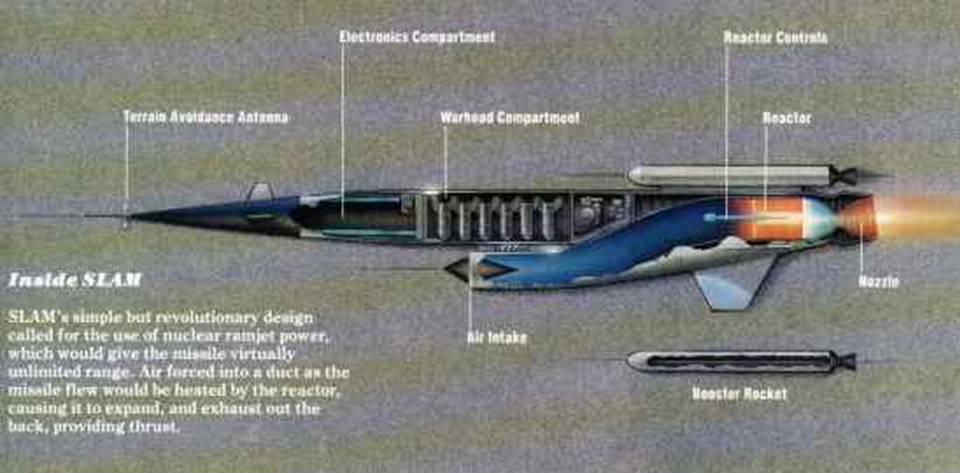
Imagine a cruise missile the size of a railway locomotive.  It's powered by a nuclear reactor similar to the one designed for the Convair X-6, but reconfigured a little.  It doesn't heat air for individual engines; it's the engine itself.  It has a big ramjet intake and is designed to heat compressed air so hot - 2330 degrees - that it needs no fuel at all.  It just blasts the superheated air out the tailpipe. 

Is this for real, you ask?  Well, for starters, they built the aerial reactor (amusingly nicknamed the 'Tory' Reactor), as part of Project Pluto, which eventually became the nickname for the whole project, including the airframe:


They also built (at the unbelievably appropriately-named Jackass Flats) the 25 miles of oil well pipe casing needed to contain enough compressed air to test the ramjet capacity of the engine...


...and they also built the Tory IIC engine, and tested it in 1964.


At full power, the Tory IIC engine produced 35,000 pounds of thrust and 513 MW of power.  For the sake of comparison, that's roughly the same as the reactor in a large nuclear generating station - except that the Tory IIC was only the size of a railcar.  Amazing what you can achieve when you do away with all of that pesky radiation shielding (although according to the test results, the engine produced less radiation than expected).  As an article about the SLAM project noted, the May 1964 test was observed by "dozens of admiring AEC officials and Air Force Generals"...all from "a safe distance".  Yeah, I'll bet. Like Tasmania.

Of course, to make the missile work you first have to get it up to ramjet speeds - well over Mach 3 - before the nuclear engine starts operating properly, so to do that you strap a few solid rocket boosters onto the thing.  Stick an inertial guidance system into it, like the one used by the infamous Snark cruise missile (and like the first-generation ALCMs would get about 10 years later) and you could program it to follow a preset course.  It can fly for so long (estimates put its range at an incredible 100,000 km, or two and a half times around the planet) that you could launch it and let it loiter, flying figure eights over an ocean for hours or even days before sending it a command to penetrate enemy territory.  It's virtually indestructible because compared to a manned bomber it has only a fraction of the moving parts; remember, it's really nothing more than an aerodynamic teakettle (the project manager dubbed it "the flying crowbar").  It'll fly so low that Soviet radars will never spot it; so fast that Soviet fighters (and SAMs) will never catch it (so fast, in fact, that the 150 DB of the shock wave was expected to smash windows and rupture eardrums all along its flight path); and it will never run out of fuel.  Awesome, eh? 
 
But wait...there's more! 

Now you turn it into a one-shot disposable aerial SSBN!

 File under "Seriously, who thought this was a good idea?"

You install a dozen vertical-deployment tubes, each carrying a one-megaton thermonuclear warhead equipped with an ejection mechanism and a parachute.  So now your low, fast, 100,000 km-range, unstoppable, nuclear-powered flying freight train can follow a pre-programmed course across the Soviet Union, 500 feet off the ground, at Mach 3, excreting H-bombs at predetermined deployment sites. 

 
Good freaking lord.

And did I mention that it would be spewing radiation all the way?

Yeah, no need for pilots means no need for shielding other than the minimum necessary to protect the electronics.  Given the amount of radiation the lightly-built, almost totally unshielded reactor would be producing, burst eardrums and broken windows would be the least of the problems afflicting anyone under the missile's flight path.  The intake would be sucking in dust, debris, water droplets and all manner of aerosolized contaminants, cooking them to a turn in a 600-MW reactor running at full power, and blasting them back out the tailpipe as, let's face it, fallout.  According to project reports, this was regarded as a bonus.  There were discussions during the project as to whether the missile, having discharged a dozen buckets of sunshine onto the heads of unsuspecting kulaks, should be programmed to then add insult to injury by flying back and forth over Soviet territory, sowing neutrons until it eventually melted down and crashed into Comrade Sergey's potato field.  Alternatively, it could be programmed to crash itself and its screaming hot reactor into a 13th target, sort of as an added treat.  An apocalyptic baker's dozen, if you will.

Just how serious was the SLAM project?  Well, as noted above, serious enough that they built the engine, tested it, and were working on a Mach 4+ version when the plug was pulled on 1 July 1964.  A number of factors contributed to the decision to kill the project.  One was the cost; each missile was expected to run about $50 million, an exorbitant figure at the time.  The Navy was preparing to deploy the Polaris SLBM, and the Air Force had ICBMs, both of which were totally invulnerable to the SAMs of the time, and both of which arrived at their targets much faster than the SLAM (which one critic redubbed 'Slow, Low And Messy').  There were other problems, too.  Which ally would be crazy enough to allow a SLAM to overfly their territory en route the USSR?  And for that matter, how could you test the thing?  One proposal was to have it fly lazy figure-eights near Wake Island in the Pacific - and, once the test was complete, to ditch the missile, with its red-hot reactor, into the ocean.  Another (hilarious) proposal was to test it in Nevada using a long tether.  One project expert remarked rather drily, "That would have been some tether."  And what if one got away, either during testing, or in some sort of operational scenario?  After all, a SM-62 Snark cruise missile test-fired in 1956 using a similar inertial navigation system had been aimed at Puerto Rico, and was last seen on radar heading into the Amazon.(Note A)  What if that Snark had been carrying 12 thermonuclear warheads and a blazing hot, neutron-spewing reactor?

Worse, what if it didn't crash?  Remember, it didn't need fuel, and didn't have a whole lot of moving parts.  How long could such a thing stay up?  How would you bring it down?  For that matter, where would you bring it down?

Good lord, why hasn't somebody made a movie about this thing?  Oh, wait, they did:

 
Except that the SLAM moved a thousand times faster than any Terminator.  Plus it flew, spewed radioactivity, and was stuffed full of H-bombs.

Bottom line, beyond the sheer horrifying craziness of the concept, the SLAM was inferior to ballistic missiles in every conceivable way, and so it ended up on the chopping block.  The USN and USAF went on to deploy thousands of SLBMs and ICBMs which, for all their faults, were at least cheaper and faster; and while SSBNs were driven by nuclear reactors, none of the missiles were themselves nuclear-propelled.  When cruise missiles eventually were deployed a decade or so later, they were much smaller, carried only one warhead, and required fuel to fly.  Quite a different concept from the invulnerable, unstoppable "flying Chernobyl" dreamed up by the USAF, AEC, and the frighteningly innovative wrench-benders at Vought.

For those of you interested in reading more about the SLAM, you can find fascinating articles at the following websites:


A final thought about the discussion that sparked this whole line of investigation in the first place.  If you're Santa, then you're looking for something that can travel very low, very fast, for very long distances without refuelling, and that is capable of delivering packages at predetermined sites. If Santa were looking to upgrade the old sleigh to something a lot more capable, the SLAM would be a fantastic choice.  The hazard to the big guy himself shouldn't be too much of a worry, because let's face it, he's a long way past child-bearing age.  Like the Project Pluto folks, the radiation should be considered a bonus.  There'd be no need to drag Rudolph along to provide additional illumination: 
"Mommy, why is Rudolph's nose blue?" 
"Actually, sweetums, that's called the Cherenkov effect..."

And on that happy note, dear colleagues, Merry Christmas to all - and to all, a good night!  See you next year.

//Don//
 
P.S. As a contemporary note, nearly a year later, here's an example of why I think creating a nuclear-propelled autonomous flying H-bomb delivery truck might be a bad idea:

(Source: Failbook)

You see, I don't think the robot apocalypse is going to be the result of our preprogrammed servants freaking out or conspiring to destroy us all in some sort of Skynet Götterdämmerung.  I think we're in much more potential danger from a combination of our own laziness and our chronic lack of imagination about the potential consequences of robots doing exactly what we built them to do. 

"Judgement Day" is a whole lot cooler and much less embarassing as an explanation for the demise of humanity than "The Poop Spiral of Doom".


Notes:
A) http://www.airforce-magazine.com/MagazineArchive/Documents/2004/December%202004/1204snark.pdf

Tuesday, September 18, 2012

9 November 2011 – Mapping the Twitterverse

Colleagues,

I thought I'd direct your attention to a fascinating study the results of which, in my humble opinion, are as beautiful as they are useful.  Check this out:


That's a map of the worldwide prevalence of languages used in Tweets.  Mike McCandless extracted the compact language identification software from Google Chrome, and Eric Fischer applied it to Twitter, generating a geolinguistic map of the global 'Twitterverse'.

Apart from the sheer beauty of the result (which in my opinion is a function of the simplicity of the approach and the fact that it is 100% based on empirical data), the cartographic output gives folks like us oodles of food for thought.  Take a look, for example, at the North American map:


It's pretty easy to understand the concern about the future of the French language in the midst of an otherwise almost entirely Anglophone continent, non?  At the same time, look at the US, and try to see how many different languages (colours) you can pick out, particularly in urban areas.  Nowhere else on Earth are so many languages represented in such intermingled proximity.  Incidentally, this map also demonstrates just how little of Canada's population - or at least the Twittering part of it - lies more than 100 km or so from the Canada-US border.  At the extreme left edge of the map, you can see how El Paso, Texas, is virtually all English-speaking, but also how, just across the Rio Grande, Juarez, Mexico, is entirely Spanish-speaking.  And why is everybody in Bermuda Tweeting in what appears to be either German or Swedish?

Now take a look at Northeast Asia:


Japan and the ROK are both pretty wired, aren't they?  No surprises there.  China's not far behind, though, although the Twittering seems to be largely confined to urban areas along the coast.  It's also a non-surprise that North Korea is an electronic wasteland.  In fact, it's interesting how much this map resembles the map of electrification I sent around some time last spring.  It's also interesting to see all the Russky Tweeters in Vlad and the Kuriles.  You can just see the Bonin Islands at the bottom centre, and at the bottom left, Taipei at the northern tip of Taiwan; I wish we could see more of it.

Now take a look to the north of Japan; there are a bunch of isolated, unilingual bright spots.  You know that's ocean, so what can they be?  There are some islands there – is that what we’re seeing?  Or is it something else?  Clusters of light spots where there isn't any land are probably groups of ships with multiple Tweeters aboard.  Are we seeing Korean and Japanese fishing fleets in the Sea of Japan?  But then there are also long, straight lines of dots (you can see many of these south of Japan). What makes those lines? My guess is we're seeing the electronic ghost of individual Tweeters travelling aboard international airliners.  How cool is that?

Now for the gold – Europe:


That has got to be one of the neatest things I've ever seen.  Look, you can see the Dutch!  And the Danes!  And the three Baltic countries! And the Catalans, for crying out loud!  You can see how thinly the former Soviet satellite states are "informationized" on an individual basis as compared to Western Europe (and Western Turkey!)  You can see how population patterns in Russia and the Ukraine follow the coasts, the rivers, the main cities, and the highways connecting them.  You can see how Corsica compares to Sardinia!  You can just barely see northern (Turkish) Cyprus, and the first hints of the Greek-speaking southern half of the island.  You can see what a horrid linguistic muddle the Balkans are.  And you almost can't see North Africa at all, although Tunis and Algiers stand out; that sort of makes you wonder to what extent the “Arab Spring” really was driven by modern communications technology, as opposed to telephones, newspapers, and word of mouth.

You can see the mountains between Portugal and Spain that Wellington and the lads had to struggle over in the Peninsular War, because they're still sparsely populated - but you can see how densely populated the Alps are!  You can see how England is almost totally blanketed by Tweeters!  And how the North Sea, the Med and the Bay of Biscay are full of Tweeter-bearing ships, but the Black Sea and the eastern Baltic, not so much.  And even cooler, you can see how it's almost impossible to make Switzerland out at all, because when you look at it in terms of language, it might as well be split between France, Italy and Germany.  Same deal for Belgium; Wallonia blends into France, and Flanders blends into Holland.  The notional, national borders are entirely invisible when you look at countries on a linguistic basis.

There are some weaknesses in this sort of approach.  Returning to the world map for a moment, one wonders about the sub-Continent; why is densely-populated India so short of Tweeters?  At this point you realize that you’re only seeing the shadows of English tweets; the software apparently doesn’t detect Hindi.  Pakistan, Afghanistan and Iran are likewise nearly blank, because Persian, Pathan, Dari and so forth are similarly not being picked up.  Just because you don’t see it, doesn’t mean it isn’t there.  “Absence of evidence is not evidence of absence.”

What else could we do with this sort of capability?  Look back at the world map up top for a second.  You can see the Canary Islands, but Africa is almost nonexistent.  What can we learn from that?  And could you use this capability for military purposes?  If you can make out a single Tweeter aboard an aircraft over water, I wonder if you could follow the movement of groups of soldiers or sailors by tracking their Twitter signature?  Would a 10,000-man US Army division full of iPhones, iPads, Blackberrys and the like show up on this sort of graphic?  Would you be able to see a US CVN with 6000 madly-Twittering crewmen and women aboard?  How about a Marine Amphibious Group afloat?  What would someone expecting an attack make of a big blotch of English Tweeters (with, say, 10-15% Spanish Tweeters mixed in with them) in the middle of the South China Sea?

Here's the link to the site where I found these graphics, "Strange Maps":

http://bigthink.com/ideas/41004

The original pics created by Fischer can be found here:

http://www.flickr.com/photos/walkingsf/6277163176/in/photostream

Cheers,

//Don//