Showing posts with label Lulz. Show all posts

Monday, March 4, 2013

SMASHWORDS Read an e-book week!

Hello all,


Smashwords is hosting Read-an-e-book week, and I've signed up.

From now until 9 March 2013, all of my books will be 50% off at my Smashwords author site.

If you feel like a little escapist fantasy (or some hard-core strategic analysis of NATO's crisis decisionmaking organs and how they functioned in the Kosovo campaign), head on over and pick up my books for half price.

And thanks!

- Don

Thursday, October 25, 2012

Patron saint of empiricists

 
After Richard Feynman, Karl Popper, E.H. Carr, and so forth.
 
Also, patron saint of people with alien tracking devices lodged in their skulls, and people with gullible, clinically insane colleagues.
 
(Image courtesy Failblog)

Thursday, October 11, 2012

21 December 2011 – H-bombs, Santa, and the Poop Spiral of Doom

Colleagues,

The Yuletide season is upon us, and with comes the annual ritual of NORAD tracking the big guy in the red suit.  If you're so inclined, you can follow his progress here, on NORAD's on-line Santa Tracker:


As I write, we're currently 3 days and 17 hours (and some assorted minutes) away from launch.  As an Air Force brat, I've been familiar with NORAD's tracking efforts for most of my life, and I recall wondering whether Santa, like the Tu-4s that drop by from time to time, ever merited an escort.  You sort of had to be concerned about whether his IFF transponder was operating, and whether he had the right codes (which in turn makes me wonder whether Santa has to wait three years to get his security clearance updated like the rest of us so he can even be ISSUED the codes); because if he didn't, well, in an era of AIM-120s, a pilot might be cleared to engage from beyond visual range, and then it'd be Run, Run Rudolph! for real.

In today's world, however, an air-breathing intercept seems somewhat less likely.  After all, with the ground-based interceptors of the BMD system in place and operational, it might - given how fast Santa would have to be travelling in order to get through his assigned duties in the allotted time - be more realistic to forego the F-22s and simply send an exo-atmospheric kill vehicle his way.  It's worth working through the intercept from an air defence perspective, if only to get a better grasp of the nature of the problem.

Well, what are the capabilities of the system?  Assuming Santa's sleigh operates on a cold launch system (which is not necessarily true, but more about that later), his take-off probably wouldn't be detected by the Defense Support Program (DSP) satellites that watch missile fields for the thermal signature, or bloom, of an ICBM launch.  On a southbound trajectory from the North Pole, the first piece of equipment to pick up Dasher, Dancer and the rest would be the Ballistic Missile Early Warning System, from one of two stations: Clear, Alaska, or Thule, Greenland. 

Ballistic Missile Early Warning System Sites

Clear has a PAVE PAWS phased array radar system that operates in the UHF band, with two faces each giving 120 degree coverage, with elevation coverage from 3 to 85 degrees above horizontal.  At peak power (about 500 kW for the main beam) it can detect an object the size of a small car at a range of 5550 km (3000 NM).  Since that accords pretty much with a large sleigh, it's the figure we'll use.  Even if Santa has adopted stealth technology, we can assess 8 "tiny reindeer" as adding up to the radar cross-section of a small car - or 9, if it's a foggy Christmas Eve and Rudolph's on duty.

PAVE PAWS phased array radar system at Clear, Alaska

The problem, of course, is that Santa's flight profile doesn't come close to that of a ballistic missile launched from the Asian heartland, or of a SLBM launched from a sub lurking in the - let's face it - totally ice-covered Arctic Ocean.  There's never been any indication that the sleigh is pressurized, so unless he's wearing breathing apparatus, the old guy's going to have to keep it below 10,000 feet ASL.   That poses some horizon issues, but solving them is a relatively straightforward problem in geometry:

If the PAVE PAWS was capable of detection at the visual horizon, calculating its detection range D for a target at altitude X is simple.  Knowing that the polar radius of the Earth R is 6,356,752 m, and that R1 is therefore R+3077 or 6,359,829 m, then D would simply be the square root of R1 squared minus R squared, or 197,810 m - or about 197.8 km from the radar station.  However, the PAVE PAWS has a minimum detection altitude of 3 degrees above horizontal, so detection would be a little later, when the bogey was closer to the site.  I'd recalculate that for you but I don't feel that into trigonometry this morning.

With a detection range of only 200 km or so for a target at an altitude of 10,000', would there be enough time for the warning system to react?  Maybe; depends on how fast the sleigh is travelling.  From Santa's perspective, he could vastly improve his survivability by flying lower and faster.  That's the same conclusion that was reached by the designers of the B-1 Lancer bomber, the performance of which I've had occasion to witness.  It's true; the lower and faster you fly, the less time anyone watching has to find you, fix you, and intercept you.

Which brings me, in a roundabout way, to the topic of this week's message.  You think the B-1 is low, fast, and nasty?  Well, amigos, you ain't seen nothing yet.  A colleague who is also an aficionado of all things ancient and atomic brought to my attention the other day one of the historical gems from America's glorious nuclear past.  Back in the halcyon days of the late 1950s - the era that brought us the Pentomic Army and such weapons systems as Atomic Annie, the 280-mm nuclear howitzer, and the Davy Crockett, the A-bomb-firing recoilless rifle - there were no problems that couldn't be solved by judicious application of the Mighty Atom.

The Davy Crockett nuclear recoilless rifle; and the Atomic Annie 280-mm nuclear howitzer

Thing is, those weapons, crazy as they might have been (and the Davy Crockett was crazy enough that, under certain firing conditions and selected yields, its lethal radius exceeded its range), those weapons were actually deployed.  The ones that fascinate me are the ones that did make it off the drawing board, but only as far as proof-of-concept and test and evaluation stages.  The most infamous one is probably one that, although it was closely connected to military weapons research, wasn't really a Defense programme at all: Project Orion.

 Project Orion - MY kind of crazy

In a nutshell (ahem), Project Orion was a spaceship designed to be propelled by the explosion of nuclear bombs fired out of its base.  The force of the explosion against a pusher plate (equipped with, shall we say, "powerful" shock absorbing systems) would drive the ship forward.  Thousands of bombs would be needed to reach planets throughout our solar system, which required miniaturizing the weapons as much as possible.  The research aimed at miniaturizing nuclear weapons - remember, this was the late 1950s and early 1960s, when much research was put into making bombs as big and destructive as possible, leading to monstrosities like the boxcar-sized B-17 - eventually led to the nuclear artillery rounds small enough to be put into 155mm and 203mm projectiles - and to the enhanced radiation weapon or 'neutron bomb' that bedevilled the Carter Administration, and was responsible for so much Euro-angst in the late 1970s.

In between the Davy Crockett and the Orion spaceship, though, were a good many 'almost-rans.'  One of those was the Convair X-6.  Based on the Convair B-36 bomber, the X-6 was to have been propelled by nuclear reactor-driven engines.  The idea was that the plane would carry a 3 MW air-cooled nuclear reactor in the bomb bay - and a 12-tonne lead and rubber shield to protect the crew from the otherwise unshielded powerplant.  A testbed aircraft - the XB-36H - was built to trial the shielding requirements, and logged 215 hours of flight time, during 89 of which the on-board reactor was operated. 

 
Based on the results of the testing, the Convair X-6 project was scrapped in 1961.  Had the thing gone to trials, a number of problems would have had to have been overcome.  One was the weight.  The takeoff weight of the beast was expected to be 363,000 pounds - roughly the same as a 747, but decades before the 747 became a reality.  The testing facility was on the point of building a 15,000-foot runway when the programme was cancelled.  Also, there was the small matter that only the aircrew were protected against the radiation of the reactor; everything else, including the plane body and everyone around it on the tarmac, wasn't.  The nature of the problem might have been telegraphed just a little when the Air Force started advertising for pilots who were past child-bearing age.

The biggest problem with the plane, though, was the fact that the aircraft engines weren't...err...well, you couldn't really shut them off.  You see, in a real jet turbine, propulsive force is achieved by superheated exhaust expanding out the back end of the engine.  The heat is provided by burning fuel.  Turn off the fuel flow, the engines shut down.  In the X-6 concept, however, there was no fuel; the heat was supplied by the nuclear reactor.  Airflow over the reactor elements superheated the air, and the efflux from that drove the aircraft.  It also cooled the reactor, as there was no space in the plane for the hundreds of tonnes of water and other assorted cooling media associated with terrestrial or naval reactors.  The cooling provided by air rushing over the reactor elements at hundreds of miles per hour would still be needed even when the aircraft was on the ground and parked. 
 
Something of a poser, as they say.

Well, put all of these problems and capabilities together, and what do you get?  Think about it: a plane powered by a nuclear reactor doesn't really need fuel, so it can fly pretty much forever, except that it produces so much radiation that nobody wants to get near it.  You can't shut it off, so it's pretty much a one-shot deal.  And it can go really fast.  REALLY fast, in fact, once you realize that the reactor can produce so much heat that the rate-limiting factor, really, is how fast you can get the air into the core to be superheated.  And once you realize THAT, you start thinking about something that the scientists had only just begun talking about after the X-15 programme was under way, which was...ramjets.  In a jet turbine engine, air is compressed to the necessary density by compressor blades (hence the name).  But if you get an air-breathing vehicle up to a high enough speed, you can do away with the compressor blades, and simply shape the intake to force the incoming air to the right density. 
 
Put all of these factors together, add a monocle and a white Persian cat, and what do you get?  That's right: a doomsday machine. 
 
Enter the Vought SLAM.

 
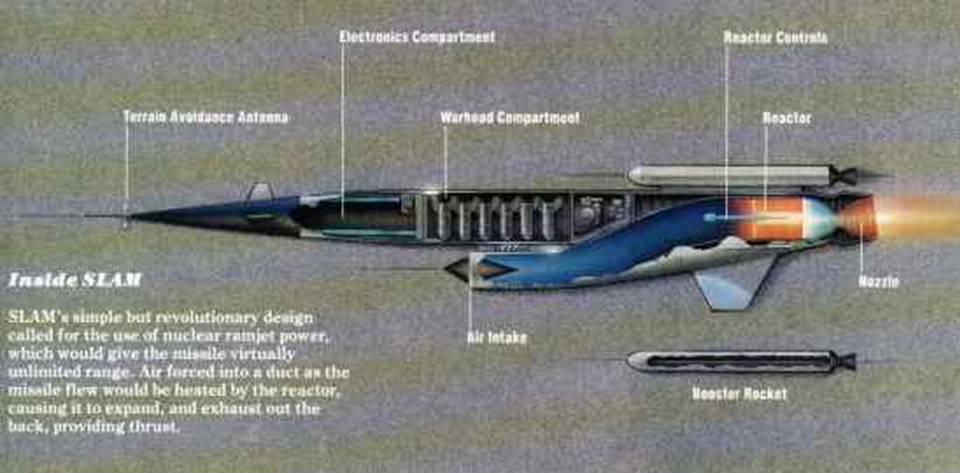
Imagine a cruise missile the size of a railway locomotive.  It's powered by a nuclear reactor similar to the one designed for the Convair X-6, but reconfigured a little.  It doesn't heat air for individual engines; it's the engine itself.  It has a big ramjet intake and is designed to heat compressed air so hot - 2330 degrees - that it needs no fuel at all.  It just blasts the superheated air out the tailpipe. 

Is this for real, you ask?  Well, for starters, they built the aerial reactor (amusingly nicknamed the 'Tory' Reactor), as part of Project Pluto, which eventually became the nickname for the whole project, including the airframe:


They also built (at the unbelievably appropriately-named Jackass Flats) the 25 miles of oil well pipe casing needed to contain enough compressed air to test the ramjet capacity of the engine...


...and they also built the Tory IIC engine, and tested it in 1964.


At full power, the Tory IIC engine produced 35,000 pounds of thrust and 513 MW of power.  For the sake of comparison, that's roughly the same as the reactor in a large nuclear generating station - except that the Tory IIC was only the size of a railcar.  Amazing what you can achieve when you do away with all of that pesky radiation shielding (although according to the test results, the engine produced less radiation than expected).  As an article about the SLAM project noted, the May 1964 test was observed by "dozens of admiring AEC officials and Air Force Generals"...all from "a safe distance".  Yeah, I'll bet. Like Tasmania.

Of course, to make the missile work you first have to get it up to ramjet speeds - well over Mach 3 - before the nuclear engine starts operating properly, so to do that you strap a few solid rocket boosters onto the thing.  Stick an inertial guidance system into it, like the one used by the infamous Snark cruise missile (and like the first-generation ALCMs would get about 10 years later) and you could program it to follow a preset course.  It can fly for so long (estimates put its range at an incredible 100,000 km, or two and a half times around the planet) that you could launch it and let it loiter, flying figure eights over an ocean for hours or even days before sending it a command to penetrate enemy territory.  It's virtually indestructible because compared to a manned bomber it has only a fraction of the moving parts; remember, it's really nothing more than an aerodynamic teakettle (the project manager dubbed it "the flying crowbar").  It'll fly so low that Soviet radars will never spot it; so fast that Soviet fighters (and SAMs) will never catch it (so fast, in fact, that the 150 DB of the shock wave was expected to smash windows and rupture eardrums all along its flight path); and it will never run out of fuel.  Awesome, eh? 
 
But wait...there's more! 

Now you turn it into a one-shot disposable aerial SSBN!

 File under "Seriously, who thought this was a good idea?"

You install a dozen vertical-deployment tubes, each carrying a one-megaton thermonuclear warhead equipped with an ejection mechanism and a parachute.  So now your low, fast, 100,000 km-range, unstoppable, nuclear-powered flying freight train can follow a pre-programmed course across the Soviet Union, 500 feet off the ground, at Mach 3, excreting H-bombs at predetermined deployment sites. 

 
Good freaking lord.

And did I mention that it would be spewing radiation all the way?

Yeah, no need for pilots means no need for shielding other than the minimum necessary to protect the electronics.  Given the amount of radiation the lightly-built, almost totally unshielded reactor would be producing, burst eardrums and broken windows would be the least of the problems afflicting anyone under the missile's flight path.  The intake would be sucking in dust, debris, water droplets and all manner of aerosolized contaminants, cooking them to a turn in a 600-MW reactor running at full power, and blasting them back out the tailpipe as, let's face it, fallout.  According to project reports, this was regarded as a bonus.  There were discussions during the project as to whether the missile, having discharged a dozen buckets of sunshine onto the heads of unsuspecting kulaks, should be programmed to then add insult to injury by flying back and forth over Soviet territory, sowing neutrons until it eventually melted down and crashed into Comrade Sergey's potato field.  Alternatively, it could be programmed to crash itself and its screaming hot reactor into a 13th target, sort of as an added treat.  An apocalyptic baker's dozen, if you will.

Just how serious was the SLAM project?  Well, as noted above, serious enough that they built the engine, tested it, and were working on a Mach 4+ version when the plug was pulled on 1 July 1964.  A number of factors contributed to the decision to kill the project.  One was the cost; each missile was expected to run about $50 million, an exorbitant figure at the time.  The Navy was preparing to deploy the Polaris SLBM, and the Air Force had ICBMs, both of which were totally invulnerable to the SAMs of the time, and both of which arrived at their targets much faster than the SLAM (which one critic redubbed 'Slow, Low And Messy').  There were other problems, too.  Which ally would be crazy enough to allow a SLAM to overfly their territory en route the USSR?  And for that matter, how could you test the thing?  One proposal was to have it fly lazy figure-eights near Wake Island in the Pacific - and, once the test was complete, to ditch the missile, with its red-hot reactor, into the ocean.  Another (hilarious) proposal was to test it in Nevada using a long tether.  One project expert remarked rather drily, "That would have been some tether."  And what if one got away, either during testing, or in some sort of operational scenario?  After all, a SM-62 Snark cruise missile test-fired in 1956 using a similar inertial navigation system had been aimed at Puerto Rico, and was last seen on radar heading into the Amazon.(Note A)  What if that Snark had been carrying 12 thermonuclear warheads and a blazing hot, neutron-spewing reactor?

Worse, what if it didn't crash?  Remember, it didn't need fuel, and didn't have a whole lot of moving parts.  How long could such a thing stay up?  How would you bring it down?  For that matter, where would you bring it down?

Good lord, why hasn't somebody made a movie about this thing?  Oh, wait, they did:

 
Except that the SLAM moved a thousand times faster than any Terminator.  Plus it flew, spewed radioactivity, and was stuffed full of H-bombs.

Bottom line, beyond the sheer horrifying craziness of the concept, the SLAM was inferior to ballistic missiles in every conceivable way, and so it ended up on the chopping block.  The USN and USAF went on to deploy thousands of SLBMs and ICBMs which, for all their faults, were at least cheaper and faster; and while SSBNs were driven by nuclear reactors, none of the missiles were themselves nuclear-propelled.  When cruise missiles eventually were deployed a decade or so later, they were much smaller, carried only one warhead, and required fuel to fly.  Quite a different concept from the invulnerable, unstoppable "flying Chernobyl" dreamed up by the USAF, AEC, and the frighteningly innovative wrench-benders at Vought.

For those of you interested in reading more about the SLAM, you can find fascinating articles at the following websites:


A final thought about the discussion that sparked this whole line of investigation in the first place.  If you're Santa, then you're looking for something that can travel very low, very fast, for very long distances without refuelling, and that is capable of delivering packages at predetermined sites. If Santa were looking to upgrade the old sleigh to something a lot more capable, the SLAM would be a fantastic choice.  The hazard to the big guy himself shouldn't be too much of a worry, because let's face it, he's a long way past child-bearing age.  Like the Project Pluto folks, the radiation should be considered a bonus.  There'd be no need to drag Rudolph along to provide additional illumination: 
"Mommy, why is Rudolph's nose blue?" 
"Actually, sweetums, that's called the Cherenkov effect..."

And on that happy note, dear colleagues, Merry Christmas to all - and to all, a good night!  See you next year.

//Don//
 
P.S. As a contemporary note, nearly a year later, here's an example of why I think creating a nuclear-propelled autonomous flying H-bomb delivery truck might be a bad idea:

(Source: Failbook)

You see, I don't think the robot apocalypse is going to be the result of our preprogrammed servants freaking out or conspiring to destroy us all in some sort of Skynet Götterdämmerung.  I think we're in much more potential danger from a combination of our own laziness and our chronic lack of imagination about the potential consequences of robots doing exactly what we built them to do. 

"Judgement Day" is a whole lot cooler and much less embarassing as an explanation for the demise of humanity than "The Poop Spiral of Doom".


Notes:
A) http://www.airforce-magazine.com/MagazineArchive/Documents/2004/December%202004/1204snark.pdf

Sunday, May 13, 2012

6 May 2011 – Virtual necking, demography, and robots

“I’m afraid the Holodeck will be mankind’s last invention.”

– Scott Adams, The Dilbert Future

Colleagues,

Stephen King once said that everyone’s mind is like a sink, and we all have a different filter that strains out the gunk at the end of every day.  One of the unusual things that got caught in my mental gunk-filter this week was an article about how robotics researchers in Japan working at the Kajimoto Laboratory of the University of Electrocommunications are in the final stages of perfecting a device for kissing over the internet. 

Yeah, you heard that right – it’s a machine for recording oro-lingual input, transmitting it digitally, and recreating it at the other end.(Note A)  It’s not such an alien concept, really; after all, a fax machine is just a device that optically scan pieces of paper, recording white pixels as zeroes and dark pixels as ones, transmits the numbers over a phone line, and recreates them as a picture at the other end.  A traditional telephone did the same thing with sound waves absorbed and transformed into electric current by a piezoelectric receiver, and turned back into sound waves by a piezoelectric transmitter at the other end.  Hell, a telegraph machine uses a simple switch to send on-off pulses over a wire, which were then turned by an electromagnet back into clicks.  This dandy new gadget is the direct lineal descendent of a Morse code key.  It just happens to be one that you stick in your mouth.

I don’t imagine I need to describe where, given human inventiveness, this sort of development is likely to lead; suffice it to say that it’s likely to involve the words “hardware interface” and could eventually render “sexting” as anachronistic as hoopskirts.  But thankfully, we’re not there yet, and the proof is in the “hardware interface” that has been developed at Kajimoto.  Take a look at a picture of the device in use.  It might sound hot in theory, but in practice it’s about as erotic as a breathalyser.

“You have witchcraft in your lips, Kate: there is more eloquence in a sugar touch of them than in the tongues of the French council; and they should sooner persuade  <404 ERROR>


As I see it, this is all part of an interesting and potentially very problematic trend.  In addition to using robots in innumerable applications designed to free humans from dangerous tasks (for example, measuring radiation levels in buildings at the damaged Fukushima nuclear power plant), Japan is leading the world right now in the development of anthropomorphic robots.  Japanese robotics engineers are pushing the envelope for all they’re worth, trying to bridge the “uncanny valley” that separates creatures (and features) that humans can identify with from those that we cannot.(Note B)  The more outré examples tend to be the ones that make the news – for example, “female” robots designed to hit the runway as 95-pound fashion models (Note C), or child-sized robots designed to serve as surrogates for childless couples (Note D).  There are of course other examples, but decorum forbids mentioning them here.

Compared to the internet kiss-transmitter, attempts to develop convincing anthropomorphic robots represent the opposing end of the spectrum of seamless human-machine interface engineering.  Developments in this fascinating field are proceeding apace.  According to a recent (and admittedly hilarious) Google search, somewhere between 2034 and 2037 the US government will be fielding “autonomous attack drones” or even an “autonomous robot army”; by 2050, sex with robots will be “possible”; by 2056, robots will be given the same rights as humans; and by 2059, humans will have “domesticated” robots.(Note E)  Leaving aside the wisdom, propriety and morality of giving rights to machines that we have not yet domesticated (let alone dimming the lights, putting on some Barry White, and cracking the Spumante Bambino with something that is physiologically indistinguishable from us and self-aware, but is legally a non-person), clearly the popular zeitgeist expects roboticists to bridge the “uncanny valley” at some point in the near future.  No pun intended.

Okay, so why should we care?  Well, not to come off like a waxen-haired televangelist, but there’s something a little pathologically misanthropic in seeking interpersonal interactions with a machine instead of with a real person.  The idea that a child-shaped robot is a desirable sop to the unsatisfied maternal/paternal instincts of humans who didn’t have children of their own is a little chilling.  And not to wax too apocalyptic, but there’s something else that Japan is known for that bears an interesting correlation to their fascination with the non-human.  It’s that fact that Japan has by far the lowest total fertility rate of any G8 country.  In fact, Japan’s TFR of 1.21 children per woman (estimated for 2011) stands at 215th out of 220 states and regions.  Replacement rate to maintain zero population growth is roughly 2.1 children per women.  With a TFR of 1.21, Japan’s population is declining faster than just about any population in the civilized world.(Note F)

 I’m not the first to mention this; far from it.  Pundit and self-described “demographics bore” Mark Steyn noted it years ago in America Alone, the book that got him hauled before three separate “Human Rights” commissions and tribunals for alleged “Islamophobia”.  One of the phenomena he noted was that national fertility rate statistics tend to be deceptive; while the UK, for example, boasts a TFR of 1.66, that is an average figure comprising very low fertility rates for native Britons, and much higher fertility rates for immigrant communities.  The disparity in fertility rates, Steyn argues, is changing the ethnic, religious and socio-cultural makeup of Western nations that have attempted to mitigate their own declining birthrates through expansive and liberal immigration policies.  Japan, which does not have an “expansive and liberal” immigration policy, more accurately reflects the rapidly declining birthrates common among industrialized Western nations.  It is worth noting that Japan’s neighbours on the low end of the TFR scale include nearly all European nations, eastern and western alike; while the top end of the scale includes the African, Middle-Eastern and South Asian states that are the points of origin of many of the larger and growing immigrant communities in the West.


To the extent that changing demographics are a matter of strategic concern for Western countries, one of the larger issues meriting investigation must be the fact that a combination of declining birthrates in industrialized nations and much larger birthrates among immigrant communities is rapidly transforming the sociocultural makeup of the West.  In the context of the ongoing “war on terror”, the fact that states of concern, and the slow-to-integrate immigrant communities that come from those states, have a much higher TFR than the countries attempting to stem the tide of Islamism and the jihadism that comes with it, is surely a matter of strategic interest.  Canadians – or at least those with a passing knowledge of our own history – should be more sensitive to this phenomenon than most; after all, it wasn’t all that long ago that Quebec nationalists were talking about “la vengeance des berceuses.”  That did not come to pass, of course; Quebec society, in the violence of reaction against the stultifying grip of the Church, embraced the libertine excesses of the 1960s with far greater enthusiasm than did the rest of Canada, and the impact on Quebec’s TFR was noteworthy. 

Today Quebec’s TFR (1.74) is slightly above the Canadian average of 1.68.  Some have suggested that this is due to the high TFR of large immigrant communities.  But if we look at the data, there does not seem to be any obvious correlation between the TFR of a province, and the proportion of that province’s population listing a place other than Canada as their place of birth.

This chart (prepared with 2006 census data from StatsCan) compares total fertility rates (TFR) per province against the proportion of each province’s population listing a place other than Canada as their place of birth.  There are some preliminary conclusions that may be drawn; first, that the maritime provinces are not popular as a place of settlement for new immigrants to Canada, while BC and Ontario definitely are; and second, that if we eliminate the maritime provinces as a clustered anomaly, there appears to be a very loose, inverse, correlation between the proportion of a province’s population not born in Canada, and the total fertility rate of that province.  This would appear to fly in the face of the theories posited by inter alia Steyn.

But perhaps it’s only certain segments of the immigrant community that affect birthrates?  The next chart compares provincial TFRs against the proportion of provincial populations contributed by immigrants from high-TFR regions, i.e., Africa, West Asia and the Middle East, and South Asia (again, using 2006 census data):


Again, the correlation appears to run counter to the arguments posed by Steyn et al.  If we once again deduct the Maritimes, where proportional representation by immigrants is very small (perhaps too small to enable us to draw robust conclusions), then what this chart appears to show is in fact an inverse correlation between provincial TFR and the proportion of the provincial population contributed by immigrants from high-TFR regions.  Ontario and BC, after all, have the two highest provincial representations by immigrants from Africa, the Middle East and South Asia, and two of the lowest fertility rates in the country; while Saskatchewan and Manitoba, with low representation from these regions, have TFRs above the Canadian average.  It is, of course, also likely that the overall low representation of immigrants from these regions on a national level (4.7%) is too low to have a significant impact on aggregate provincial TFRs.  It is equally possible that these data, which are 5 years old, are no longer representative (but they do post-date Steyn’s book).  The census currently under way will provide new numbers that will enable us not only to conduct more accurate investigations into demographic change in Canada, but also to look at how change itself is changing over time.

If there were an observable correlation between immigrant representation and TFR, then in theory the quickest way to neutralize the transformative effect of differential birthrates between native and immigrant populations in Western states would be to effect the integration of new immigrants as rapidly as possible.  This may be what the charts are showing. It has also been posited that declining birthrates throughout the Western world are at least in part a consequence of the welfare state, which provides means of support for aging citizens other than the traditional primate method of guaranteeing familial stability by having children.  The problem, of course, is that support programs are paid for by taxpayers, and the more citizens who avail themselves of such support in lieu of procreating, the fewer citizens there will be in the next generation to provide the revenue to pay for the continuation of the programs.  This is the heart of the “unfunded entitlements” dilemma overshadowing the present US problems with long-term deficits (and also the heart of the demographic pothole that China is facing as a result of its one-child policy).  It is also the basis of the principle that because voting public largesse, availing one’s-self of it, and declining to procreate are all individual choices, the resultant inevitable societal decline – as Japan’s citizens, with their catastrophic TFR and, as a consequence thereof, equally catastrophic public debt problem are discovering – is also by definition a choice.

Politicians in Washington have been decrying the accumulation of debt that will have to be paid “by our children and grandchildren.”  They should consider themselves lucky; with a TFR of 2.05, Americans, their horrific spending habits and massive debt notwithstanding, are at least more likely to be able to dig themselves out of their hole than anyone else in the Western world, because unlike the rest of the West, they’re at least still having children to leave their debt to.  The situation is far more precarious in countries that are racking up enormous, historically unprecedented levels of public debt, but whose populations, instead of having children, are designing anthropomorphic child- and spousal-replacement droids and trying to figure out how to swap spit over the internet.

I guess if there’s a moral to the story, it might be one that was mooted on Futurama a few years back:


 Anthropomorphically yours,

//Don//

Notes

(A) [http://www.theregister.co.uk/2011/05/03/japanese_internet_kissing_machine/]
(B) [http://www.telegraph.co.uk/technology/8494633/Japanese-robot-twins-fail-to-bridge-the-uncanny-valley.html]
(C) [http://www.msnbc.msn.com/id/29720798/ns/technology_and_science-innovation/]
(D) [http://www.spacedaily.com/reports/Japan_child_robot_mimicks_infant_learning_999.html]
(E) [http://www.xkcd.com/887/]
(F) [http://www.indexmundi.com/g/r.aspx?c=ja&v=31]

Saturday, March 24, 2012

18 January 2011 – Let the sun shine in

The fault, dear Brutus, is not in our stars / but in ourselves...

Colleagues,
You’re not who you thought you were.  And gravity’s to blame.
Ever since it was introduced by the Babylonians more than three thousand years before the birth of Christ, astrology has served mankind as a means of unscrewing the inscrutable - of finding meaning for terrestrial events in extraterrestrial happenings.  Proxies for the acts of the gods and their minions, the constellations, their rising and setting aspects, and their relative seasonal positions in the heavens have been believed to have an influence on the day-to-day doings of one particular species of bipeds here on Earth.  And that belief is still pretty strong.  According to a 2008 Harris poll, 31% of Americans believe in astrology - the same number that believe in witches (one hopes that it’s the same individuals, but that’s not clear from the polling data).  Belief in astrology is more common even than belief in reincarnation.  One might take comfort from the fact that the same poll reported that 47% of US respondents “believed” in the Darwinian theory of evolution, were it not for the fact that 75% believe in “miracles” (insert obligatory sports joke here).  Anyway, what’s interesting about the poll data is that belief in astrology correlated more with Catholicism than Protestantism, and with regular but infrequent church attendance.  So it’s not all atheists, Wiccans and tie-dyed Age-of-Aquarius types making up the numbers (note A).  A similar poll conducted in 2009 found belief in astrology down to 26%, but this time 17% of respondents were “unsure”.  This was, incidentally, up from 25% in 2005 (note B).
Lest you think I’m picking unfairly on our American cousins, belief in the predictive power of astrology is widespread and very consistent across the English-speaking world.  A 2005 Gallup poll, for example, showed that while 25% of Americans believed in astrology, 25% of Canadians shared the same belief, along with 24% of Britons (note C).  That same poll, incidentally, showed that women were far more likely to believe in paranormal phenomena than men; the ratio of female to male proponents of astrology was 28% to 23% in the US, 33% to 17% in Canada, and a whopping 30% to 14% - or more than 2 to 1 - in Britain.
(Off topic, but that poll also showed that while the male-female split was similar, if not as pronounced, for belief in haunted houses, communication with the dead, and witches, it reversed itself in one specific area: men in all three countries were uniformly more likely than women to believe that aliens had, at some point in the past, visited the Earth.  If that’s not grist for future analysis, I don’t know what is).
Clearly even in this enlightened age astrology has an enduring hold over the human mind.  So it should come as no surprise that the astrological community rose up in righteous outrage when it was announced last week that the zodiac was short by one astrological sign.  Parke Kunkle (yes, that’s his name), a member of the board of the Minnesota Planetarium Society, told the Star Tribune that the precession of Earth’s rotational axis (the same phenomenon that means that Polaris isn’t going to be the “North Star” in another couple thousand years) meant that the Age of Aquarius was, in point of fact, really the Age of Pisces - a blow not only to generations of professional palmists and navel-gazers, but also to Fifth Dimension’s lyrical scansion.  Your “sign”, you see, is determined by the position of the Sun in the sky at the moment of your birth - a matter of some precise calculation.  The ancient Babylonians knew they had a problem with the constellations that the Sun seems to travel “through” over the course of the year, and they simply jettisoned one.  According to Kunkle, “we’re off by ten degrees or so,” and the abandoned constellation - Ophiucus, also known as the Snake-Bearer - needs to go back into the rotation (note D).  It’s not the first time an adjustment has been necessary; Libra didn’t make it into the batting order until 2000 years ago.
What does all of this mean?  Well, for the 75% of us that lump astrology in with fortune cookies, nothing.  But for the 25% that believe in the predictive power of astrology, the thing is...they’ve been reading the wrong horoscopes.  Adapting to the reality of precession means that the signs are offset by a day for every 70 years that pass, so to catch up we all have to shift a little bit left in the calendar.  I, for example, once a Pisces (“generous, caring and kind”), am now an Aquarius.  On the upside, I suppose this means that my astrological predisposition to “escapism, fantasy, drugs (especially alcohol), a small nose, a weak jaw, and a double chin” will spontaneously transform to “emotionally detached utopian idealism” characterized by “a high forehead, a slender figure, an aquiline nose, and a vague expression” (note E).  I would take comfort in the fact that I should be joining celebrity Aquarii like Clark Gable, Nick Nolte, and Alan Alda - except that, thanks to Kunkle, they’re all now Capricorns, so I’ll still be stuck with my fellow former-Pisces uggos Sally Jesse Raphael, Erma Bombeck, and Ted Kennedy.
Meanwhile, everyone born between November 29th and December 17th has now got a new sign: Ophiucus.  The name comes from the Greek “φιοχος” which in fact means “Serpent-Bearer”.  For those of you astronomically rather than astrologically inclined, Ophiucus is located in Serpens, north of Antares, and is made up of two stars and five star clusters: Ras Al Haque (Alpha Ophiuci, an A5 blue-white giant 60 LY distant); Cheleb (Beta Ophiuci, a K2 yellow giant 100 LY distant); and M9, M10, M12, M14 and M19, all globular clusters of magnitude 7-9.  For those more classically oriented, Ophiucus is associated with the tale of Asclepius, the physician who cured Orion of a scorpion bite to the heel.  As the story goes, he became so skilled at healing that Hades felt his realm threatened, prompting Zeus to whack the successful doctor with a lightning bolt.  Zeus thereafter placed Asclepius/Ophiucus in the sky, perhaps as some sort of post-homicide “achievement in the field of excellence” award.  I guess there’s such a thing as being too good at your job.

Figure 1 - Ophiucus the Serpent-Bearer, and his sign

The good news is that the newly-minted Ophiucans get to join Britney Spears, Taylor Swift, Jennifer Connelly, Billy Idol, and (gasp!) Ozzy in the club of late-November to early-December celebrities.  The bad news is that Woody Allen’s there, too.   Another plus is that, for collectors of Zodiac-themed tchatchkes, there’ll soon be another one to add to the mantle-piece (Christel Marrot’s Royal Copenhagen Zodiac line is particularly impressive).

What on Earth does all of this have to do with strategic analysis?  Well, history - especially military history - is replete with examples of great events being preceded by attempts at divination.  Rome, despite its manifest dedication to reason, adopted astrology from its Greek slaves and educators, and positively teemed with auspexes, haruspexes, and augurs of all description (according to the Annals of Tacitus, augurales were even established in legion camps).  Roman statesman regularly had their horoscopes updated to determine auspicious and inauspicious times for business and other affairs, and didn’t stir out of doors on days when the signs were ill.  Even the warning hurled at Caesar by Shakespeare’s unidentified soothsayer to “beware the Ides of March” was reportedly originally issued by a Roman astrologer named Spurinna.  According to the play, Caesar was sufficiently taken with prophecy that he considered heeding the warning; the Bard has Cassius fret that Caesar “is superstitious grown of late / Quite from the main opinion he held once / Of fantasy, of dreams, and ceremonies,” and worries that ”these apparent prodigies, / The unaccustom’d terror of this night, / And the persuasion of his augurers / May hold him from the Capitol today,” and thereby avert the plotters’ sanguinary vote of no confidence.  Caesar thereafter consults “the augurs”, who fail to find a heart within the sacrificial beast; but he ignores the omen, noting that “the valiant never taste of death but once”.  Back in the real world, Suetonius and Plutarch tell different stories about why Caesar chose to ignore the warning; but whatever the excuse, the result was the same, and he ended up on the Senate floor, done in by a pack of “honourable men”.  I suppose the moral is that if a bearded weirdo shouts advice at you on the street, you should take it.

As for the to-do over Ophiucus, it’ll come as no surprise to the billion folks in India who follow a sidereal (Jyotish) rather than a tropical zodiac. The difference between the two is that sidereal astrology is fixed to the position of the Earth relative the background stars, i.e. the galaxy, whereas tropical astrology is fixed to the position of the Earth relative the solar system.  Sidereal fixation negates the precession problem that is now afflicting the tropical astrologers.  The two cycles coincided and overlapped about 1600 years ago but have been steadily diverging ever since, and now they’re offset from each other by 24 degrees (exacerbating the 10 degree offset of tropical astrology from itself).  So an Indian born under the sign of Virgo isn’t really born under the same “sign” as an American born under Virgo. Add to this the fact that Indians tend to refer to where the Moon is at birth, rather than the Sun, and what you’ve got is a recipe for astrological mayhem.

I guess the bottom line is that the stars aren’t steered by love any more than the planets are guided by peace; they’re both yanked around by gravity, a consequence of which is the precession of the equinoxes, which we’ve known about since Hipparchos figured it out at some point between 146 and 130 BC.  Given that we’ve had the info in hand for more than two thousand years, I’d say it’s long past time for astrology to update its methodology.  Science, after all, adapts to new facts.  While they’re at it, they might consider adding the post-Copernican satellites into their calculations, too, since these have been traditionally ignored despite having been visited repeatedly by our robots.  I suspect their reluctance has something to do with having to write horoscopes explaining where Uranus was and what it was doing at the moment of your birth.

I’m also looking forward life as an Aquarian.  Have you ever noticed how they always come first in the newspaper horoscope listings, whereas Pisceans always comes last?  It feels like I’ve been promoted.

Cheers,

//Don//

P.S.  From the cool file: Voyager 1, presently moving at 61,548 km/hr relative to the Sun, is the fastest object ever created by humans, and is on course to pass within 1.6 light years of AC+79 3888, a star located in Ophiucus. 

It’ll get there in 40,000 years.

Notes
[A] [http://www.harrisinteractive.com/vault/Harris-Interactive-Poll-Research-Religious-Beliefs-2008-12.pdf]
[B] [
http://www.harrisinteractive.com/vault/Harris_Poll_2009_12_15.pdf]
[C] [
http://www.gallup.com/poll/19558/paranormal-beliefs-come-supernaturally-some.aspx]
[D] [
http://www.foxnews.com/scitech/2011/01/11/age-aquarius-actually-age-capricorn-thanks-rotation-earth/]
[E] [
http://zodiac-signs-meanings.com/]

Saturday, March 17, 2012

8 December 2010 – The Disney Bomb

Colleagues,

No, this isn't about "Tangled" or "TRON: Legacy".  I haven't seen either film yet.

The Fixx were right; one thing does indeed lead to another.  Late last week I found myself searching online for information on a certain WWII-era British free-flight unrotating artillery rocket.  I didn’t have a lot of luck until I stumbled across a fairly heavy .pdf file of a 300+ page report by the US Army Chemical Material Destruction Agency.  This 1994 doc provided all of the information I needed, including line drawings and dimensions for the munition in question.  It also, interestingly, included information about fuzing options, and noted that the standard fuze for the item was the "British No. 721". 

22 October 2010 – Innovation, organization, and monsters

Colleagues,

As we all know, science is about innovation.  We heard many times this week that our role as scientists on the public payroll is to “challenge assumptions”, to come up with novel solutions to “hard problems”, and to determine the “boundaries of the possible”.  Given the proximity of Samhain, I couldn’t help being reminded of a scientist who excelled in all of these things:

Victor Frankenstein.