Showing posts with label Russia. Show all posts

Tuesday, December 4, 2012

3 February 2012 – That’s no moon…

Colleagues,

You may recall that shortly before Christmas I sent around a message in which I discussed the design, developmental work and testing that had been done on the Vought SLAM - the nuclear ramjet-powered, H-bomb sowing flying leviathan that was one of many unbelievable but terrifyingly realistic weapons systems dreamed up by atomic eggheads in the 1950s and 1960s.  Not surprisingly, this little trot down memory lane sparked a good many comments, most of them concerning the sheer lunacy of creating something that carried a belly-full of nuclear weapons, irradiated anything it flew over, and had a virtually unlimited range.  In one subsequent conversation, however, the point came up that, with such maniacal inventions cluttering up our collective history, there didn't seem to be much point in unleashing speculation in an attempt to posit the sorts of innovations ("disruptive technologies", if you like) that might pop up in the future.  This is not to suggest that speculation isn't fun, just that there isn't much point in it - particularly when there's no way to predict where technology will go, and especially when we're so woefully ignorant about our own past, and haven't figured out how to deal with things that we ourselves invented half a century ago, but just somehow didn't get around to putting into production.  We don't have to go to the history of the space race for such examples; we only need to look into our own archives.

For example, we're all familiar with HEAT rounds - they've been around since WWII, and are fairly simple in concept.

The British PIAT - Projector, Infantry, Anti-Tank - relied on a HEAT warhead to (occasionally) penetrate enemy armour.  A HEAT warhead consists of an explosive charge with a conical well in the centre, lined with metal (usually copper).  The charge is initiated by a base fuze.  In the case of the PIAT warhead (below), the projectile is fired at a target; the extended probe on the nose fuze ("transit plug") transmits the shock of impact to the fuze at the base of the HE charge.  When the HE charge detonates, the shock wave compresses the copper cone into a jet of molten metal travelling at the speed of the explosion - roughly 7000 m/s in the case of a conventional TNT or Composition B fill.  The liquid metal jet penetrates the armour of the target and does corresponding damage to the interior of the vehicle, and its crew.  HEAT rounds are very effective, which is probably why they continue to constitute part of the basic load (along with kinetic penetration munitions, like APFSDS) of main battle tanks and armoured fighting vehicles even today.  They also continue to make fantastic infantry AT weapons; virtually all current light, medium and heavy AT missiles and rockets, from the venerable RPG-7 to the modern TOW2 missile use HEAT warheads.


Defending against HEAT rounds requires different strategies.  First, you can keep the jet away from your armour plate.  That means hanging something on your vehicle to make the incoming round detonate further away.  Second, you can keep the jet from forming; one way of doing so being explosive reactive armour panels, which detonate when the HEAT round strikes them, destroying the round as the jet is forming.  Third, you can thicken up your armour (bearing in mind the requirement that the vehicle still has to be able to move and carry stuff).  And fourth, you can try to disrupt the jet and prevent it from penetrating all the way through to the interior of the vehicle (which led to layered armour, with various materials sandwiched between plates to disperse the jet horizontally).
Research in the 1980s and later on took the HEAT concept somewhat further, into explosively formed projectiles (EFPs, also known as self-forging fragment projectiles).  During my first visit to Suffield as a staff officer back in the early 90's, I was shown test fragments and videos from trials on a new type of experimental munition: a scaled-up version of an EFP.  By thickening the conical well liner in the explosive charge, or by changing to a different, tougher metal than copper (e.g., iron), the charge, when detonated, would - instead of forming a liquid metal jet - compress the metal cone into a slug moving at very high speed.  The slug would not be affected by stand-off detonation mechanisms or explosive-reactive armour panels, and layering armour to disperse a metal jet horizontally wouldn't be much help. 
Moreover, you could make the slug big.  Really, really big.
 

THIS big.  That's from a test at Suffield back in the 90's.  I recall handling something like this during a visit.  It was more than a foot long and weighed about 30 pounds.  Imagine that thing coming at you at several thousand metres per second.  And the creation of them, by the way, is an exercise in perfect machining backed up by mathematics.  Here's an image from a DRES paper from 1995 (by one of our own colleagues - see note A) on modelling EFPs:

Note the similarities - and the caption which states that the mathematical models were confirmed by experimentation.  That hunk of metal started out looking like a wok about an inch thick, and after being whapped with a couple dozen kilos of HE, ended up looking like the lawn dart from Hell.  Math is awesome.
There's no point in going into too much more detail on EFPs, because that isn't what I really wanted to talk about in this message anyway.  I simply wanted to emphasize the fact that this technology is now old - so old that the Iraqi insurgents, al Qaeda, and other jihadist adversaries have adapted self-forging fragment technology to off-road mines and IEDs, and we're still having a heck of a time dealing with it.  What I'm getting at is that we don't need to invent science-fictiony "future" threats like "tunable weapons" and "gray goo nanobots" and "hyper-empowered individuals" if we're already facing things invented decades ago, but that have got us completely boggled.
Which takes me to today's topic - the Death Star.  Or at least the Soviet equivalent, Polyus. 
 

A few years back I penned a tech note looking at the arms control implications of space testing missions, specifically the October 2009 LCROSS experiment in which NASA slammed a rocket body into the Moon as part of its search for water on the lunar surface. The paper attracted its fair share of mocking laughter due to the title, which I wrote in jest ("Bombing the Moon"), but anyone who'd taken a moment to read the thing - it wasn't long - would have realized that I was trying to point out the implications of arms control treaties, agreements and regimes for otherwise legitimate space exploration and testing exercises, and vice versa. More knowledgable individuals with a higher security clearance who read that note would have recognized that I was trying to discuss in synecdoche a much more profound incident with significant legislative implications.

Of course, these days most folks don't seem to go in for specialized knowledge, and those who do often seem to lack the security clearance (or the simple interest) to delve deeper into important, paradigm-altering problems that actually impact us on a daily basis. People styling themselves "scientists" seem to prefer to fiddle with models rather than data and evidence, blathering on in bland, meaningless generalities devoid of any linkage to the real world rather than grappling with current problems. I guess that's easier and safer. Whether it's anything more than a complete and utter waste of time and taxpayer money, on the other hand...that's for other folks to decide.

But I digress. In the course of that tech note, I discussed the arms control prohibitions against space-based weapons, briefly mentioning the 1987 launch of an 80-tonne orbital object by the USSR.  This vehicle, it has been suggested, was to have been the forerunner of a series of orbital battle platforms intended to neutralize the US Strategic Defence Initiative systems (which of course were never deployed). 

Polyus failed to achieve orbit and ended up in the Pacific Ocean, and the Soviets never tried again - but the point is, they tried once.  Polyus wasn't some postulated "disruptive technology" or theorized "future threat". It was very real. 

And yes, I know the above picture has "MIR" on the side of the big black thing; according to the official article on Polyus from the Buran website, MIR space station modules were used in its construction.  Here's a pic of the vehicle on the launch pad at Baikonur in 1987; the "Polyus" name is clearly visible on the side (you can sort of see it in the colour pic above, too):


For the sake of reference, the Polyus vehicle in the image above is 40 m long, about 4 m in diameter, and weighed 80 tons.  The Space Shuttle Orbiter is 37 m long, and weighs about 70 tons empty (its gross liftoff weight is about 109 tons).  So this was no mere firecracker.

How real was all this?  Well, real enough that Mikhail Gorbachev showed up at Baikonur on 11 May 1987 to see the thing shortly before it was launched.


According to one news report, one of the purposes of Gorby's visit was to confirm that Polyus was not carrying any weapons.  Did it, or didn't it?  The actual story is a little hard to get a grip on; there are numerous pictures available from different archives, and various articles published by project personnel over the years tell different stories.  Schematics abound on the innerwebz:


 If your Russian is as good as mine, you won't have gotten any of that.  Here's an alleged translation, according to an article penned by one Ed Grondine:

There isn't much in the way of empirical support for Grondine's assertions.  Most of what is available in the public domain about Polyus comes from official websites (for example, Buran), which don't mention self-defence armaments, much less "nuclear space mines".  A lot of the funkier stuff comes from a 2005 article by Konstantin Lantratov, a former press officer in the Russian space industry, entitled "Star Wars That Didn't Happen".  According to the Buran website, for example, the Polyus vehicle carried ten separate scientific experiments - the first of which was testing the USSR's ability to orbit super-heavy packages...like Polyus.  Interestingly, the site contains dozens of photos of the spacecraft in the assembly stages; it appears to have been cobbled together out of spare parts:

The service block looked like a "Salyut" slightly modified for this task and was made up from parts of the ships "Cosmos-929, -1267, -1443, -1668" and from modules of MIR-2 station. In this block took place the management systems and on-board displacement, the telemetric control, the radiocommunication, the heating system, the antennas and finally the scientific installations. All the apparatuses wich not supporting the vacuum were installed in the hermetic section. The part of the engines made up of 4 propulsion engines, 20 auxiliary engines for stabilization and the orientation, 16 precision engines, as well as tanks and pneumo-hydraulics conduits. Lastly, the production of electricity was made by solar panels which were spread when Polyus was into working orbit. (Note B)

The size, design and components of the vehicle - not to mention the secrecy with which it was fabricated and launched (which was not at all uncommon during the Cold War, remember) - would naturally spark all manner of conspiracy theories.  The vehicle according to Buran contained large quantities (420 kg) of xenon and krypton in 42 cylinders of 32 L capacity, with an injector to squirt the gas into the upper atmosphere to "generate ionized signals with long waves".  Grondine argues that the purpose of this was to produce light by fluorescence, in order to signify that a container (possibly holding a nuclear space mine?) had been launched without generating radio energy, which could be tracked.  According to other sources (e.g., the always infallible Wikipedia), the gases were intended to be used to test, with the appearance of innocence, the venting apparatus for a zero-torque exhaust system for a 1 megawatt carbon dioxide laser intended to damage Strategic Defence Initiative satellites.
Grondine also commented, as many others did, on the "optically black shroud" covering the whole thing.  Painting a space object black is one way to make it more difficult to see via reflected light - although the point of doing so when you've got huge solar panels sticking out of the sides of the thing escapes me.  Also, painting it black would tend to make it hot, as it would absorb rather than reflect solar radiation; and unless the thing incorporated stealth technology, it would still be easily visible by radar, which is how SpaceCom tracks large orbital objects anyway.
The fate of Polyus was in any event not a happy one.  It was launched on 15 May 1987, two days after Gorby's visit to Baikonur ended.  The Buran website has a comical description of why the GenSec missed the launch:

The first launch of Energia and Polyus was so important for the direction of the party that the General Secretary of the Central Committee of the Communist Party itself, Mikhaïl Sergeevich Gorbatchev, went. However, it is well-known that any apparatus, so simple is it, have a strong probability of breaking down during a demonstration or in the presence of VIPs, this is why the Management committee had decided (on May 8) to delay the departure on May 15, under pretext of technical problems, knowing that M.S. Gorbatchev could not remain because it had a voyage to the head office of UNO at New York.(Note B)

Their precautions turned out to be well-founded.  Because the Energiya had been designed with hang-points for the Buran space shuttle system, Polyus had to use the same connection mechanisms.  This led to it being mounted backwards, i.e. with the main thruster engines facing forward, resulting in a complicated mission profile.  In order to achieve orbit, after about 8 minutes into the flight program, at an altitude of about 110 km, the Polyus would jettison its engine shroud, separate from the Energiya booster, and execute a 180 degree turn using its thrusters.  Once this was complete, about 15 minutes into the flight and at an altitude of about 155 km, it would fire its main engines periodically to level the craft, and eventually achieve a stable orbit at 280 km altitude, by about 30 minutes after launch.
That's not what happened.  Only one of the positioning thrusters functioned, and the Polyus, instead of making a 180 degree rotation, made a full 360, leaving the main engines pointing forward.  Instead of accelerating the craft into orbit, the engines decelerated it, and Polyus deorbited into the Pacific Ocean, reportedly landing in water that was several kilometres deep.  According to open sources, the spacecraft was never retrieved.
So, Polyus was real.  The Soviets really built it, and they really launched it.  Did they arm it? Was it supposed to be the first real space battle station?  Would it have worked?  A 1-megawatt laser isn't much in atmosphere, where blooming and attenuation quickly destroy beam coherence; but in space, it might be fairly effective over a reasonably long range.  Could it also have carried "nuclear space mines", presumably for use against US orbital assets?  I think a more important question is, could it have carried nuclear warheads as part of a fractional orbital bombardment system, or FOBS?  That was one of the big worries of the 1960s, and it was one of the key reasons that the US and USSR negotiated the 1967 Outer Space Treaty, which prohibited placing "nuclear weapons or other weapons of mass destruction" either in orbit or on celestial bodies.(Note C - and here we are back at the "Bombing the Moon" technical note again. Funny how this arms control nonsense keeps coming back to haunt us. Almost like it was relevant or something.) 
Would the Soviets have broken the OST? Well, when you can't figure out why somebody's doing what they're doing, or whether they're likely to be doing something they shouldn't, you've got two choices: pull a guess out of your nether regions (the preferred option for "analysts" who don't know anything about anything and think that history is "stuff that's in books"); or use actual evidence. In such cases, the only evidence we have to go on is historical precedent - i.e., what have the suspects done in the past, and why.  Would the USSR have abrogated the 1967 OST by placing nuclear weapons in orbit?  Well, they signed the 1972 Biological and Toxin Weapons Convention, which prohibited producing biological weapons...and then went on to build the biggest biological weapons complex in the world, churning out weaponized anthrax, smallpox, and a host of other pathogens literally by the metric tonne.  By the late 1970s, the USSR was consuming 400,000 fresh eggs per week simply to incubate the weaponized India-1 strain of Variola Major, and had developed refrigerated, heat-dissipating ICBM warheads specifically designed to keep viral and bacterial agents alive during re-entry.
So you could say that, when it comes to the former USSR and its adherence to non-proliferation, arms control and disarmament conventions, there are some legitimate trust issues.
 
Soviet-era fermenters in Building 221 at Stepnogorsk, Kazak SSR.  Fool me once, shame on you.  Fool me twice...

I guess the final take-away from this is that when it comes to trying to figure out what a potential enemy might be able to do in the near future, one of the best guides is knowing what they've done to you in the near past.  If nothing else, the existence of things like the Vought SLAM and the Polyus Space Battle Station should give us a smidgeon of perspective on some of the prerequisites and challenges involved in creating massive and potentially threatening items of military hardware.  In other words, if we want to figure out whether somebody might put an orbital battle station in Low Earth Orbit and use it to dazzle or destroy our satellites or FOB a nuke onto one of our cities, the first thing we should do is make a list of folks who (a) can build space stations, (b) have a heavy-lift rocket capability, and (c) don't like us.  The intersection in that Venn diagram is where we ought to start looking. 
And if the intersection is empty, maybe we shouldn't waste our time making up non-existant things to fill it.
Anyway, if anyone wants to read Lantratov's article and feels like slogging through 28 pages of "Google-translated" grammar, just let me know.  He gives all the details about cannons, targets, gas generators, and mentions that the black finish on the vehicle was to help maintain working temperature by absorbing solar energy.  It's a cornucopia of awesome, and by the time you're finished reading it you'll be muttering "Commence primary ignition!" under your breath.
Cheers - and may the farce be with you!

//Don//

Notes
A) The paper is available from the DRDC online archive.
B) http://www.buran-energia.com/polious/polious-desc.php
C) http://www.unoosa.org/oosa/SpaceLaw/outerspt.html.  The OST also prohibits laying claim to celestial terrain. 

Saturday, September 29, 2012

Impossible things

Colleagues,

For years now, I've been a fan of Failblog. With the possible exception of Mark Steyn's punditry, it does a better job of blending the sublime with the ridiculous than just about any other site out there.

But I had to take issue with this photo:


Actually, not so much with the photo as with where it was posted: under "Win".

It's not a "win", people. Sure, it's a great picture of SST ENDEAVOR...but it's a picture of America's last operational space shuttle being delivered to a museum.  To put it another way, a couple of weeks after Neil Armstrong died, and 40 years after a human being last walked on another planet, America parked its last manned space launch vehicle forever.  The US government couldn't build a Saturn V rocket right now if it tried.  Think about that; it's like saying Chrysler couldn't build a 1968 Plymouth Fury.

Okay...maybe that's a bad example. They probably couldn't.

What that picture really signifies is that America is out of the manned space travel business, which - given that every other space programme in the world has only ever been a half-arsed attempt to copy America - is pretty much the same as saying that mankind is out of the manned space travel business.  Sure, there are robots on Mars, and lots of stuff like Cassini flying around the solar system (and out of it) - but even in the unmanned realm, the most extraordinary successes, like Voyager, are decades in America's past.

Maybe the death of manned space travel was inevitable. Is exploration really a necessity, or is it a luxury? Should the brokest nation in the history of human civilization not place its priorities elsewhere - like, for example, getting its fiscal house in order before spending billions to shoot a select few to tromp around Mare Tranquilitatis again (or, heaven forfend, Olympus Mons)?

Or is manned space travel one of those activities the ancillary civilizational benefits of which outweigh the costs? Is it le beau geste - the technological, the emotional, the moral equivalent of Caesar standing alongside the Rubicon and saying Alea iacta est? Is it a challenge that draws us onwards? Do we need a destiny to strive for?

I don't mean to suggest that we should aim for L5 colonies and lunar settlement and Martian terraforming; not just now, anyway.  But we need that challenge. Carl Sagan, a prisoner of the Cold War, used to say that a human future in space was our only defence against the possibility that we might destroy ourselves. I'm not that apocalyptic about it; I simply think that we need a challenge. Without a challenge, a civilization stagnates and festers. From a challenge comes shared purpose, and from shared purpose comes a sense of destiny.  For England, it was Empire; for America, it was serving as the democratic ideal. Hell, for the Soviets it was world socialism (at least until the West's economic karma ran over their dogma).  Bottom line, we need a goal; something unusual, something glorious even, to strive for. We need something inspiring to work towards. Not a mishmash of feel-good sociocultural gobbledegook of the sort peddled by Obama and his band of free-spending vandals and wastrels; not pastel sunshine, happy unicorns, or (as Steyn puts it) a "far distant horizon where educated women and fire-breathing Imams frolic and gambol side by side around their Chevy Volts". That's an image of America as a low-rent rest home, where the disabled half of the population squats in cheap wheelchairs staring blankly at Honey Boo-Boo while the other half spoons pabulum into their mouths.  That's not a vision, but a nightmare; a purgatory of cultural senescence that is far more destructive (and, terrifyingly, far more likely) than the shower of plasma and neutrons that had Sagan quaking in his boots.

No, we need something more than that, a greater purpose to draw us onwards; something grander and more inspiring to work towards than the vital goal of sacrificing the livelihood of the present to achieve a statistically immeasurable decline in the rate of increase in sea levels. We need something to struggle for that's not merely difficult, but that's impossible.  Why impossible? Because we're humans, that's why. Isn't "you can't do that" the most annoying thing you've ever been told? Doesn't it make you want to head right out and do "that", whatever "that" might be?  Doesn't the word "impossible" just...well, doesn't it just piss you off?

The White Queen famously told Alice that she sometimes believed six impossible things before breakfast.  When Rev. Dodgson wrote those words, balloons were common, but human flight was an impossibility.  Half a century later, courtesy the Wright brothers, it was not only possible, but routine; but rocket-powered flight was impossible.  Ten years after that, thanks to Robert Goddard, rockets weren't impossible anymore, and ten years later they were being used as weapons of war; but pushing a human past the speed of sound certainly was. Twenty-two years after Goddard, the sound barrier was broken by Chuck Yeager, but putting a man into space and bringing him back was impossible.  Fourteen years after Yeager, man was exceeding the sound barrier by several factors, and Yuri Gagarin went up and came back; but it seemed impossible that man would ever walk on the Moon.  Only eight years after Gagarin, Neil Armstrong took that first historic step.  That was forty-three years ago.

That's five impossible things, and we're just getting started.  We've visited every planet in our neighbourhood and our robot servants are patrolling the most promising one, looking for signs of water and life. Our emissaries, bearing our greetings, are on their way out of the solar system - the most primitive and inefficient form of interstellar communication imaginable, but the first one we could achieve, and so we did it.  We did it.

The shuttles were great, but enshrining them is like enshrining a bus or a dumptruck. They were not the tools of glory. Those will be the next ship - the one that takes humans to Mars, or to the asteroids, or to Ganymede or Europea or Titan. Or somewhere else.

So yeah, it's a nice picture of Endeavor.  But Endeavor was a UPS truck. It was a service van.  I want to see the next Flyer, the next X-1, the next Saturn V.  I want to see the next Nina, Pinta, and Santa Maria.

Endeavor is what was.

I want to know what's next.

//Don//

Sunday, June 3, 2012

7 June 2011 – Royal blush

Colleagues,

Email being what it is, I found myself engaged in a series of exchanges yesterday that was launched when a certain colleague, who shall remain nameless, forwarded a copy of an article detailing a developing scandal in Sweden over allegations contained in a book published last year.  According to author Roger Lundgren, who penned The Reluctant Monarch, HM King Carl Gustav of Sweden frequented strip clubs in Slovakia and the US during travels in those countries.(Note A)  This initial article led to numerous observations about the pulchritudinal penchants of Europe’s throng of miscellaneous nobles, and how they all seem to evince similar proclivities for scandal.

HM King Carl XVI Gustav of Sweden.  I wish my folks had named me after an anti-tank weapon.

Leaving aside the incongruity of the Scandinavian press with its Side 9 Pigern (“Page 9 Girls”) expressing puritanical shock and dismay at such reprehensible conduct, it wasn’t the “scandal” so much as the “sameness” of it that got me thinking about the similarities between so many royals.  While I’m something of a monarchist, I’m the opposite of a royal-watcher, and I certainly don’t purport to be an expert on genealogy; and I don’t subscribe to Thomas Carlyle’s “great man” theory of history (or at least not to all of it).  But as I’ve said before, history by its very nature is comprised of people and the impact of their actions on the flux and flow of international events.  We ignore interconnectivity between people at our peril.  To put it another way, given how often we have to listen to folks ramble on about “complexity”, it’s worth remembering that one of the characteristics of complexity (and therefore of ”complex systems”, another phrase used ad nauseum these days) is interdependence between individual actors.  Ceteris paribus, the greater the number of “nodes” where two or more individual actors interact, the greater the level of actual or potential complexity in a given system.

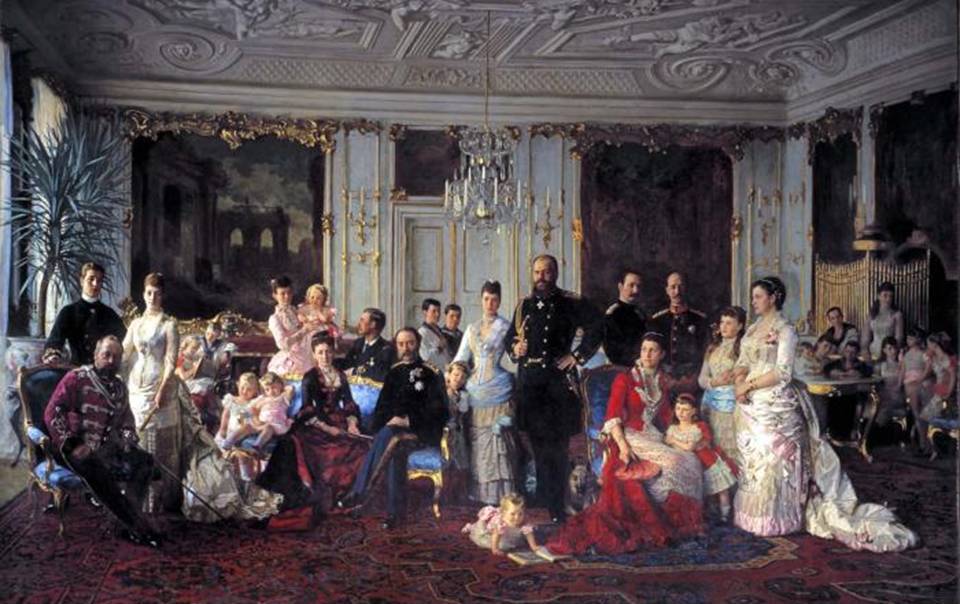
We don’t have to look to the computing sciences or delve into the mysteries of bosons, mesons and other members of the subatomic bestiary for examples of this sort of thing.  History - the history of people and their interactions, especially when the inter-actors are people who exercise power and influence - provides a wealth of examples of complex systems.  This was brought forcibly to my attention when, during a visit to Denmark in 1990 to be vetted by my future in-laws, I visited Christiansborg Castle in Copenhagen and saw this painting:

 “Fredensborg Days”, Laurits Tuxen (painted 1863-1866)

The painting - which, at 5 x 7 metres, is bloody enormous - takes up a whole wall and depicts a fictionalized scene during the “Fredensborg Days” period of the monarchy of King Christian IX of Denmark (1818-1906), who was on the throne from 1863 until his death, making him one of the longer-reigning monarchs in Danish (and European) history.  The painting’s informal name is “The Father-In-Law of Europe” because of its depiction of the massive range of family connections enabled by Christian’s six children.  You can see Christian and his wife, Louise of Hesse-Kassel, seated on the blue settee.  There are a number of other notables in the painting; I’ll get to them in a few moments.

I won’t go into too much detail about how he ended up on the throne.  Suffice it to say that Christian, a scion of a lesser male branch of the ruling Oldenburg family, found himself at the centre of a succession debate resulting from the inability of King Frederick VII to father children.  Christian’s marriage to Louise proved to be fortuitous and an example of dynastic foresight; as a great-niece of Christian VII (b.1749, r.1766, d.1808) she actually had a better claim to the throne than her husband (save for the fact that Denmark adhered to a partial version of the Salic Law that prohibited - as Shakespeare put it in Henry V - “your highness claiming from the female”).  In 1847, the great powers of Europe put their heads together and nominated Christian to succeed Fredrick when the latter should shuffle off the mortal coil; Fredrick agreed in exchange for promises of financial support. 

When Fredrick died in November 1863 and Christian came to the throne, an immediate crisis exploded over possession and status of Fredrick’s hereditary domains of Schleswig and Holstein, two provinces on the Danish-Prussian border.  Christian signed the November Constitution, making Schleswig part of Denmark, and resulting in a brief war between Denmark and a Prussian/Austrian alliance in 1864.  While this Second War of Schleswig didn’t turn out well for Denmark (Schleswig and Holstein, along with Saxe-Laurenburg, became Prussian and Austrian possessions in 1865 under the Treaty of Vienna), it did include the famous Battle of Dybbøl Mølle, a defensive action outside of the southern Danish city of Sønderborg, which was notable for the use of complex defensive earthworks of a type that wouldn’t be seen again until 1914 (you can visit the site; the windmill - which is what mølle means - is still there).

“Kampene ved Dybbøl, 1864”, by Jørgen Valentin Sonne, 1871

It’s worth noting that the trench system constructed by the Danes at Dybbøl Mølle followed and was built on the line of the Danevirke, a system of fortifications more than a thousand years old, which had been begun by King Gudfred in 808 to defend against the Franks, recently united under Charlemagne.  There’s a reason that battles keep happening at strategic places; it’s called “geography”. 

Anyway, back to Christian IX.  His accession to the throne put an end to the Oldenburg Dynasty and launched the Glucksburg dynasty, only the second dynastic change in the history of Denmark’s royal family (the Oldenburgs came to the Danish throne with the election of Christian I in 1448, replacing the succession of Viking and Medieval kings that had preceded them since Gorm the Old, who reigned from 936-958 AD).  The number of kids that Christian and Louise managed to produce over the next several years (as well as Christian’s staunch defence of the prerogatives of the monarchy and his resistance to the liberalizing forces sweeping Europe in the latter half of the Victorian era) created complex familial nodes that continue to dominate Europe’s royal relations today.  His children, their spouses, and their grandchildren included:

·         King Fredrick VIII of Denmark (1843-1912) m. Princess Lovisa of Sweden

o   King Christian X of Denmark

o   King Haakon VII of Norway

o   Princess Louise of Denmark

o   Prince Harald of Denmark

o   Princess Ingeborg of Denmark

o   Princess Thyra of Denmark

o   Prince Gustav of Denmark

o   Princess Dagmar of Denmark

·         Princess Alexandra of Denmark m. King Edward VII of the UK

o   Prince Albert Victor, Duke of Clarence

o   King George V

o   Louise, Princess Royal

o   Princess Victoria

o   Prince Maud of Wales

o   Prince Alexander John of Wales

·         King George I of Greece m. Olga Konstantinovna of Russia

o   King Constantine I of Greece

o   Prince George of Greece and Denmark

o   Princess Alexandra of Greece and Denmark

o   Prince Nicholas of Greece and Denmark

o   Princess Maria of Greece and Denmark

o   Princess Olga of Greece and Denmark

o   Prince Andrew of Greece and Denmark

o   Prince Christopher of Greece and Denmark

·         Dagmar of Denmark m. Czar Alexander III of Russia

o   Czar Nicholas II of Russia

o   Grand Duke Alexander Alexandrovich

o   Grand Duke George Alexandrovich

o   Grand Duchess Xenia Alexandrovna

o   Grand Duke Michael Alexandrovich

o   Grand Duchess Olga Alexandrovna

·         Thyra of Denmark m. Ernst August of Hanover, 3rd Duke of Cumberland

o   Princess Marie Louise of Hanover and Cumberland

o   Prince George William of Hanover and Cumberland

o   Princess Alexandra of Hanover and Cumberland

o   Princess Olga of Hanover and Cumberland

o   Prince Christian of Hanover and Cumberland

o   Prince Ernest Augustus of Hanover, Duke of Brunswick

·         Prince Valdemar of Denmark m. Marie of Orléans

o   Prince Aage of Denmark

o   Prince Axel of Denmark

o   Prince Erik of Denmark

o   Prince Viggo of Denmark

o   Princess Margaret of Denmark

Say what you like, that’s a perfectly astonishing brood.  And there are some pretty big names among Christian’s list of grand-kids.  If you take a swing around Europe’s royal families these days, quite a few of them still have a Viking somewhere in the woodpile.  Let’s try it out, starting with an easy one:

·         Margrethe II of Denmark: Fredrick IX - Christian X - Fredrick VIII - Christian IX of Denmark

·         Elizabeth II of the United Kingdom: George VI - George V - Princess Alexandra of Denmark - Christian IX of Denmark

·         Harald V of Norway: Olav V - Haakon VII - Frederick VIII of Denmark - Christian IX of Denmark

·         Albert II of Belgium: Astrid of Sweden - Princess Ingeborg of Denmark - Fredrick VIII of Denmark - Christian IX of Denmark

·         Constantine II of Greece (until the monarchy was abolished in 1973): Paul of Greece - Constantine I - George I - Christian IX of Denmark

Queen Beatrix of the Netherlands, Prince Henri of France, Grand Duke Henri of Luxembourg, Nicholas Romanov of Russia, and Hans-Adam II of Lichtenstein are not directly descended from Christian IX, putting them in something of a minority (especially as the French and Russian royal houses are considered ‘deposed’).  And while King Juan Carlos of Spain is not descended from Christian, his son and heir-apparent, Felipe Prince of Asturias, is, by virtue of Juan’s marriage to Sophia of Greece and Denmark (eldest child of Paul of Greece, and sister to King Constantine II of Greece) another descendent of Christian IX.  So once Juan Carlos disappears into the pages of history, the next King of Spain will be one Christian IX’s scions, further cementing that ancient gentleman’s hold on the thrones of Europe.

And what of our friend Carl XVI Gustav, whose indiscretions launched this whole line of discussion?  Well, it turns out that, unlike so many of his peers, he is not in fact, a descendent of Christian IX. 

Charles Edward, Duke of Saxe-Coburg and Gotha, Grandfather of King Carl Gustav, ca. 1933

But he came close.  Carl is the son of Princess Sibylla of Saxe-Coburg and Gotha, who was the daughter of Charles Edward, Duke of Saxe-Coburg and Gotha - a chap infamous in the Swedish royal lineage for having been an Obergruppenfuhrer of the S.A.  Charles Edward was something of a scandal for the British royal family too.  He was the eldest (and only) son of Prince Leopold, Duke of Albany, who was the eighth child and fourth son of Victoria and Albert. 

 Prince Leopold, Duke of Albany (1853-1884)

Prince Leopold, a haemophiliac, was notoriously frail and, as such, his mother (protective at the best of times) did her best to keep him around the house.  Seeing marriage as his only chance for escape, Leopold expressed an interest in a number of prominent ladies of the era - including, interestingly, Alice Liddel, the daughter of the vice-chancellor of Oxford for whom Reverend Dodgson (aka Lewis Carrol) wrote Alice’s Adventures in Wonderland.  Leopold eventually married (at his mother’s suggestion, natch) Princess Helene Friederieke, the daughter of Georg Viktor, Prince of Waldeck-Pyrmont, in 1882.  But before he did, he courted none other than Princess Karoline Mathilde of Schleswig-Holstein-Sonderburg-Augustenburg, a great-niece of Victoria, and a daughter of one of Napoleon III’s paramours and Fredrick VIII, Duke of Schleswig Holstein.  Fred was the rival Oldenburg claimant to the duchies that were at stake when Christian IX took the Danish throne for the Glucksburgs in 1863, and later lost to Prussia and Austria.  Had his great-grandfather Leopold married Princess Karoline, Carl Gustav would’ve enjoyed an older (and Salic Law-compliant) claim to the Danish throne than its current occupant, Margrethe II. 

History is full of what-ifs.  For one of the best examples imaginable, take another look at that painting of Christian IX and his flock of relatives.  Two of the children depicted are the future King George V of the UK and the future Czar Nicholas II of Russia (probably added as the painting was being completed, seeing as how they were born, respectively, in 1865 and 1868). 

Here’s what Nick (on the left) and George (on the right) looked like forty years later, in 1913:


The resemblance is uncanny, and it goes beyond the mere physical.  Reigning monarchs, first cousins, and virtual twins, glorious in their finery - blissfully unaware that the world they knew would cease to exist in less than a year, and that only three years after that, the gentleman on the left, with all of his family, would be butchered by Bolshevik fanatics in a filthy basement in Yekaterinburg.

One line dies, another line lives on.  There’s something to be said for having big families - even if, from time to time, some of them get up to shenanigans.

Cheers,

//Don//

P.S.      If you like big-scene paintings, here’s another one by Tuxen - the wedding of Nicholas II in 1895: http://en.wikipedia.org/wiki/File:TsarNicholasIIWedding.jpg
P.P.S.   Tuxen’s also famous for being a member of the “Skagen School” of artists that painted realistic maritime scenes of the northernmost tip of Denmark.  I have a number of prints (my wife’s maternal grandfather was a merchant marine/fisherman).  Here’s an example of that sort of work: http://rubensgallery.org/upload1/file-admin/images/new22/Laurits%20Tuxen-227734.jpg

Notes
A) [http://www.smh.com.au/lifestyle/people/strip-club-scandal-pressure-mounts-on-swedish-king-20110607-1fpty.html].

Saturday, March 17, 2012

5 November 2010 – Occupational intoxication: Not as fun as it sounds

Comrades,

There’s been a little accident at the Russian chemical demilitarization facility at Maradykovsky, an Air Force base in the Kirov Oblast (see Figure 1).  It seems that, back on 23 September, four CW specialists fell ill at the CW destruction plant.  The conclusive diagnosis is now in, and the four appear to have been suffering from “acute occupational intoxication”.  This means something a little more serious in the CW destruction business than in most other fields of endeavour.


Figure 1 – Russian CW Storage and Destruction Facilities
(US General Accounting Office, Report to the Chairman, Committee on Armed Services: Delays in Implementing the Chemical Weapons Convention Raise Concerns About Proliferation (Washington, D.C.: GAO, March 2004), 9.)