Thursday, July 26, 2012

12 August 2011 – Charged up

Colleagues,

The Ontario government announced this week that it would invest $80M in charging stations for electric cars.  Around about the same time I came across a few articles on electric vehicles that caught my eye, and that engendered a little arithmetic.

According to the NRCAN 2007 Canadian Vehicle Survey, in 2007 there were 19,003,427 “light vehicles” (cars and trucks) on Canada’s roads (more than one third - 6,957,086 - in Ontario alone); 392,608 medium trucks; and 314,877 heavy trucks.  A “light vehicle”, by the way, is defined as any vehicle with a gross weight of less than 4.5 tonnes.  The vast majority of light vehicles (18.3M) are gasoline powered; most of the rest are diesel-powered, and a small percentage (64,587, or 0.35% of the total) use “other” fuels, principally propane.

In 2007, Canada’s light vehicles travelled 300,203,000,000 km (300 billion kilometres).  To do so, they burned 31,305,000,000 litres of gasoline and 1,291,000,000 litres of diesel, racking up average fuel consumption rates of 10.8 litres of gasoline, or 12.3 litres of diesel, per 100 km travelled.  Gasoline contains 34 Mj/litre, so on average, light vehicles in Canada used 34 x 10.8 / 100 or 3.672 Mj per km travelled.

The Chevy Volt has a 200-kg lithium-ion battery that according to GM literature gives the vehicle an electric-only range of 25-50 miles “depending on terrain, driving techniques and temperature”.  The battery holds a maximum energy charge of 16 kWh, or 57.6 Mj.  At maximal charge-to-power performance, this means that the Volt uses 0.720 Mj/km; and at minimal charge-to-power performance, twice that, or 1.44 Mj/km - in other words, somewhere between one-quarter and one-half the energy required by light vehicles powered by internal combustion engines.  Clearly, EVs are more energy-efficient than IC vehicles.  No surprise there; electric motors have always been more efficient at turning input into output.*

Of course, the Volt figures are theoretical numbers provided by the company that makes them, while the NRCAN figures are actual statistical numbers gathered from huge amounts of empirical data.  Moreover, the “light vehicles” category includes many vehicles that the Volt cannot compete with - e.g., SUVs, pickup trucks, minivans, larger vans, construction trucks, cube vans, and other vehicles with significant passenger and/or cargo storage space.  In terms of size and passenger capacity, the Volt is more comparable to, say, a Nissan Sentra, which according to the manufacturer gets 34 mpg or 6.96 litres per 100 km (which translates to 2.36 Mj/km).  So in other words, the Nissan Sentra uses somewhere between 1.6 and 3.2 times the energy per unit of distance travelled as the Volt does. 

Of course, with a 55-litre tank the Sentra has an unrefuelled maximum range of 788 km, which is ten times the Volt’s maximum 80 km range.  In order to manage the same range as the Sentra on battery power alone, the Volt would need 2000 kg of batteries instead of just 200 kg, which would degrade vehicular performance and take up a lot more space - more space, in fact, than the vehicle has.

It would also have an impact on charging time.  According to company literature, the Volt takes 10-12 hours to fully charge from a 120-Volt charging station (the charging time can be compressed to “about 4 hours” by using a special-purpose 240-Volt charging station).  Assuming zero losses (unrealistic, I realize, but we’re modelling here, not measuring), taking 10 hours to put 16 kWh into a battery pack means that you’re adding 1.6 kW to your household current load for that entire period.  That’s about the same draw as running an electric kettle, a curling iron, or a 3-ton air conditioner for 10 hours straight.

That’s not the way to look at it, though.  Returning to the NRCAN data, if there are 19M light vehicles driving 300B vehicle-km, then that’s an average of 15,789 km per light vehicle per year.  That’s 57,977 Mj in gasoline, at the 10.8 litres/100 km cited above for light vehicles (not at the lower Nissan Sentra rate).  If those vehicles were all Volts, that 15,789 km per vehicle would translate to an absolute minimum (assuming perfect performance, no losses, no overcharges, and no deleterious effects to performance from “terrain, driving techniques or temperature”) of 197.36 full 16 kWh charges.  That equates to 197.36 charges per vehicle x 16 kWh per charge x 3.6 Mj per kWh = 11,368 Mj per vehicle.  In theory, therefore, swapping out all the light vehicles in Canada for Volts and running the volts solely on electric power would result in an energy savings of something like 80%.

There are, of course, a couple of problems with these calculations.  Among them are the fact that Volts aren’t trucks; that without burning fuel, they can’t go further than a maximum of 80 km unrefuelled; that their total cargo capacity is 200 litres (about one-fifth of your average SUV, to say nothing of pickup trucks); and that their performance (especially battery performance) in Canadian weather conditions is, shall we say, somewhat less than the company claims.  But put all that aside for a moment and consider only the question of electric power. 

Suppose Ontario’s fleet of 7M light vehicles consisted of all-electric vehicles like the Nissan Leaf. The Leaf has a battery capacity of 24 kWh and a claimed range of 160 km.  Because each light vehicle in Canada drives an average of about 16,000 km/year, assuming perfect performance and no losses, each Leaf would require 100 full charges, or 2400 kWh, or 2.4 MWh per year.  Charging those vehicles would consume 16,800,000 MWh, or 16,800 GWh, or 16.8 TWh.

Ontario Power Generation, which generates about 70% of Ontario’s electricity, produced 88 TWh in 2010.  The total output of all of its hydroelectric generating stations last year was about 30 TWh; and the total output of all of its nuclear plants was about 45 TWh.  What’s most interesting, though, is that the total output of OPG’s thermal generating stations in 2010 was 12.2 TWh - which is about two-thirds of the amount of power necessary to support a province-wide switch to electric vehicles.  It’s also the generating capacity that the Ontario government plans to close by 2014.  Not to put too fine a point on it, but it’s a little odd to be simultaneously spending money to build electric car charging stations at the same time you’re reducing the amount of the electrical generating capacity you need to charge them with.

Lest you think I’m pounding unduly on Ontario, the situation in the US is far, far worse.  The EPA has issued MACT - Maximum Achievable Control Technology - regulations that come into effect on 1 January 2012, and that will essentially price coal-fired generation out of the market, leading to colossal underproduction of electricity and the loss of hundreds of thousands if not millions of jobs, especially in places like Indiana, which obtains 95% of its electricity from coal.  Not to put too fine a point on it, but perhaps folks should have listened when Obama promised during the campaign that he would bankrupt coal-fired generating stations.  He intended to do it through carbon trading, of course; but since his legislative efforts in that direction failed in Congress, his EPA is doing it through regulatory action.  The US government is of course still subsidizing purchases of hybrids and EVs; it’s just not clear what folks are going to use to charge them.

The bottom line is this: electric vehicles are the future, because they are at a minimum twice as energy-efficient as IC engines, and because we have 8000 years’ worth of uranium (and a virtually infinite supply of fuel for thorium-based reactors).  But the future isn’t here yet.  It took over 40 years to get the internal combustion engine-powered private automobile from a curiosity to a useful consumer product, and 80 more to turn it into the reliable, low-cost, fuel-efficient piece of awesomeness that it is today.  Electric vehicles are actually older as a concept than IC-powered cars, but due to slow advances in battery technology, they haven’t benefitted from more than 100 years of market-driven innovation.  Also, the infrastructure to support EVs simply does not exist, and creating it will take decades and literally hundreds of billions of dollars.  The IC automobile was not a government project, and its replacement by EVs cannot be imposed by government fiat - it’s as simple as that.  The market - which is to say, consumers - will decide when it’s time to switch, and the switch will take decades.  Attempts by governments to accelerate the process, either through punitive taxation on conventional vehicles (did governments impose a punitive tax on horses in the 1890s and 1900s to force people to switch to cars?) or by using taxpayer money to build infrastructure that the market has no incentive to create, will be a waste of money at best, and will impede the process at worst.

Okay, enough of that.  Two more interesting and related points.  The first is that electric and hybrid vehicles respond very differently from conventional internal combustion engines when they run out of fuel / battery power.  These two articles make interesting reading for anyone who’s ever poked around under the hood of a car.

http://www.popularmechanics.com/cars/reviews/hybrid-electric/when-the-nissan-leaf-dries-up

http://www.popularmechanics.com/cars/how-to/repair/what-to-do-when-your-hybrid-cars-battery-dies?click=pm_latest

As the author of the articles makes clear, advertised charge times and operating ranges are a little squishy, and when your EV flatlines on the highway, you can’t just catch a lift to the nearest charging station for a one-gallon jerrycan of electrons.  As for California’s solar-powered EV charging stations, it’s worth recalling where the Sun usually is when you have the time to park your car for a 10-hour charging cycle.

Second, here’s a link to a paper that warns about what might happen to electricity grids under real-time pricing: http://arxiv.org/abs/1106.1401v1

Don’t bother with the equations; just flip to the conclusion, which states that “As the penetration of new demand response technologies and distributed storage within the power grid increases, so does the price-elasticity of demand, and this is likely to increase volatility and possibly destabilize the system under current market and system operation practices.”  In other words, once you can set all of your appliances to operate after the rates go down, the demand during “cheap time” will increase, necessitating altering the generation schedules and, therefore, increasing prices during the new demand time.  And just imagine what happens when a significant fraction of the population comes home from work at 1800 hrs and plugs their 4-wheeled, 2400-Watt EVs into the wall, all at the same time.  Or, alternatively, when everyone sets the charging to begin exactly at 1900 hrs, just as the rates go down. 

EVs that will offer a genuine, comparable, cost-effective alternative to conventional IC-engine vehicles are coming.  They’re just not here yet.

Cheers,

//Don//

*The calculus changes if you factor in the cost of burning fuel to generate electricity to charge an EV’s batteries.  I’ll save that discussion for another day, though.

Monday, July 23, 2012

5 August 2011 – Heat wave horrors and fusion follies

Colleagues,

Two interesting articles on the “alternative energy” front yesterday, the first from our cousins south of the 49th.  Back in the winter months, I briefly discussed the energy situation in the Lone Star State (“Braking Wind in Texas”, 3 February 2011), noting, among other things, that ice storms had caused damage to transmission lines and gas-fired backup power plants, leading to rolling blackouts during periods of high heating demand.  Part of the problem is that about 8% of the total generating capacity of the state’s various electricity producers is provided by wind turbines, and as Britons found out this past winter, when their wind farms consumed more power than they produced in order to keep turbine gearboxes from freezing up, the wind often doesn’t blow when it’s really cold.

Well, as I remarked a few weeks back during the early July heat wave in Ontario, the wind tends not to blow when it’s really hot, either, which of course is when electrical demand climbs due to air conditioning requirements.  This poses sort of a meta-question for the whole wind power industry: if the systems are least effective when power demands are highest, are they really the sort of generation systems we need to be subsidizing to the tune of billions of taxpayer dollars?  Anyway, not surprisingly, the same thing is happening in Texas right now as happened back in February, although for a slightly different reason.  Back then, persistently cold weather increased demand and reduced supply; now, persistently hot weather is leading to increased demand, and reducing supply.

Figures provided by ERCOT (the Electricity Reliability Council of Texas, Inc., an Orwellian title given that they are currently spending more time explaining why electricity is not reliable than providing reliable electricity) the largest single power utility in the state (kind of like OPG here in Ontario) illustrate the nature of the problem.[Note A]  On Wednesday this week, the demand on ERCOT’s generating capacity reached 68,294 MW.  That’s just 50 MW shy of the utility’s total generating capacity.  50 MW is 25 wind turbines - so much of Texas was only two-dozen bird-blenders away from rolling blackouts.  And there lies the heart of the problem.  The installed capacity of ERCOT’s wind turbines is 9000 MW, but on Wednesday, they were generating only 2000 MW - because the wind tends not to blow when it’s really hot.  That’s a capacity factor of 22.2%.  In other words, for every 1 MW of wind generation you plan to get, you have to install 4.5 MW of wind generation capacity.  Compare that to nuclear, gas and coal-fired plants, where for every 9 MW you need, you have to install 10 MW of capacity.  This is not calculus, people, it’s basic arithmetic.  And here’s some more: the standard production rate price per MWh in Texas runs about $110.  At peak periods, producers can earn $300-$400 per MWh.  But when the supply-demand margin goes razor-thin, as it did on Wednesday, prices go completely nuts; generators chugging out the last few MW to meet skyrocketing demand can earn up to $3000/MWh, which is the state cap for production prices.  Think about that - it’s thirty times the going rate, and those increases get passed on to consumers through higher rates.  Imagine what gasoline would be like if instead of fluctuating by 5-10% in response to per-bbl price changes, the pump price changed by a factor of 30, and on the Friday before a long weekend you had to pay $36/litre to tank up?  Clearly there is some financial benefit to generators to keeping capacity right at the breaking point, which wouldn’t happen if supply was designed to meet peak demand.  Of course, running right at that razor edge is pretty hard when you have no idea what proportion of your 9000 MW worth of wind turbines are going to be spinning, and how many are just going to be sitting out there like modern art sculptures.  When the difference between state-wide power and rolling blackouts comes down to 25 turbines out of the 1000 or so (out of 4500 installed) that are actually running, you’re really gambling on the breeze.

One of the ERCOT representatives interviewed argued that capacity shouldn’t be designed with “extreme” situations in mind.  Kent Saathof, ERCOT’s VP of system planning and operations, said, “You have to determine if it is worth spending millions or billions to avoid a one in 10-year event.” [Note A]  That’s generally a fairly sound businessman’s argument, and I’ve made it many times myself in design discussions.  But when you’re talking about state-wide power generation, there are a few problems with it.  First, when 8% of your generators cannot be relied on to produce at least 90% of their nameplate capacity, your margin of error is a lot bigger and therefore a lot less predictable.  If Texas had suffered the same sort of wide-area heat dome effect that eastern Ontario suffered back in July, the 2000 MW of generation they were getting on Wednesday (out of the theoretical 9000 MW of installed wind capacity) could easily have dropped by 90%.  It’s a lot harder to make up 2000 MW of generation with gas-fired emergency turbines - in fact, it’s pretty much impossible.  That’s two whole nuclear power plants worth of electricity - plants that Texas hasn’t got.  Second, if you’re structuring your capacity on a “one in ten-year event” with heavy reliance on intermittent sources like solar and wind power, you’ve either got to be prepared with reliable (which means fossil-fuelled) backup systems, or you’ve simply got to accept that there will be blackouts when demand goes too high.  This is what the UK grid chief, Steve Holliday, meant when he said last March that one of the consequences of the UK government’s decision to “go green” was that “the era of constant electricity at home is ending” and that “families will have to get used to only using power when it is available.” [Note B] 

Remember when electrification was one of the triumphs of the modern world?  Remember when we used to mock the Soviets for being unable to provide continuous electricity to their citizens?  Remember last decade, when certain politicians in the US decried every brownout in Baghdad as evidence of the failure of post-war reconstruction efforts?  When exactly did not having electricity become virtuous?

The third problem, of course, is the breathtaking inconsistency of these arguments.  The whole reason for ”going green” is to lower the carbon (dioxide, everybody forgets the dioxide) emissions that are allegedly killing the planet.  Global warming, we are continuously being told, is now inevitable, and extreme heat waves are going to become more common.  In other words, according to the most ardent proponents of “green energy”, heat waves like the one in Texas this week, and the one in Ontario last week, are not going to be “one in 10-year events”; they are going to become routine.  If these folks actually believed their rhetoric, they would logically be structuring electrical generating capacity to deal with heat waves as occurrences that are inevitably going to become more frequent.  And yet they’re not.  They’re acting as though either (a) they expect major heat waves to remain a rare occurrence; or (b) they expect heat waves to become more common, but think that the end of the “era of constant electricity at home” is a good thing.  They’re either hypocrites or Luddites.

So much for the late, great state of Texas.  The second interesting article was also about alternative energy, but has nothing to do with wind turbines, blackouts or the Alamo.  Anybody remember who Pons and Flesichmann were?  They were the chaps who, back in 1989, announced that they had discovered “cold fusion”.  Basically, they reported anomalous heat production and nuclear reaction by-products in a fuel cell where heavy water (normal water with a high proportion of deuterium) was being electrolysed by a palladium electrode.  Their experiment could not be replicated, and “cold fusion”, like Piltdown Man, became a running joke for any bogus scientific claim.  Well, fast-forward 20 years.  For the past few months there have been reports coming out (not via the MSM, which doesn’t seem to have noticed the situation) from a private research lab in Italy where a scientist/entrepreneur named Andrea Rossi has been working on a similar concept using nickel substrates instead of palladium.  An experiment back in January consumed 400 Watts of power and produced 12,000 Watts of heat, a result that would have been virtually impossible absent some nuclear-level effect.  While Rossi hasn’t published his process (presumably because he hopes to make money from patenting it) or allowed observers to deconstruct his apparatus, objective monitoring and evaluations of his setup by physicists suggest that there are no other explanations for how much energy is produced by his “energy catalyzer”. 

Yes, it sounds like something between black magic, alchemy and phlogiston.  Yes, it has yet to be independently verified.  However, Rossi is currently working on a 1 MW commercial version of his reactor based on ganging-up modules of the sort used in the January demo.  It is expected to produce output water at 500 degrees C (See Note C; I won’t reproduce the article as it’s an excellent summary of the project to date).  Such a device could be used for a wide variety of commercial (and military) applications.  For large-scale power plants, for example, it could be used to provide input water to a final-stage boiler, generating - at almost no cost - the first 500 degrees of the 600 degrees generally needed by steam turbines, and thereby cutting fuel requirements for electrical generation by more than three-quarters.

Is it true?  Maybe.  From a scientific perspective, we have at present a small amount of confirmatory evidence, and no falsifying evidence.  If Rossi produces and sells a 1 MW variant, it’ll be testable, and the evidence, pro or con, will pile up rapidly.  In the meantime, though, what I find very interesting about this is that it came pretty much out of left field.  In his famous 2003 speech entitled “Aliens Cause Global Warming”, Michael Crichton opined on how it was impossible to predict the future.  Looking back at the year 1900, he asked how it would have been possible for citizens of that era to predict what the world would be like in 2000.  His survey of the technological and sociological changes alone is worth a read:

Let’s think back to people in 1900 in, say, New York. If they worried about people in 2000, what would they worry about? Probably: Where would people get enough horses? And what would they do about all the horseshit? Horse pollution was bad in 1900, think how much worse it would be a century later, with so many more people riding horses?

But of course, within a few years, nobody rode horses except for sport. And in 2000, France was getting 80% its power from an energy source that was unknown in 1900. Germany, Switzerland, Belgium and Japan were getting more than 30% from this source, unknown in 1900. Remember, people in 1900 didn’t know what an atom was. They didn’t know its structure. They also didn’t know what a radio was, or an airport, or a movie, or a television, or a computer, or a cell phone, or a jet, an antibiotic, a rocket, a satellite, an MRI, ICU, IUD, IBM, IRA, ERA, EEG, EPA, IRS, DOD, PCP, HTML, internet. interferon, instant replay, remote sensing, remote control, speed dialing, gene therapy, gene splicing, genes, spot welding, heat-seeking, bipolar, prozac, leotards, lap dancing, email, tape recorder, CDs, airbags, plastic explosive, plastic, robots, cars, liposuction, transduction, superconduction, dish antennas, step aerobics, smoothies, twelve-step, ultrasound, nylon, rayon, teflon, fiber optics, carpal tunnel, laser surgery, laparoscopy, corneal transplant, kidney transplant, AIDS... None of this would have meant anything to a person in the year 1900. They wouldn’t know what you are talking about.

Now. You tell me you can predict the world of 2100. Tell me it’s even worth thinking about. Our models just carry the present into the future. They’re bound to be wrong. Everybody who gives a moment’s thought knows it. (Note D)

I particularly like the second sentence of the second paragraph - “in 2000, France was getting 80% of its power from an energy source that was unknown in 1900.”  In 1900, we didn’t know what an atom was, and today nuclear power is prevalent worldwide.  Is Rossi’s “energy catalyzer” one of the things that nobody saw coming as much as 10 years ago, and that in 20 years, could be an important source of worldwide energy?  Maybe, maybe not.  Maybe it’s a load of bushwah.  Maybe we’ll be getting the bulk of our power from something different entirely - perhaps a scientific development for which the basic science still has to be done.  But if Rossi’s “E-Cat” is real, it will render discussions of “peak oil” and the nuclear willies of the hand-wringing post-Fukushima panickers entirely moot.  If it’s real, wind turbines will be quickly abandoned as the costly and ineffective white elephants they are (or used for pumping water on farms, as they have been for centuries).  And if, like oil, low-energy ’fusion’ does end up changing the world, then we - like the 19th Century prophets of the horse-manure apocalypse - didn’t see it coming, because, as Crichton warns, you can’t predict where technology will go, and we were, as a result, simply projecting current trends into the future.

Here’s hoping that Rossi’s got something, that it will be commercializable in the near term, and that it will contribute to electrical generation.  Because the 1,323-page “Cross-State Air Pollution Rule” that the Environmental Protection Agency just passed at the end of July and that is due to take effect on 1 January 2012 will force Texas to close 18 power plants that provide about 11,000 MW of coal-fired generation capacity.  Imagine what the past week would have been like for Texans without that electrical power.

Looks like the “end of the era of constant electricity at home” isn’t going to just be a British phenomenon. 

Cheers,
//Don//

Notes

A) [http://www.reuters.com/article/2011/08/04/us-utilities-ercot-heatwave-idUSTRE7736OT20110804]

B) [http://johnosullivan.livejournal.com/31784.html]

C) [http://wattsupwiththat.com/2011/08/04/andrea-rossis-e-cat-fusion-device-on-target/#more-44578]

D) [http://scienceandpublicpolicy.org/commentaries_essays/crichton_three_speeches.html]

Thursday, July 19, 2012

2 August 2011 – Peer Review: The Bear Facts

Colleagues,

Two of my interests - scientific methodological rigour in general, and climate science in particular - bumped uglies this week, in more than just the figurative sense.

For those of you who shelled out the requisite bucks a half-decade or so ago, or those who remember the 2007 Oscars, you might recall Al Gore’s venture into the art of documentary film-making, entitled An Inconvenient Truth.  Known throughout the climate blogosphere by the shorthand “AIT”, Gore’s flik purported to display conclusive evidence that human-produced greenhouse gases are imperilling life on this planet.

One of the pieces of evidence he trotted out in support of his argument - a superb example of photogenically-apt saccharine bathos if there ever was one - was a study suggesting that polar bears are being endangered by climate change because retreating Arctic ice means that they are having to swim further to find ice to hunt from.  The film was full of footage of the big, pretty, fluffy predators frolicking on the floes, gambolling merrily with their adorable offspring, and gamely swimming hither and yon…at least, until they drowned and were found floating and dead, allegedly (according to Gore) because even superb swimmers like polar bears eventually get tired.

The film footage touched hearts worldwide and sparked all manner of imitative imagery from AGW advocates and green groups, from articles accompanied by photoshopped images of a lonely polar bear in the flagship journal Science...


(Which the magazine itself captioned as follows: “This image is a photoshop design. Polar bear, ice floe, ocean and sky are real, they were just not together in the way they are now”*)

...to a papier-mache polar bear riding a plastic iceberg in the Thames…


...to polar bears hanging themselves from bridges (in what seems to be a bizarre bi-polar suicide pact with penguins, a startling display of inter-species solidarity given that penguins live roughly 20,000 km away in the antipodean Antarctic, where sea ice extent has been steadily increasing)...


...to the amazingly ham-fisted advertisement by Planestupid.com, who - in order to convince air travellers to air-travel less - executed a feat of propaganda not to be surpassed until 10:10 UK made a commercial showing school children being blown into bloody flinders by their teacher for asking skeptical questions about consensus climate science. Planestupid.com produced a video showing polar bears plummeting from the skies and smashing themselves into ursine tartare on pavement and the odd car.

 “Oh, the bearmanity!”

And all because Al Gore swore up and down that polar bears were threatened by climate change. 

Incidentally, one wonders how these Planestupid folks think to get off their island, if not via some piece of fossil-fuel-burning man-made equipment.  These people put me in mind of what Lord St. Vincent had to say about Napoleon's invasion prospects in 1803: "I do not say that they cannot come. I only say that the cannot come by sea." Or by air, if the Planestupiders get their way. Or via the Chunnel.  Perhaps they intend to swim.  Hopefully the plastic polar bears won't jump off their plastic icebergs in the Thames and eat them.

Let’s ignore a few obvious facts - for example, the fact that polar bears as a species have survived at least three warmer interglaciations without going extinct; the fact that they seem somehow to be able to cope with an annual phenomenon known as “summer”, when the amount of Arctic sea ice shrinks by two-thirds; the fact that polar bear numbers are vastly higher than they were forty years ago, during which period the Earth has allegedly undergone “unprecedented warming”; and for that matter, the fact that if polar bears were really drowning in record numbers, we would expect to find a corpse now and again (references available on request) - and turn instead to the source of Al’s assertions.

The source was a paper by Dr. Charles Monnett, an Alaska-based researcher with the U.S. Bureau of Ocean Energy Management, Regulation and Enforcement.  In 2006, Monnett lead-authored an article in Polar Biology entitled “Observations of mortality associated with extended open-water swimming by polar bears in the Alaskan Beaufort Sea”.  The article was based on multi-decadal observations during aerial transect flights aimed principally at observing whale populations. From 1987-2003, hundreds of swimming polar bears were observed during these flights, and no dead ones were reported.  In 2004, however, four polar bear carcasses were seen floating offshore and were “presumed drowned” by the researchers.  The researchers first extrapolated this into a broader trend, and then interpreted it as proof that climate change was threatening polar bear populations (especially, according to the authors, lone females and cubs) because the bears have to swim longer distances to find ice to rest on.  Gore cited Monnett’s research in his film, launching the whole furry fandango.  The following year he collected his Oscar (and his Nobel Prize); and the year after that, the US Government classified polar bears as a “threatened species”.

If you’re interested, Monnett’s original article is here:

http://www.abc.net.au/rn/backgroundbriefing/documents/bbg_20110717_dead_polar_bears.pdf.

Fast-forward to 2011.  Monnett was recently suspended from his position and has been grilled extensively about his research.  The transcript of the inquiry makes interesting reading for a number of reasons, ranging from his methodology (using models to infer a species-wide threat from only four carcasses) to his startling inability to articulate what he was doing and how he was doing it. (the transcript of the interview with Monnett can be found here:

http://www.peer.org/docs/doi/7_28_11_Monnett-IG_interview_transcript.pdf).

Apart from the difference between modelled (extrapolating from four corpses) and genuinely empirical (counting all the corpses) methodologies demonstrated in the paper, what I found especially interesting was the fact that Monnett’s paper - the paper that inspired Al, and that sparked the whole panic about the poor, doomed polar bears - seems to have been peer-reviewed by his wife (see line 26, page 35 of the transcript).  It was apparently reviewed elsewhere too, of course (including, presumably, by whomever the journal sent it to for review), but the fact that the internal review for the first version of the report seems to have been by Monnett’s spouse, a co-worker who shares his views and research funding, certainly sets off some alarm bells.  If nothing else, it gives the appearance of a conflict of interest - something that presumably any research organization would want to avoid.  One of the key complaints about the climate science community in recent years has been its insularity and propensity for gentle “pal reviews” rather than robust “peer reviews”.

It’s also worth noting that it doesn’t seem clear whether the questions posed by secondary reviewers were ever addressed.  At one point in the interview transcript (see page 41), for example, the investigator cites a reviewer’s question about Monnett’s numbers and statistics and asks whether Monnett ever addressed the reviewer’s concern, and Monett replies as follows:

“I would assume since they signed off on it, that they were satisfied with whatever answers they got”.

It’s an interesting argument, because there is no indication that the reviewer in question was ever asked whether he was satisfied with Monnett’s answers.  Monnett then cites “management review” in his defence, arguing that the paper must have been okay because his manager signed off on it.  It’s an amusing fallback position, since Monnett argues, near the end of the interview, that his managers have been trying to kill his study “ever since the polar bear thing came out” due to the sensitivity and policy implications of the issue; “management”, according to Monnett, doesn’t want anything to interfere with oil drilling in Alaska.  "God forbid" he publish, he says, “something that has anything to do with the climate change debate.”
The transcript of Monnett’s interview is as painful to read as any transcript where the interviewers don’t understand what the interviewee is talking about, and the interviewee isn’t particularly good at explaining it.  But a couple of interesting points emerge.  One is that peer review as a mechanism for ensuring scientific rigour depends for its utility on a combination of expertise and objectivity.  While it is possible for any adequately experienced scientist to offer a critique of the methodology in a paper, one can’t provide an adequate review of the substance of a paper unless one is at least as expert in the subject as the author (this is what the word “peer” means).  For this reason, most peer reviews of complex and detailed arguments tend necessarily to be about methodology more than substance.  Objectivity is equally important, and consists of two parts: perceived disinterest, i.e., that the reviewer has no stake in the results of the study he or she is reviewing (and thus has no incentive either to support the author’s conclusions, or to challenge them); and actual disinterest, i.e., that the reviewer is able to step back from personal or professional involvement with the author and/or his arguments, and provide a qualitatively impartial analysis of the strengths and weaknesses of the arguments presented in the paper.  These are of course in addition to the basic elements of scientific professionalism, e.g., refraining from ad hominem observations and other fallacies of logic while reviewing another scientist’s work, providing evidence when challenging data or conclusions, etc.
For all of these reasons, even in cases where the reviewee and the reviewer possess roughly comparable levels of expertise, it is inadvisable to have papers reviewed by members of the same organization as the author.  It is especially inadvisable - as the Monnett case demonstrates - to assign as a reviewer for a new and potentially controversial project someone who (a) has a demonstrable personal, pecuniary or bureaucratic interest in either supporting or undermining the paper’s conclusions; or (b) someone who, for whatever reason, is unlikely to be able to take an objective, unbiased stance vis-à-vis the subject of the paper under review.  We are none of us saints, and in the interest of preserving the integrity of the process, it is always best to avoid even the possibility of the appearance of bias.  Scientific rigour is a little like Caesar’s wife in that regard; it must not only be pure, but also be seen to be pure.
There are a couple of interesting codas to this story.  One is that Al Gore’s polar bear claim was cited in 2007 by a UK High Court as one of eleven demonstrably disprovable inaccuracies in An Inconvenient Truth; the Court noted that Monnett’s paper stated that only four carcasses had been observed, and that the deaths of these bears was attributable to “a particularly violent storm” rather than “climate change” (or for that matter, to falling out of the sky onto the M25).  Another is that Arctic sea ice extent was the same in 2006 as it was in 2004, when the dead bears were observed, and was actually lower in 2005, 2007, 2008, 2009 and 2010 than it was in 2004 - and yet, as with the 20 years preceding Monnett’s 2004 observations, no floating, ”presumably drowned” bears were observed in any subsequent years.  
Finally, according to the CBC, two polar bears did in fact drown in 2007.  However, they drowned because they slid off the ice after being shot with tranquilizer darts by researchers from Nunavut’s Environment Department.  While expressing regret over the deaths, Steve Pinksen, the department’s Director of Policy, defended the value of polar bear research, and added that gaining important scientific data always has costs - “including the odd dead bear.”  He added that these were only the third and fourth deaths in 25 years of research. 
So in other words, the number of dead bears that Al Gore used to spark worldwide panic over the future of the species (and which led directly to the whole string of bizarre imagery and mind-bogglingly insane public relations campaigns noted above) - four in a twenty-five year period, in other words - is precisely the same as the number of bears that the Nunavut Environment Department accidentally killed in a twenty-five year period as the regrettable but necessary cost of doing scientific business.
Wow.
Anyway, it seems that while much of the interview transcript concerned Monnett’s (in)famous polar bear paper, his suspension seems to be related to an entirely different issue.  According to last Friday’s Sacramento Bee, Monnett was suspended over “integrity issues”, possibly in conjunction with his acting as a contracting officer for some $50M in research funds that he’s been responsible for administering for the last few years.

Even if we can’t support Monnett on his research methods, his results, or how he deals with adverse comments from peer reviews, I’m sure we can all sympathize with a fellow scientist finding himself driven to distraction by the ineffable joys of contracting.

Cheers,

//Don//

P.S. Here's a picture of Elvis Presley playing the guitar next to the Venus de Milo atop a steam locomotive on the Moon.
*In the spirit of Science magazine, I should probably warn you that this image is a photoshoppe design. Steam locomotives, the Venus de Milo, Elvis Presley, and the Moon are all real; they were just “not together in the way they are now”.

Monday, July 16, 2012

22 July 2011 – Coal Comfort

Colleagues,

Going outside yesterday felt a little like being burnt at the stake, what?


 Auto-da-fé ?  What’s an Auto-da-fé ? It’s what you oughtn’t to do, but you do anyway! (Mel Brooks)

Many of us probably recall enduring the infamous Great Northeast Blackout of 14 August 2003, which occurred on a particularly hot day when a 3500 MW power surge towards Ontario tripped automatic relief systems, causing five hundred or so generating units at more than 200 separate power stations to go off line across Eastern Ontario and the US Northeast.  The grid supply dropped from 29,000 MW to about 6,000 MW in a matter of minutes - about 2 Tj slamming to a halt, forcing the grid to absorb roughly the equivalent of a small nuclear bomb going off.  Given the scale of the outage, recovery was remarkably quick.
Recalling that event, I spent some time yesterday and this morning glancing every now and then at the real-time generation monitor on the Ontario Power Generation website (OPG produces about 2/3 of the power consumed in Ontario), and was relieved to see that it had peaked well below the maximal generating capacity of OPG’s combined generating facilities.  I was only slightly relieved, of course, given that the existence of excess capacity is due entirely to the interminably slow recovery from the recession, which has caused electricity consumption to decline throughout North America over the past couple of years; but I suppose we need to take good news wherever we can find it.
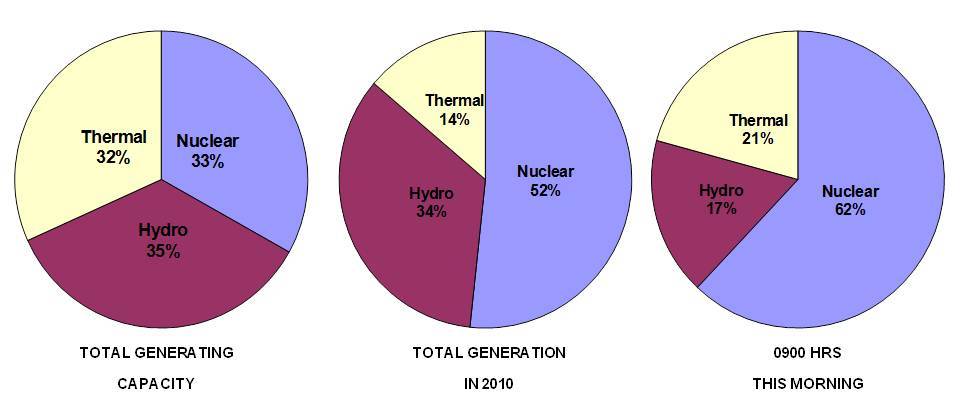
Clicking through the OPG site afterwards, I found various annual reports and statistics and what-not. Two bits of information that stood out to me were the following. First, OPG operates 3 nuclear sites, 5 thermal generating sites, and 65 hydroelectric stations. When you compare three sets of statistics - total generating capacity, total power generated in 2010, and the current power generation breakdown as of 0900 hrs this morning, you note some very interesting things:
Ontario Power Generation - Generating Capacity Comparison

In theory, the generating capacity of OPG’s three types of facilities is roughly equal - they’re each between 6000 and 7000 MW total capacity (the 2 MW produced by the two wind turbines OPG owns don’t produce enough power to show up on these charts against the roughly 20,000 MW capacity of conventional generating plants).  However, when we look at how much power was generated over the course of the 2010 calendar year, we find that nuclear plants accounted for more than half of production, and thermal plants for less than 1/6th.  This demonstrates, among other things, that the full-time availability and utility of nuclear plants is such that they are the best suited to providing base-load power, augmented as necessary by other means; and that all other things being equal, “carbon producing” electrical generation accounts for only a small proportion of OPG’s generated power.  Indeed, 2010 was an anomaly.  Hydro generation was lower than usual due to the dryness of the year; according to OPG’s annual report for 2010, low reservoir levels led to less power than usual being produced from its hydro stations.  This also, incidentally, caused a serious drop-off in revenues, since hydro-electric power has by far the lowest cost per MWh produced (because, amongst other reasons, the “fuel” is free).
Comparing these charts to the figures from 0900 hrs this morning shows yet another picture: most of the time, nuclear power meets most of the baseline load, with hydro largely held in reserve due to the need to conserve water in reservoirs, and -on days when a high load is anticipated - thermal plants operating and ready to increase production as demand picks up. Indeed, in the 30 minutes since I started writing this message, OPG’s total production went from 9260 MW to 10111 MW - 851 MW, a 9% increase, and roughly the equivalent of a couple of large nuclear reactors or a whole coal-fired generating station. If today is anything like yesterday, peak demand for Ontario is likely to reach about 24,000 MW, of which OPG will supply roughly 2/3, or about 16,000 MW. Supplying this much power will take all of OPG’s nuclear capacity (which it is already pumping out - 6156 MW as of this moment, which is 93% of its installed capacity), all of its thermal generating capacity (which has increased by 50% to 2396 MW since I last looked at it 20 minutes ago), and most of its hydro capacity.
Why detail all of this? Well, because of the second bit of data you find on the OPG site, which is the fascinating fact that the Ontario government still intends to prohibit using coal to produce electricity as of 2014.
The arithmetic is simple: OPG cannot meet the daily demand load without thermal generation. It is currently trying to convert thermal plants to alternate fuels (i.e., natural gas, which as the Yanks have found out is much more expensive than coal to burn for electricity, and which - being methane, or CH4, still produces a molecule of CO2 for every molecule of gas burnt), and it is both refurbishing reactors and building new hydro facilities, but these will not be on line by the time the coal plants are supposed to be shut down. According to Queen’s Park, the shortfall will be overcome through “efficiencies” and “green power”. On the “green power” front that massive 2 MW of “green” capacity from OPG’s two wind turbines doesn’t comfort me all that much; and if enough people suddenly start taking advantage of the program to install solar photovoltaic panels to sell power to OPG for 8 times what OPG can sell it to customers for, we’re all going to go broke that much sooner. You don’t need graduate courses in microeconomics to understand that government-subsidized solar power is a classic pyramid scheme; it’s awesome for the first few folks who manage to get in on the deal, but the last ones - in this case, the tax-paying consumers - end up taking it in the shorts.
As for efficiencies, I don’t see air conditioners (or any other major appliance, for that matter) becoming in the next three years so efficient as to use only 1/3 as much electricity to do the same job. Motors are pretty efficient already, and believe me, if somebody were to suddenly build a scroll compressor that provided 3 times the motive power for the same amount of electricity, he’d be able to buy and sell Bill Gates inside of a year.
Is this important? Well, according to the BBC, this week’s heat wave has resulted in 22 deaths in Canada and the US. Of course, during a similar heat wave in July 1936, according to an Oregon paper (the Bend Bulletin), more than 3300 more people died in 86 cities in the US than during the same period the previous year.  

(from The Bend Bulletin, 15 July 1936)

Naturally, this kind of weather phenomenon represents an extreme, and it’s possible to adapt to it.  These days we have air conditioning - even 78.3% of those Americans classified as “poor” by the US Government have air conditioning.  To see what happens during a heat wave when you don’t have air conditioning, you only need to look back to 1936 - or to 2003, when 15,000 French citizens died during an August heat wave.  According to the New York Times, “The victims were generally found inside apartments, houses and hotels. In virtually every case, there was no air-conditioner.” (NYT, 22 Aug 03).  There are many reasons that North Americans consume roughly twice as much power per capita as Europeans.  One of them is that our weather is much worse, and we like living through it.

Meanwhile, as of 1130 hours today, here’s the OPG generation picture: 

Notice how thermal generation had to increase to meet the rising load?  What would happen if that thermal generating capacity wasn’t there?  Making up 2396 MW using wind power, at an assumed capacity factor of 25%, would take 4800 full-scale 2 MW turbines, each of which costs about $5M USD to install (total installed cost: $24B).  Except that, as CTV News reported earlier this week, when it’s really hot the wind doesn’t blow.  According to IESO, the Independent Electricity System Operator, three days ago, on 19 July 2011, when Ontario’s total electrical consumption peaked at more than 23,000 MW, Ontario’s 1200 MW of installed wind turbine capacity was producing a grand total of 10 W of power.  That’s “Watts”, not “Megawatts”.  That’s less than one-millionth of one percent of installed capacity.  It’s not quite enough power to light a single David Suzuki-endorsed compact fluorescent bulb.
In a heat wave, air conditioning can mean the difference between mild discomfort and mass death.  Air conditioning requires compressors.  Compressors are powered by electricity.*  So, are those coal plants likely to close on schedule?  Well, that depends on how much politicians enjoy hearing from constituents enduring blackouts when the humidex is 47.  If the plants do close and their generating capacity isn’t replaced by an equal amount of equally reliable generating capacity, then we’ll be buying power at a premium from whomever has excess power to sell - for example, the Americans, who get more than 50% of their generated electricity from coal-fired plants, something that isn’t going to change this century unless somebody manages to figure out fusion.  Thanks to the recession, the US also has some excess capacity.  Or maybe, just maybe, people will start to wonder whether saving the planet from global non-warming is worth crippling our civilization.
Or maybe they won’t.  Heck, at one time, the auto-da-fé must’ve seemed like a good idea.  Unless of course you were the one tied to the stake.
Cheerio,

//Don//
*Technically you can run a heat engine with just about any energy source - even by directly burning fuel.  Propane-burning refrigerators used to be quite common.  But burning fuel to run an a/c to cool your house would be somewhat counterproductive.

Thursday, July 12, 2012

18 July 2011 - Rai Stones and the Debtly Hallows

Colleagues,

Last week witnessed a defining moment in the cultural history of the West.  Two small bands of dedicated idealists banded together in final, desperate attempts to grapple with and defeat waxing menaces to the freedom and well-being of their respective worlds.  The results were, regrettably, quite different.  In the wizarding world, Harry Potter and his comrades kicked Voldemort’s undead tuckus, killed Bellatrix Lestrange, and restored peace, order, and mangled Latin to the galaxy.  In Washington, in stark contrast, Congressional representatives and the White House failed to find common ground on dealing with budgetary reductions and debt limits, prolonging the condition of petrificus totalis presently afflicting the US economy, and condemning future generations to de facto membership in the Debt Eaters. 

One of the key kerfuffles on the margins of last week’s debt drama in Washington was an engagement between Ben Bernanke, the Chairman of the Fed, and Rep. Ron Paul, perennial presidential candidate.  Rep. Paul asked Chairman Bernanke a simple question: “Is gold money?”  And Bernanke, for a good ten seconds, said nothing, before eventually gabbling out the official administration line that of course, it was not. 

The price of gold immediately shot up by about $40 an ounce.

Think about that for a second - “Gold is not money.”  So much for 6000 years of human history.  I was reflecting on this surreal exchange during a hosting exercise yesterday.  With a number of in-laws visiting from across the pond, I could think of no more fascinating, touristy-type thing to do than to inflict upon them a tour of the Royal Canadian Mint.  I like the Mint; more to the point, I like the idea of the Mint.  If economics are the lifeblood of any civilization, then national mints serve the role that used to be played by the Red Cross, imposing a thin patina of order on what would otherwise be currency chaos. 

Chaos isn’t always bad, of course; in bygone eras, money was a far less abstract thing.  If you’ve read Barbara Tuchman’s A Distant Mirror (her chronicle of the ‘tumultuous’ 14th Century, told from the perspective of Enguerrand de Coucy, 7th Sieur of that impressive ruin that overlooks the Picardy countryside), you may recall an introductory disquisition on the nature of money some seven hundred years ago.  Currencies, standards, rates of exchange and even names of coins were often so mutable and so imprecise that there was little point, in her view, in trying to arrive at some modern equivalency of what this rent or that ransom amounted to in today’s gelt.  Europe dealt in shillings, pence, pounds, crowns, guilders, florins, bezants, shekels, sovereigns, talents, livres, louis, dollars, ducats, piastres and even the occasional chunk of Viking hacksilver.  Goods - particularly highly valuable goods like precious stones, spices, church plate, holy relics and the like - served as coinage as well.  Letters of credit and exchange were only beginning to be used - and it was only with their arrival that the concept of a redeemable financial instrument came into vogue.

Standing in the Mint and staring at a 300 kg rolled bar of 24-carat Canadian-made awesomeness, you can see the attraction.  Gold is pretty.  It’s heavy.  It’s mutable, malleable, and ultimately fungible - today’s gold candlestick could be tomorrow’s gold coins and vice-versa.  Gold was soft enough to strike easily, and also soft enough to allow the practice of clipping - both the unofficial sort carried on by crooked merchants and money-changers, and the official sort engaged in by kings and princes looking to expand their purchasing power, at the risk of debasing their currency.  It’s one of the reasons that coins came first to be edged, and later to be rimmed (the other reason being to increase lifespan by protecting the images on the face and obverse).  Later, alloying gold with baser metals became the rule. 

Clipping, thinning and alloying all debased the currency.  The whole idea of a debased currency is an intriguing one, isn’t it?  In an age when the value of money lay in the quantity of metal making up the coinage - as it does in the investment coins struck by mints these days, which are worth nothing more than their mass times the daily commodity price for the metal of which they are made - you could only ‘debase’ a currency if its purchasing power were based on its face value rather than its weight, no?  A clipped or especially thin shilling would be a problem if you considered that value lay in the metal, because the mass of, say, fifty clipped shillings would be less than the mass of fifty newly-minted ones.  It wouldn’t be a problem if shillings, however, were only a representation of a promise by the crown to redeem them for a given amount of some commodity (e.g., gold).  Except for one thing: the practice of clipping by the crown was instituted as a means of increasing the crown’s purchasing power.  It resulted in more coins going into circulation, which resulted in - of course - inflation.  A clipped shilling meant that no matter how you looked at money - whether as a mass of precious metal or a representation of redeemable value - you were going to have to line up more coins to buy the same loaf of bread.

One thing leads to another, and looking at those coils of gold - each one of which, at today’s prices, would be worth about $18,000,000 - got me thinking about another form of currency that, although not quite as fungible, was roughly as easy to transport, and a good deal more pragmatic than gold: the limestone Rai coins of the Yap islanders.


Figure 1 - two Bits, to a Yap islander

No, I’m not kidding.  For those whose grandparents didn’t have a stack of well-thumbed 70s-era National Geographics near the clawfooted cast-iron bathtub, the Yap islanders, lacking a source of precious metals or other materials to serve in the stead of valuta, canoed hundreds of kilometres across the open ocean to limestone quarries on Palau.  There they cut and decorated enormous stone wheels, some as large as 10-12 feet in diameter and weighing several tons, pierced them for carrying poles, and rafted them back to Yap to serve as currency. 

The neat thing about the Rai stones (an American anthropologist, William Henry Furness III, writing in 1910 called them ‘Fei’ in his book, The Island of Stone Money) was that they didn’t have to be mobile to be useful.  In fact, their immobility, which made them impossible for even several men to move by themselves, served as the equivalent of a bank vault.  Rai stones may even have been the first form of fiat currency.  Furness, for example, tells about the ownership of stones changing hands, for example as a dowry or in payment of a debt, without ever having to move.  The exchanged stone would simply remain on the former owner’s property - but all would know who the stone now belonged to.  Ownership was never in doubt.  One of the more extreme examples was the loss of a particularly valuable stone during shipment in a storm.  Because the loss had been no fault of the owner, and because the boat’s crew attested to its “exceeding value”, the fact of it being sunk in a few hundred feet of water was deemed to have no impact on its purchasing power; it remained, according to Furness, “as valid as if it were leaning visibly against the side of the owner’s house...”

Furthermore, the value of the stones was considered increased if their manufacture was especially artistic, or if they had been transported by an especially famous individual or crew, or - and this is interesting - if anyone had died in producing or transporting them.  This variability in value of the stones reinforces the idea that they were more analogous to investment properties than to currency as such - although from a practical perspective, other than the fiat nature of modern currencies, there isn’t really much difference between a concrete investment property like a giant rock, and a piece of gold, or a piece of money.  You see, value isn’t an absolute - it’s an agreement between purchaser and seller.  Value is set by the act of sale.  MPAC - the Municipal Property Assessment Corporation - might evaluate your house at a certain amount, but its value is what someone will pay for it.  Same thing for your services - your time is worth what people are willing to pay for it.  That’s a thought destined to keep some of us awake at night.

To the Yap islanders, ownership of a Rai stone gave you access to its value, i.e. its purchasing power, regardless of where it was.  The rocks had no intrinsic worth; the labour that had gone into creating and transporting them was a sunk cost, and the resulting product could not be used for anything at all.  Too big for a paperweight, too round for a foundation...apart from the Germans and Japanese, who used the stones for anchors during the Second World War, they were good for nothing whatsoever.  Their value lay only in the agreement between the islanders that they had value.  Milton Friedman, in a 1991 paper on the stones, recounts a story about how the German occupation forces in WWII tried to get the islanders to improve the footpaths on the island into roads that would be useful for vehicular traffic.  They couldn’t pay the islanders, because they didn’t use Western money, and no other form of inducement could be found...until some bright chap hit upon the idea of sending representatives around the island to paint black crosses on the most valuable Rai stones, indicating that these now belonged to the occupiers.  This “fine” did the trick; the islanders improved the roads, and the Germans took the paint off the stones. 

Here’s a question for you: did the painting of crosses on the stones constitute theft, a fine, extortion, or a tax?  And is there really a difference?

In his paper, Friedman - a die-hard opponent of the gold standard - offers a modern analogy in which the New York Federal Reserve Bank (the one Jeremy Irons robbed in Die Hard 3), in response to concern in 1932-33 by the French government that the US was going to abandon the standard gold price of $20.67 an ounce, agreed to sell gold to France - a classical example of fiscal nervousness leading to currency conversion into precious metals.  France, unwilling to risk shipping a big pile of gold across the ocean, asked the Fed to simply leave the ingots in New York and mark them appropriately.  The Fed put France’s newly-purchased gold into separate drawers and labelled them, indicating that they were now French property.  For all that it mattered, Friedman remarks, “they could have done so by marking them with a cross in black paint, just as the Germans did to the stones.”

What's fascinating about the story of the "French" gold is that the news of the transfer affected the markets exactly as you would expect such an event in a gold-standard system.  France now owned more gold, so the franc grew stronger, while newspapers bemoaned the “drain” on US gold stocks, leading to a weaker dollar, and contributing to the banking panic of 1933...all despite the fact that the gold never left US custody.

Given such practices, what’s the difference between gold and Rai stones?  What’s the difference, in fact, between Rai stones and your pension fund or your RRSPs?  “How many of us”, Friedman asks, “have literal personal direct assurance of the existence of most of the items we regard as constituting our wealth?” Well, there are a few differences between rocks and modern investments.  For one thing, it’s harder for a government to devalue your investments by suddenly flooding the market with 800 billion four-ton rocks, if only because quarrying massive rocks is a lot harder than churning out greenbacks - even virtual ones.  And when the debt crunch finally comes, it’s a lot harder for the government to cart off a four-ton rock that’s leaning against the wall of your house than it is to purloin - even temporarily - monies stored electronically by citizens, or monies owed by the government to the citizenry.  These are pretty much the core arguments of those who advocate a return to some form of a gold standard: that eliminating the standard may have solved some problems, but doing so definitely enabled governments to play a lot faster and looser with the nation’s finances.  Once you’re no longer obliged to have a gold ingot in your vault or a big rock in your back yard to back up your claim to “wealth”, then you’re pretty much free to say that you have as much “money” as you want to have. 

Friedman’s conclusion is that the Yap and US/France examples illustrate the importance of “unquestioned belief” in monetary matters.  Fiat currencies are about confidence - confidence that the instrument of currency you accept in exchange for a debt today will be worth the same tomorrow.  Confidence, in short, about the future.  Which is why, when I took the in-laws to Fort Henry last week, the sign in front of the ticket booth said “US Exchange Rate - $0.95”.  Confidence in the future of the US dollar, which is to say the future of the US economy, isn’t all that high these days - and the thumb-fingered bumbling shenanigans in Washington aren’t doing much to dispel the worries that are pushing the dollar down and keeping unemployment stagnant.  Nor, for that matter, are long, baffled silences from senior administration officials when they’re asked fairly basic questions about what money is, and isn’t. 

Is gold money?  Technically, maybe not.  But without confidence in the future, neither are dollars.  To put it another way, if government debt and unemployment keep spiralling upwards, what would you rather have in your pocket - 1600 greenbacks, or an ounce of gold?


Figure 2  - the best of both worlds: Canada’s Rai coin, one of five: 
100 kg of 99.999 percent pure gold (worth $6.4M at noon today)

Gold keeps going up in price, as it does every time confidence in fiat currencies begins to decline; after all, scarcity, as with Rai stones, adds to value, and there’s only so much gold in circulation, and so much being produced annually.  If it gets too pricey, we might have to start looking for other things to invest in.  Unless our cousins down south get their fiscal house in order, we might not be all that far from a world where the dollar, which according to Bernanke is money, becomes useless; and gold, which according to Bernanke isn’t money, becomes the exchange medium of choice simply because it’s impossible to debase because without transmutation, we can’t make any more of it.

Who knows? The way things are going, at some point 8000 pounds of limestone on the bottom of the Pacific might start to look like a sound investment opportunity.

Cheers,

//Don//

Reference: Milton Friedman, “The Island of Stone Money”, Working Papers in Economics E-91-3, The Hoover Institution, Stanford University, February 1991.

Wednesday, July 11, 2012

Skepticism and evidence

There's a debate going on over at Watt's Up With That involving a paper discussing the uses of terms like "denier" and skeptic.

I threw my two cents into the pot:

-----------------

Donald A. Neill says:


If you’re not a skeptic, you’re not a scientist. A skeptic is someone who wants to see evidence, and who values it above all other things. So is a scientist.

In science, there is no higher law than evidence. All things give way before it. Models and speculation, no matter how elegant (or how deeply believed-in) cannot substitute for observed data. Why else did humanity spend untold billions to build the LHC? Why did we orbit the Hubble Telescope? Why are there robots on Mars? Why is Voyager leaving the Heliosheath…if not in order to obtain evidence? Why bother, if our guesses are good enough?

“Denier” is an ad hominem term. So is “warmist”. They are debating techniques, and base ones at that. They have no place in science. All that matters is where one stands on the evidence. At present, there simply is no statistically significant observational evidence demonstrating a causal linkage between CO2 (let alone human-produced CO2) and global climate. Temperatures are not responding to increased CO2 concentrations as the models say they should. Nor are predicted phenomena being observed. Sea level rise is not accelerating. Ice is not disappearing, much less “death-spiralling”. Predicted tropospheric hot spots are absent. There is no increase in storm frequency or severity. Ecosystems are not perishing. Entire species are not disappearing. None of the model predictions, no matter how modest or how lurid, are being borne out.

On the other hand, lobster is getting cheaper. Okay – who predicted THAT?

Meanwhile, as to the notion that “every reputable scientist agrees that the earth is warming”…well, what does the EVIDENCE say? Anthony has spent the better part of the last several years demonstrating that we cannot trust the US land-based temperature record because the instruments are poorly sited and maintained. Steve Goddard has shown that we cannot trust it because of illogical manual alterations to that record by GISS. The UHI has not been adequately quantified or understood. The UEA admits that their original temperature data no longer exist. Four-fifths of the measuring stations disappeared over the past couple of decades. I don’t disagree that we assume/think the Earth has warmed since the end of the Little Ice Age (fancy that!) – but from a point of view of the data that we do have, there are sound scientific reasons to be skeptical about the EVIDENCE that it has warmed. For crying out loud, this very site just published yet another peer-reviewed study showing that the Earth has actually cooled since the Roman Warm Period!

Stop and think about the stakes for just a moment. We just spent decades and tens of billions of dollars trying to figure out if our models were right or wrong about the Higgs Boson. But if the models were wrong, all that would have happened is that a bunch of physicists will spend the next few years being very happy and very busy. The lives of average people will not be affected one jot or tittle. But if we’re wrong about the AGW thesis and the models based upon its assumptions, then we are going to drastically alter the trajectory of human technology at enormous (probably unbearable) expense for no logical purpose, deepening the catastrophic financial straits in which the developed states find themselves, and preventing developing states from using cheap energy to pull themselves up by their bootstraps. The human cost of making the wrong move will be incalculable.

That’s the sort of step you don’t really want to take until you’re confident in your evidence, wouldn’t you say?

----------------------

My comment was generally well-received. One chap took issue with my analysis, arguing that the term "denier" has far greater negative connotations than the terms "warmist" or "alarmist".

No argument there, obviously. But that's only a matter of degree. My point is that both terms are ad hominem arguments, which makes this a matter of kind rather than one of degree. Ad hominem arguments - arguments literally "against the man", rather than those that engage data, method, logic or analysis - have no place in a scientific debate, regardless of whether they are venomous or benign. If you engage an issue on any basis other than its author's observations, evidence and reasoning, then you are not doing science, you are doing something else.

This is the problem that genuine skeptics face regardless of which side of the debate they may be on. When you try to focus solely on data, the "white noise" of ad hominem nonsense from people who do not understand science, or from people who do but who consciously decide to ignore it, tends to obscure and overwhelm rational thought. 

In my view, the latter are far worse than the former. The ignorant can be taught; it's those who understand science and who still consciously decide to betray its most fundamental precepts that are the gravest threat to reason, the Enlightenment, and the future. Idiots deserve our pity; traitors, our contempt.

Thursday, July 5, 2012

8 July 2011 – Mmmm, incapacitating!

Colleagues,

Bit of a shocker this week as a police officer who intervened in what seemed to be a domestic dispute ended up with a face-full of bear spray.  It seems that the perpetrator had flagged the officer down whilst chasing another man down a street in Barrie shortly before midnight Wednesday.  When the two caught the fleeing man, the first man cut loose with the chemicals.  Unfortunately for him, he hit the police officer with it.

Unfortunately for the officer, too. Bear spray is pepper spray, more or less - it just tends to come in concentrations, quantities and delivery systems less appropriate to subduing greasy hippies screaming anarchist slogans and more suited to discouraging a 500-pound ursine predator from killing and eating you. Some of the more popular commercial formulations contain relatively high percentages of the active ingredient, oleoresin capsaicin (OC to chemical weapons aficionados), and come in pressurized delivery canisters containing hundreds of grams of the concentrated pepper extract dissolved in alcohol or some other organic solvent. Instead of having dispersal mechanisms designed to dispense a fine mist of agent, bear sprays tend to have nozzles designed to hit a relatively small target up to thirty feet away. This is necessary because aggressive or hungry bears often need a lot of persuading, and unless you hit them in the eyes, nose and mouth, they probably won’t even notice the stuff until it’s too late. For you, that is.
Figure 1 - Bear Sprays and how they work

Figure 2 - Oleoresin Capsaicin: structural formula

OC, incidentally, is a magnificent empirical proof of evolutionary adaptation.  Birds do not have the molecular receptors for capsaicinoids, and thus feel no burning sensation when they ingest the peppers.  Birds also don’t have molars.  Bird feces are the primary means of spreading chilli seeds.  Mammals, by contrast, have molars, which destroy the seeds by grinding - and mammals also have capsaicinoid receptors, meaning that they feel pain from ingesting OC.  Production of OC is a defensive mechanism that evolved to deter only creatures that ingest and destroy chilli seeds, not creatures that ingest and then spread them.  It’s fascinating to note that tarantula venom also activates precisely the same pain pathways - an example (one of the only ones known) of a plant and an animal evolving separate chemical mechanisms for targeting the same mammalian vulnerability.

How hot is OC, anyway?  Well, that’s a good question.  Pain measurement is a science still in its infancy, and unlike other systems of measurement, there is no precise objective scale; pain, in other words, is a subjective experience, and is different for everyone.  The piquance of chili peppers is measured on the Scoville Scale, using Scoville units (SHU).  The scale is 99 years old this year, having been invented by Wilbur Scoville in 1912, although modern measurements, using concentrated pepper extract dissolved in organic solvents in liquid chromatography, have come a long way since the days of laudanum and radium pills.  Scoville’s original method was entirely subjective; capsaicin oil from various different peppers was dissolved in alcohol and the strength of solution gradually increased until heat was detectable orally by a panel of five tasters.  The dilution ratio at which heat is first detected is the Scoville rating.  Using this system, sweet or Bell Peppers have no measurable piquancy at all (and thus a Scoville rating of zero), while the hottest of commercially cultivated peppers, like Habaneros or Scotch Bonnets, have a rating of around 200,000.  In other words, the capsaicin oil that these peppers produce must be diluted by a factor of 200,000 before their heat becomes undetectable by humans.

Figure 3 - Red Savina Habanero pepper (ripe)
The hottest naturally occurring capsaicin oils are produced by the Red Savina Habanero pepper, which has a Scoville rating of about 580,000.  Pepper spray, however, uses either concentrated extracted capsaicins from the hottest peppers available, or synthetically-produced capsaicinoids.  Here’s a comparison.

·         Banana peppers: 100-500 SHU

·         Jalapeno peppers: 3,000 - 6,000 SHU

·         Habanero peppers: 100,000 - 350,000 SHU

·         Red Savina habanero peppers: 350,000 - 580,000 SHU

For those who want to kick it up a notch and meet the Space Coyote, there’s the Naga Viper, the Naga Jolokia or Ghost Chili, the Trinidad Scorpion Butch T, and the appropriately named Infinity Pepper, all of which clock in at 855,000 to 1,463,700 SHU.  Chilly Chillies, a specialty hot stuff company which used to have a shop on Sussex Street in Ottawa in front of the US Embassy, used to sell concentrated Infinity Pepper oil in a small glass phial with a wax-sealed stopper shaped like a skull.  You had to sign a waiver to buy it.  My eyes started watering every time I went in there.

Beyond this point we cross into the realm of law enforcement-grade pepper spray - pure, concentrated capsaicin oil either extracted from the hottest natural chillies, or produced in laboratories by organic synthesis.  Pure OC comes in at around 5,000,000 on the Scoville scale.  One cup of this stuff dissolved in an Olympic-sized swimming pool of alcohol would still be detectable.  From the point of view of getting a face-full of highly concentrated OC, the difference between natural Habaneros and cop-quality Pepper Spray is like the difference between a 5 kt or 5 Mt explosion - it doesn’t really matter how big the bomb is if you’re at ground zero.  Where it does matter is when you’re hosing down a crowd, because even the slightest hint of mist from a dispenser putting out 5,000,000 SHU spray will be enough to temporarily incapacitate whoever’s on the receiving end, whether it’s some angsty teenage anarchist with an iPhone, an iPod, an iPad, an autographed copy of Naomi Klein’s NoLogo in his designer backpack, Nikes on his feet, and a "Down With Capitalism" sign scrawled in orange Highlighter on a Wal-Mart box...or an angry bear looking to score lunch.

Speaking of the NoLogo crowd, if you’re planning on crashing the next G8 summit, you should know that, like CS, OC isn’t soluble in water and can’t be washed off no matter how hard you try.  Rubbing affected areas merely pushes the oil into the skin, prolonging the discomfort.  Anarchist groups have circulated recipes for home-made “pepper spray decontaminant” (including ingredients like Maalox, lidocaine gel and milk) but none of these really work.  Ambulance attendants report that washing affected individuals with baby shampoo seems to work well - but in fact any soap would work against the oil, and baby shampoo simply has the virtue of being low-irritant on areas most likely affected by OC, like the eyes and other mucous membranes (Johnson and Johnson’s “No More Tears” might be a good bet).  Unlike CS, OC isn’t deactivated by sodium metabisulfite - but unless you’re a passionate home wine-maker, you probably don’t have any of that around the house anyway.

Putting on my CWC-bore hat for a minute, it’s worth noting that OC, like CS (“tear gas”) isn’t on the Schedules of Chemicals and thus isn’t “controlled” per se by the Chemical Weapons Convention.  However, like CS, it does meet the definition of a “riot control agent” (RCA) under paragraph 7 of Article II (“Any chemical not listed in a Schedule, which can produce rapidly in humans sensory irritation or disabling physical effects which disappear within a short time following termination of exposure”), and thus is subject to declaration requirements under Article III, paragraph 1(e) of which requires each State Party, “with respect to Riot Control Agents”, to “specify the chemical name, structural formula and Chemical Abstracts Service (CAS) registry number, if assigned, of each chemical it holds for riot control purposes.”

Which introduces something of a conundrum.  You see, this declaration requirement does not include RCA held for “law enforcement purposes”, and the language in the “purposes not prohibited” definition (paragraph 9 of Article II) refers to “law enforcement, including domestic riot control purposes” as a “purpose not prohibited”.  In other words, the Convention text specifically contemplates “domestic riot control” as a subset rather than the totality of “law enforcement” (this was done to allow member states to continue to use chemicals for judicial execution), which means that there is the acknowledged possibility that States Parties may use OC, CS and other RCA for “law enforcement” purposes other than “domestic riot control”.  One example would be, subduing unruly arrestees.  The declaration requirement also does not include “military training purposes”; and since the Canadian Forces (to take one example) do not have “riot control” as a specific defence task, technically speaking we do not have to declare any of the tear gas or other RCA we hold (e.g., OC held by the MPs, or bear spray held by range control authorities at rural military bases), so long as we don’t use it, or intend to use it, as a “method of warfare”, which is prohibited under paragraph 5 of Article 1.

Of course, none of this means you can blast a cop in the face with bear spray and just walk away.  The fellow in the story cited above has been charged with possession of a dangerous weapon and (surprise, surprise!) breach of probation.  All of which, to paraphrase a former giant of Canadian politics, means that the best place for pepper is probably on your plate.

Piquantly yours,
//Don//