Showing posts with label Energy. Show all posts

Friday, December 14, 2012

Apollo 17 - 40 years, and still waiting

Colleagues,

40 years ago today, Gene Cernan was the last human to walk on another planet.


It had only been 11 years since Alan Sheppard had flown into space for a grand total of five minutes, atop a glorified bottle rocket. Cernan and his crewmates Ron Evans and Harrison Schmitt spent three days on the Moon.

To quote Tom Hanks (as Apollo 13 commander Jim Lovell), "It's not a miracle.  We just decided to go."

Man's reach must exceed his grasp, else what's a heaven for?

Monday, December 10, 2012

Bad Gas

Colleagues,

Last year, when the EPA announced its new fuel efficiency standards for automobiles, I penned this little analysis. I thought I'd post it now, seeing as how Canada, courtesy the irrepressible bureaucrats at Environment Canada, has decided to follow Obama down the rabbit hole.

--------------------------------------------


Colleagues,

Just a short note today to signal Wednesday's announcement by the White House of new EPA regulations that will require automobiles, by 2025, to achieve a fuel efficiency standard of 54.5 miles per gallon (Note A).

…yeah, okay then.  For the record, the auto industry, and the internal combustion engine that is it's principal component, is over 100 years old.  Automakers have been attempting to improve fuel efficiency for pretty much the whole of that period.  How far, you ask, have they gotten?  Well, according to Ford, the top fuel efficiency of the Model-T - the Flivver, the infamous Tin Lizzie, mass production of which began in September of 1908, a little over 104 years ago - was 25 MPG.  The highway fuel efficiency rating of a 2012 4WD Ford Fusion is…25 MPG.  The latter is naturally a little more comfortable, what with air conditioning, a CD player, and cushioned as opposed to wooden seats, but the fuel efficiency is pretty much the same.

Think I'm joking?  Let's go to the data.  In 1978, a 6-cylinder Jeep CJ got 18.1 MPG on the highway.  In 2011, a Jeep Patriot 2WD, after 33 years of gas crunches, climbing gas prices, and EPA efficiency targets, got 29 MPG on the highway.  Not interested in SUVs?  In 1978, the top fuel efficiency for a production car was 35.1 MPG by the Chevy Chevette (it beat the famously fulminatory Pinto by half-a-MPG) with 35.1 MPG on the highway.  The Chevette, for those of you who never got to see Star Wars in a theatre, was a two-door hatchback weighing in at less than a ton.  A comparable vehicle today?  How about a Honda Civic?  It gets 36 MPG.

I expect you see the pattern.  Let's make it graphical.  Here's US Government data on the MPG characteristics of the current suite of 2012 production vehicles on offer.  Along the Y-axis we have highway fuel efficiency in MPG; along the bottom, vehicular class, as follows: 1=2-seaters, 2=minicompact, 3=subcompact, 4=compact, 5=midsize cars, 6=large cars, 7=small station wagons, 8=midsize station wagons, 9=large station wagons, 10=small 2WD pickups, 11=small 4WD pickups, 12=standard 2WD pickups, 13=standard 4WD pickups, 14=cargo vans, 15=passenger vans, 17=2WD special purpose vehicles, 20=2WD minivans, 21=4WD minivans, 22=2WD SUVs, and 23=4WD SUVs.


2015 is three years away.  Which cars meet the EPA's mandated fuel efficiency targets for that year?  Well, using composite city-highway milage, there are 8 that do (they don't all show up because of overlap on the graph).  Here they are:  The Toyota Prius, the Prius wagon, the Honda Civic Hybrid, the Toyota CT200H, the Ford Fusion Hybrid, the Ford Lincoln MKZ hybrid, the Chevy Volt, and the Toyota Scion iQ.

Guess what they all have in common?  That's right.  They're all hybrids.  Notice something else?  They're all small.  Even the one that nominally rates as a wagon - the Prius v - isn't exactly a battleship.  In other words, it's impossible for today's automakers to make a car that meets the EPA's 2015 fuel efficiency standard without making it both small and a hybrid.

What if we look just UNDER the EPA standard?  Well, the Volkswagon Passat gets 35 MPG combined (it gets 43 MPG on the highway, which is better than every hybrid vehicle except the Prius and the Civic hybrid).  Moreover, it's the same size as the Prius (bigger than the Volt or the Civic).  So what's the difference?  It's in the MSRP, amigos.


2012 Volkswagen Passat Sedan - base price $19,995

2012 Chevy Volt - base price $41,545


With that kind of price differential, who'd buy a Volt?  Well, would it change your mind if you knew that Dalton McGuinty would give you back $10,000 if you did? (Note B)  That still leaves you paying a $12,000 premium for a smaller vehicle.  At a difference in fuel efficiency of only 5.4% (combined; the Passat is actually 7% more fuel-efficient than the smaller Volt in highway driving), it's going to take a long time to make up $12K.

Now, bearing in mind that the fuel efficiency of the Model-T 100 years ago was 25 MPG, take a look at how many production vehicles currently meet the EPA fuel efficiency target for 2025.  The answer is "none".  The only one that even comes close is the Prius, and it's still 10% shy of the gold standard.  In fact, the only vehicles that presently meet that target are the all-electric Volt and the Tesla - all-electric vehicles that don't burn any fuel at all.

NOW do you get the picture?  The purpose of the EPA's 2025 target is to eliminate the internal combustion engine.

Here's my question: just how likely do you think that is?
 
//Don//
 
Notes

A) [http://www.nationalreview.com/planet-gore/283363/epa-2025-pigs-will-fly-henry-payne]
B) [http://gm-volt.com/2009/07/17/canadian-government-gives-10000-chevy-volt-subsidy-angers-toyota/]

---------------------------------------------

Just to drive the point home (so to speak), the average increase in fuel efficiency for cars over the past century has been zero. The Ford Fusion gets the same MPG as a Model T. But Obama's EPA - and now Environment Canada - expect auto manufacturers to achieve a 100% increase in fuel efficiency by 2025. That's thirteen years away. The laws of physics haven't changed. The only possible conclusion - the ONLY conclusion - is that this is an ideologically-driven attempt to regulate the internal combustion engine out of existence.

And why? As an auto-da-fe; an act of faith to propitiate the Gods of Carbon Dioxide.  As a little reminder, there has been no statistically significant warming for 16 years despite a 10% increase in atmospheric carbon dioxide concentrations. There is no justification in science or reason for the anthropogenic global warming thesis - and thus no justification in science or reason for costly, pointless government regulations aimed at outlawing one of the fundamental technologies that drive the western world.

A few more words on the Canadian take on this little endeavour. Here's how the government plans to sell the standards change to Canadians.

"These new regulations improve fuel efficiency so that by 2025 new cars will consume 50% less fuel and emit 50% less GHGs than a similar 2008 model, leading to significant savings at the pump," said Environment Minister Peter Kent. "At today's gas prices, a Canadian driving a model year 2025 vehicle would pay, on average, around $900 less per year compared to driving today's new vehicles."
 
Awesome. So at a savings of $900 per annum, it'll only take the average Canadian family thirteen and a half years to pay off the extra $12,000 that their Volt will cost them. Assuming, of course, that they didn't finance the difference, and assuming that the Ontario government can afford to continue subsidizing every Volt that's sold to the tune of $10,000 a pop.

Ontarians buy 45,000-50,000 new passenger cars per month. That's 540,000 - 600,000 new cars per year. If everyone buys Volts - and once these new regulations are in force, that's all that anyone in Ontario will be allowed to buy - then the Ontario government is going to be on the hook for $10,000 x 550,000 = $5,500,000,000 in hybrid car subsidies every year.

Ontario's budget deficit in 2012 was already $15.2 billion. These subsidies would bump that up by a third.  All to support sales of a car that can go at most 80 km on a 10-hour charge, provided it's not too cold.

Can't politicians do arithmetic?

Thursday, December 6, 2012

Doha, dear (A repeat from December 2011)


Colleagues,

In honour of the UN's annual climate alarmapalooza at Doha last week, I thought I'd reprise a little piece I wrote a year ago, after the 17th Climate Kerfuffle at Durban, South Africa - because since then, the only thing that's changed is that there is more empirical evidence than ever that the Sun controls terrestrial climate, and still no empirical evidence whatsoever that carbon dioxide - let alone the 5% of atmospheric CO2 attributable to human activities - plays any role whatsoever in twisting the planetary thermostat.

Enjoy.

---------------------------------------
The UN's annual climate conference (17th Conference of Parties, or COP) at Durban wrapped up this past weekend.  I'll spare you all the gory details; basically, delegates kicked the can down the road, agreeing to hammer out a new binding framework agreement by 2015 with provisions for greenhouse gas reductions that would kick in around 2020.  Negotiators painted this as a victory for diplomacy, climate skeptics as a victory for skepticism, and environmental crusaders as a guarantee of apocalypse.

I'm not going to rant and rail about this; I'm simply going to offer 3000 words on it in the form of three pictures.  Charts, actually.  Together, these explain the outcome at Durban.

The first one explains the problem with climate science:

 
The AGW thesis asserts that temperature responses will scale linearly with forcings, the most important of which, according to the IPCC, is anthropogenic carbon dioxide emissions.  However, anthropogenic carbon dioxide emissions account for less than 5% of atmospheric carbon dioxide - and as this chart shows, according to measured data, there is no correlation over the course of the past decade between atmospheric carbon dioxide concentration and average global temperature.  All of the arguments underlying the Kyoto Protocol, and all conceivable successor agreements, are based on linking anthropogenic CO2 to temperature - and yet temperature does not appear to respond to CO2 at all.  That's the first problem.

Here's the second problem:


The data are from British Petroleum.  That's a chart showing the CO2 emissions of the world's top 14 emitters - every country that currently puts out more than 400 million tonnes of CO2 per year.  Only three of them matter: the US (dark blue), whose emissions are declining; China (scarlet), whose emissions are skyrocketing; and India (beige), whose emissions are climbing slowly but accelerating.  Every other major emitter is lower than these three, and is showing stagnation or decline.  Accordingly, any emissions control or reduction agreement that requires reductions from the US or any other western state, but does not require significant (i.e. massively disproportionate) reductions from China and India, is utterly pointless - as is talk of any "carbon debt" owed to the "Third World".

Incidentally, activists at Durban made much of Canada's alleged "delinquency" on the carbon file.  Take a look at the data and explain to me why Canada (a delightful fuschia) is a bigger problem for the environment than, say, China.  Or India.  Or the US.  Or Japan.  Or Germany.  Or for that matter South Africa, whose emissions are at the same level as ours.  And don't be fooled by arguments about "per capita" emissions; that matters to us, but Gaia doesn't care how many people live in your country; she only cares how much CO2 you pump out.

Speaking of "carbon debts", here's the third and last chart:


This is data from Japan's Ibuki satellite, which measures carbon dioxide flux.  What is shows is the daily rate of change in CO2 flux over various parts of the planet, in the four different seasons.  As we all know, most of the world's human-produced CO2 is produced by northern hemisphere countries, because that's where most of the industry is (the only state in the above list that isn't in the northern hemisphere is South Africa).  And we see from this data that the CO2 flux changes massively from season to season.  In high summer, the northern hemisphere is a massive carbon sink.  In autumn, with the exception of the northereastern US states and parts of Siberia, the northern hemisphere is a net CO2 producer.  In the depths of winter, the northern hemisphere - except for the Middle East, the Subcontinent, and Central Asia - is a net CO2 producer; and in the spring, the northern hemisphere, except for Europe and Northeastern Canada, is a net CO2 producer.  Looks pretty simple, doesn't it?  After all, we burn more fuel to stay warm in the autumn, winter, and spring, don't we?

Well, it's not that simple. Take a look at China.  It's the only country that doesn't change colour.  Throughout the year, China is a net CO2 producer.  The oceanic bands are interesting, too; in the winter, when the northern hemisphere is producing a lot of CO2, the North Atlantic is absorbing CO2 like crazy.  This is because cold water can hold more dissolved gas than warm water.  It's also worth noting that the temperate southern hemisphere oceanic bands seem to be absorbing a lot of CO2.

Why does this matter?  Well, take another look at Canada.  We're supposed to be climate criminals - and yet it's the seasons, not human activity, that are the key determinant of our status as a net carbon emitter or consumer.  It's tempting to blame the change on the use of heating fuel, but that explanation just doesn't hold water; if you look at fuel consumption patterns for the US, fuel oil consumption peaks in the winter, when gasoline consumption troughs, and vice-versa - except that US consumers use twice as many barrels of gasoline as they do of fuel oil at any given time.  In other words, you would expect CO2 emissions to be higher in the summer time, when gasoline consumption is high, and fuel oil consumption is low; but summer is when CO2 flux over North America is at its lowest. 

The answer lies in the forests, and in photosynthesis.  When it's summer, the northern hemisphere - the boreal and temperate forest regions - becomes biologically more active and consumes more CO2 than it produces.  In the winter, photosynthetic activity declines, and CO2 emissions climb.  CO2 concentrations, in other words, seem to respond less to fuel consumption patterns than to seasonal variation leading to change in the metabolic rates of plants.

Bottom line is this: as these satellite observations illustrate, we understand an awful lot less about where CO2 comes from and where it goes than we purport to understand. Maybe the caliphs of carbon at Durban [and Doha! -ed.] ought to consider taxing states that don't grow enough trees per capita.

Yeah - can you imagine anyone from Qatar agreeing to that?

Cheers,

//Don//

Thursday, October 11, 2012

21 December 2011 – H-bombs, Santa, and the Poop Spiral of Doom

Colleagues,

The Yuletide season is upon us, and with comes the annual ritual of NORAD tracking the big guy in the red suit.  If you're so inclined, you can follow his progress here, on NORAD's on-line Santa Tracker:


As I write, we're currently 3 days and 17 hours (and some assorted minutes) away from launch.  As an Air Force brat, I've been familiar with NORAD's tracking efforts for most of my life, and I recall wondering whether Santa, like the Tu-4s that drop by from time to time, ever merited an escort.  You sort of had to be concerned about whether his IFF transponder was operating, and whether he had the right codes (which in turn makes me wonder whether Santa has to wait three years to get his security clearance updated like the rest of us so he can even be ISSUED the codes); because if he didn't, well, in an era of AIM-120s, a pilot might be cleared to engage from beyond visual range, and then it'd be Run, Run Rudolph! for real.

In today's world, however, an air-breathing intercept seems somewhat less likely.  After all, with the ground-based interceptors of the BMD system in place and operational, it might - given how fast Santa would have to be travelling in order to get through his assigned duties in the allotted time - be more realistic to forego the F-22s and simply send an exo-atmospheric kill vehicle his way.  It's worth working through the intercept from an air defence perspective, if only to get a better grasp of the nature of the problem.

Well, what are the capabilities of the system?  Assuming Santa's sleigh operates on a cold launch system (which is not necessarily true, but more about that later), his take-off probably wouldn't be detected by the Defense Support Program (DSP) satellites that watch missile fields for the thermal signature, or bloom, of an ICBM launch.  On a southbound trajectory from the North Pole, the first piece of equipment to pick up Dasher, Dancer and the rest would be the Ballistic Missile Early Warning System, from one of two stations: Clear, Alaska, or Thule, Greenland. 

Ballistic Missile Early Warning System Sites

Clear has a PAVE PAWS phased array radar system that operates in the UHF band, with two faces each giving 120 degree coverage, with elevation coverage from 3 to 85 degrees above horizontal.  At peak power (about 500 kW for the main beam) it can detect an object the size of a small car at a range of 5550 km (3000 NM).  Since that accords pretty much with a large sleigh, it's the figure we'll use.  Even if Santa has adopted stealth technology, we can assess 8 "tiny reindeer" as adding up to the radar cross-section of a small car - or 9, if it's a foggy Christmas Eve and Rudolph's on duty.

PAVE PAWS phased array radar system at Clear, Alaska

The problem, of course, is that Santa's flight profile doesn't come close to that of a ballistic missile launched from the Asian heartland, or of a SLBM launched from a sub lurking in the - let's face it - totally ice-covered Arctic Ocean.  There's never been any indication that the sleigh is pressurized, so unless he's wearing breathing apparatus, the old guy's going to have to keep it below 10,000 feet ASL.   That poses some horizon issues, but solving them is a relatively straightforward problem in geometry:

If the PAVE PAWS was capable of detection at the visual horizon, calculating its detection range D for a target at altitude X is simple.  Knowing that the polar radius of the Earth R is 6,356,752 m, and that R1 is therefore R+3077 or 6,359,829 m, then D would simply be the square root of R1 squared minus R squared, or 197,810 m - or about 197.8 km from the radar station.  However, the PAVE PAWS has a minimum detection altitude of 3 degrees above horizontal, so detection would be a little later, when the bogey was closer to the site.  I'd recalculate that for you but I don't feel that into trigonometry this morning.

With a detection range of only 200 km or so for a target at an altitude of 10,000', would there be enough time for the warning system to react?  Maybe; depends on how fast the sleigh is travelling.  From Santa's perspective, he could vastly improve his survivability by flying lower and faster.  That's the same conclusion that was reached by the designers of the B-1 Lancer bomber, the performance of which I've had occasion to witness.  It's true; the lower and faster you fly, the less time anyone watching has to find you, fix you, and intercept you.

Which brings me, in a roundabout way, to the topic of this week's message.  You think the B-1 is low, fast, and nasty?  Well, amigos, you ain't seen nothing yet.  A colleague who is also an aficionado of all things ancient and atomic brought to my attention the other day one of the historical gems from America's glorious nuclear past.  Back in the halcyon days of the late 1950s - the era that brought us the Pentomic Army and such weapons systems as Atomic Annie, the 280-mm nuclear howitzer, and the Davy Crockett, the A-bomb-firing recoilless rifle - there were no problems that couldn't be solved by judicious application of the Mighty Atom.

The Davy Crockett nuclear recoilless rifle; and the Atomic Annie 280-mm nuclear howitzer

Thing is, those weapons, crazy as they might have been (and the Davy Crockett was crazy enough that, under certain firing conditions and selected yields, its lethal radius exceeded its range), those weapons were actually deployed.  The ones that fascinate me are the ones that did make it off the drawing board, but only as far as proof-of-concept and test and evaluation stages.  The most infamous one is probably one that, although it was closely connected to military weapons research, wasn't really a Defense programme at all: Project Orion.

 Project Orion - MY kind of crazy

In a nutshell (ahem), Project Orion was a spaceship designed to be propelled by the explosion of nuclear bombs fired out of its base.  The force of the explosion against a pusher plate (equipped with, shall we say, "powerful" shock absorbing systems) would drive the ship forward.  Thousands of bombs would be needed to reach planets throughout our solar system, which required miniaturizing the weapons as much as possible.  The research aimed at miniaturizing nuclear weapons - remember, this was the late 1950s and early 1960s, when much research was put into making bombs as big and destructive as possible, leading to monstrosities like the boxcar-sized B-17 - eventually led to the nuclear artillery rounds small enough to be put into 155mm and 203mm projectiles - and to the enhanced radiation weapon or 'neutron bomb' that bedevilled the Carter Administration, and was responsible for so much Euro-angst in the late 1970s.

In between the Davy Crockett and the Orion spaceship, though, were a good many 'almost-rans.'  One of those was the Convair X-6.  Based on the Convair B-36 bomber, the X-6 was to have been propelled by nuclear reactor-driven engines.  The idea was that the plane would carry a 3 MW air-cooled nuclear reactor in the bomb bay - and a 12-tonne lead and rubber shield to protect the crew from the otherwise unshielded powerplant.  A testbed aircraft - the XB-36H - was built to trial the shielding requirements, and logged 215 hours of flight time, during 89 of which the on-board reactor was operated. 

 
Based on the results of the testing, the Convair X-6 project was scrapped in 1961.  Had the thing gone to trials, a number of problems would have had to have been overcome.  One was the weight.  The takeoff weight of the beast was expected to be 363,000 pounds - roughly the same as a 747, but decades before the 747 became a reality.  The testing facility was on the point of building a 15,000-foot runway when the programme was cancelled.  Also, there was the small matter that only the aircrew were protected against the radiation of the reactor; everything else, including the plane body and everyone around it on the tarmac, wasn't.  The nature of the problem might have been telegraphed just a little when the Air Force started advertising for pilots who were past child-bearing age.

The biggest problem with the plane, though, was the fact that the aircraft engines weren't...err...well, you couldn't really shut them off.  You see, in a real jet turbine, propulsive force is achieved by superheated exhaust expanding out the back end of the engine.  The heat is provided by burning fuel.  Turn off the fuel flow, the engines shut down.  In the X-6 concept, however, there was no fuel; the heat was supplied by the nuclear reactor.  Airflow over the reactor elements superheated the air, and the efflux from that drove the aircraft.  It also cooled the reactor, as there was no space in the plane for the hundreds of tonnes of water and other assorted cooling media associated with terrestrial or naval reactors.  The cooling provided by air rushing over the reactor elements at hundreds of miles per hour would still be needed even when the aircraft was on the ground and parked. 
 
Something of a poser, as they say.

Well, put all of these problems and capabilities together, and what do you get?  Think about it: a plane powered by a nuclear reactor doesn't really need fuel, so it can fly pretty much forever, except that it produces so much radiation that nobody wants to get near it.  You can't shut it off, so it's pretty much a one-shot deal.  And it can go really fast.  REALLY fast, in fact, once you realize that the reactor can produce so much heat that the rate-limiting factor, really, is how fast you can get the air into the core to be superheated.  And once you realize THAT, you start thinking about something that the scientists had only just begun talking about after the X-15 programme was under way, which was...ramjets.  In a jet turbine engine, air is compressed to the necessary density by compressor blades (hence the name).  But if you get an air-breathing vehicle up to a high enough speed, you can do away with the compressor blades, and simply shape the intake to force the incoming air to the right density. 
 
Put all of these factors together, add a monocle and a white Persian cat, and what do you get?  That's right: a doomsday machine. 
 
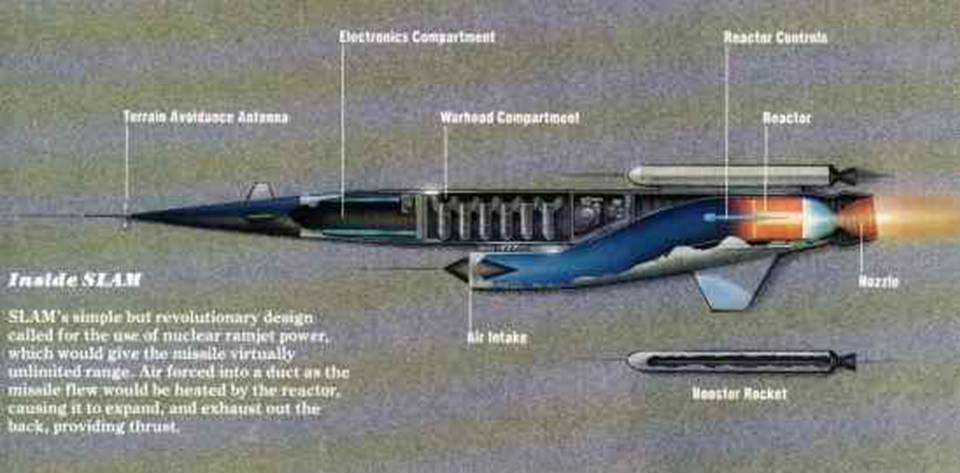
Enter the Vought SLAM.

 
Imagine a cruise missile the size of a railway locomotive.  It's powered by a nuclear reactor similar to the one designed for the Convair X-6, but reconfigured a little.  It doesn't heat air for individual engines; it's the engine itself.  It has a big ramjet intake and is designed to heat compressed air so hot - 2330 degrees - that it needs no fuel at all.  It just blasts the superheated air out the tailpipe. 

Is this for real, you ask?  Well, for starters, they built the aerial reactor (amusingly nicknamed the 'Tory' Reactor), as part of Project Pluto, which eventually became the nickname for the whole project, including the airframe:


They also built (at the unbelievably appropriately-named Jackass Flats) the 25 miles of oil well pipe casing needed to contain enough compressed air to test the ramjet capacity of the engine...


...and they also built the Tory IIC engine, and tested it in 1964.


At full power, the Tory IIC engine produced 35,000 pounds of thrust and 513 MW of power.  For the sake of comparison, that's roughly the same as the reactor in a large nuclear generating station - except that the Tory IIC was only the size of a railcar.  Amazing what you can achieve when you do away with all of that pesky radiation shielding (although according to the test results, the engine produced less radiation than expected).  As an article about the SLAM project noted, the May 1964 test was observed by "dozens of admiring AEC officials and Air Force Generals"...all from "a safe distance".  Yeah, I'll bet. Like Tasmania.

Of course, to make the missile work you first have to get it up to ramjet speeds - well over Mach 3 - before the nuclear engine starts operating properly, so to do that you strap a few solid rocket boosters onto the thing.  Stick an inertial guidance system into it, like the one used by the infamous Snark cruise missile (and like the first-generation ALCMs would get about 10 years later) and you could program it to follow a preset course.  It can fly for so long (estimates put its range at an incredible 100,000 km, or two and a half times around the planet) that you could launch it and let it loiter, flying figure eights over an ocean for hours or even days before sending it a command to penetrate enemy territory.  It's virtually indestructible because compared to a manned bomber it has only a fraction of the moving parts; remember, it's really nothing more than an aerodynamic teakettle (the project manager dubbed it "the flying crowbar").  It'll fly so low that Soviet radars will never spot it; so fast that Soviet fighters (and SAMs) will never catch it (so fast, in fact, that the 150 DB of the shock wave was expected to smash windows and rupture eardrums all along its flight path); and it will never run out of fuel.  Awesome, eh? 
 
But wait...there's more! 

Now you turn it into a one-shot disposable aerial SSBN!

 File under "Seriously, who thought this was a good idea?"

You install a dozen vertical-deployment tubes, each carrying a one-megaton thermonuclear warhead equipped with an ejection mechanism and a parachute.  So now your low, fast, 100,000 km-range, unstoppable, nuclear-powered flying freight train can follow a pre-programmed course across the Soviet Union, 500 feet off the ground, at Mach 3, excreting H-bombs at predetermined deployment sites. 

 
Good freaking lord.

And did I mention that it would be spewing radiation all the way?

Yeah, no need for pilots means no need for shielding other than the minimum necessary to protect the electronics.  Given the amount of radiation the lightly-built, almost totally unshielded reactor would be producing, burst eardrums and broken windows would be the least of the problems afflicting anyone under the missile's flight path.  The intake would be sucking in dust, debris, water droplets and all manner of aerosolized contaminants, cooking them to a turn in a 600-MW reactor running at full power, and blasting them back out the tailpipe as, let's face it, fallout.  According to project reports, this was regarded as a bonus.  There were discussions during the project as to whether the missile, having discharged a dozen buckets of sunshine onto the heads of unsuspecting kulaks, should be programmed to then add insult to injury by flying back and forth over Soviet territory, sowing neutrons until it eventually melted down and crashed into Comrade Sergey's potato field.  Alternatively, it could be programmed to crash itself and its screaming hot reactor into a 13th target, sort of as an added treat.  An apocalyptic baker's dozen, if you will.

Just how serious was the SLAM project?  Well, as noted above, serious enough that they built the engine, tested it, and were working on a Mach 4+ version when the plug was pulled on 1 July 1964.  A number of factors contributed to the decision to kill the project.  One was the cost; each missile was expected to run about $50 million, an exorbitant figure at the time.  The Navy was preparing to deploy the Polaris SLBM, and the Air Force had ICBMs, both of which were totally invulnerable to the SAMs of the time, and both of which arrived at their targets much faster than the SLAM (which one critic redubbed 'Slow, Low And Messy').  There were other problems, too.  Which ally would be crazy enough to allow a SLAM to overfly their territory en route the USSR?  And for that matter, how could you test the thing?  One proposal was to have it fly lazy figure-eights near Wake Island in the Pacific - and, once the test was complete, to ditch the missile, with its red-hot reactor, into the ocean.  Another (hilarious) proposal was to test it in Nevada using a long tether.  One project expert remarked rather drily, "That would have been some tether."  And what if one got away, either during testing, or in some sort of operational scenario?  After all, a SM-62 Snark cruise missile test-fired in 1956 using a similar inertial navigation system had been aimed at Puerto Rico, and was last seen on radar heading into the Amazon.(Note A)  What if that Snark had been carrying 12 thermonuclear warheads and a blazing hot, neutron-spewing reactor?

Worse, what if it didn't crash?  Remember, it didn't need fuel, and didn't have a whole lot of moving parts.  How long could such a thing stay up?  How would you bring it down?  For that matter, where would you bring it down?

Good lord, why hasn't somebody made a movie about this thing?  Oh, wait, they did:

 
Except that the SLAM moved a thousand times faster than any Terminator.  Plus it flew, spewed radioactivity, and was stuffed full of H-bombs.

Bottom line, beyond the sheer horrifying craziness of the concept, the SLAM was inferior to ballistic missiles in every conceivable way, and so it ended up on the chopping block.  The USN and USAF went on to deploy thousands of SLBMs and ICBMs which, for all their faults, were at least cheaper and faster; and while SSBNs were driven by nuclear reactors, none of the missiles were themselves nuclear-propelled.  When cruise missiles eventually were deployed a decade or so later, they were much smaller, carried only one warhead, and required fuel to fly.  Quite a different concept from the invulnerable, unstoppable "flying Chernobyl" dreamed up by the USAF, AEC, and the frighteningly innovative wrench-benders at Vought.

For those of you interested in reading more about the SLAM, you can find fascinating articles at the following websites:


A final thought about the discussion that sparked this whole line of investigation in the first place.  If you're Santa, then you're looking for something that can travel very low, very fast, for very long distances without refuelling, and that is capable of delivering packages at predetermined sites. If Santa were looking to upgrade the old sleigh to something a lot more capable, the SLAM would be a fantastic choice.  The hazard to the big guy himself shouldn't be too much of a worry, because let's face it, he's a long way past child-bearing age.  Like the Project Pluto folks, the radiation should be considered a bonus.  There'd be no need to drag Rudolph along to provide additional illumination: 
"Mommy, why is Rudolph's nose blue?" 
"Actually, sweetums, that's called the Cherenkov effect..."

And on that happy note, dear colleagues, Merry Christmas to all - and to all, a good night!  See you next year.

//Don//
 
P.S. As a contemporary note, nearly a year later, here's an example of why I think creating a nuclear-propelled autonomous flying H-bomb delivery truck might be a bad idea:

(Source: Failbook)

You see, I don't think the robot apocalypse is going to be the result of our preprogrammed servants freaking out or conspiring to destroy us all in some sort of Skynet Götterdämmerung.  I think we're in much more potential danger from a combination of our own laziness and our chronic lack of imagination about the potential consequences of robots doing exactly what we built them to do. 

"Judgement Day" is a whole lot cooler and much less embarassing as an explanation for the demise of humanity than "The Poop Spiral of Doom".


Notes:
A) http://www.airforce-magazine.com/MagazineArchive/Documents/2004/December%202004/1204snark.pdf

Friday, October 5, 2012

16 December 2011 – Seeing the light

Colleagues,

There's been an illuminating development in the battle in the US Congress to avoid a federal shutdown.  The $1 trillion spending bill, agreed last night, runs to more than 1200 pages and includes all manner of provisions inserted at the last minute in order to garner sufficient bipartisan support to ensure passage.(Note A)

One of those last-minute changes was a rider defunding the Department of Energy's standards for light bulb efficiency that would have gradually outlawed traditional incandescent bulbs.  The result of an energy law signed in 2007 by then-President George W. Bush, the DOE standards were to have been phased in gradually; the first victims would have been 100W incandescent bulbs, which would have been outlawed as of 1 January 2012, a fortnight hence.  Grass-roots Republican supporters had seized on the ban, making it a cause-celebre, and the issue has been at the forefront of talk radio and Tea Party-type discussions for months.  Democrats railed against the rider, but managed to eke out what they consider a win by including provisions requiring recipients of federal grants in amounts of $1 million or more to certify that they will upgrade the efficiency of facilities to the 2007 lighting standards.(Note B)

The light bulb ban is one of those rare issues that seems to galvanize the disparate ends of the political spectrum.  Democrats justified the ban by citing the impending extinction of polar bears and the drowning of coastal cities; Republicans countered with charges of war-against-the-poor and historical treason against the sainted memory of Thomas Alva Edison.  Lost in all the rhetoric, as usual, was the bulk of empirical fact, to wit, that while incandescent bulbs consume more electricity to operate, the lowest-cost alternative - compact fluorescent bulbs - are far more expensive than incandescent bulbs, contain liquid mercury, rarely last as long as advertised, must be disposed of as toxic waste, and are virtually all made in China (and thus must be shipped across the ocean on oil-powered cargo ships).  One reason for the manufacturing location is that China is virtually the world's only source of the rare earth elements used in the phosphors coating the interior of the CFL tubes.  The next generation of candidate illumination, LED lights, are even more expensive (due primarily to the need for a heavy and costly heat sink) and unless of very high quality, do not come close to mimicking the characteristics of incandescent bulbs.

As an exercise in cost-effectiveness, I ran the numbers on these back in March (see "Are governments smarter than a5th-grader?, 8 March 2011"), and concluded that the payback period for LED bulbs is about 6 years.  I'm six months [17 months, now! - ed.] into that on my office light bulbs right now and they're all still working; let's see how that goes.

Of course, the cost-effectiveness calculation is only one part of the equation.  The unit cost of the spotlamps I bought was $35, about 30 times the cost of a comparable incandescent spotlamp.  The average wage-earner isn't in a position to engage in costly experimentation with novel lighting technologies; if you're pulling down $35K a year as a general labourer, $35 for a single light bulb might seem a little outrageous.  That, in my opinion, is what fuelled much of the discontent with the DOE standards that would have led to the demise of the incandescents about two weeks from now.  Of course, the visceral response by many Americans to the government telling them what light bulbs they can and can't buy probably had something to do with it, too; live free or die, and all that.  You can have my incandescents when you pry them from my cold, dead hands...

What I find especially interesting from a strategic analysis perspective is how some in the environmental lobby responded to the news that the bill effectively lifted the impending ban.  Jim DePeso, the policy director of the group "Republicans for Environment Protection", was quoted as saying:

"In the real world, outside talk radio's echo chamber, lighting manufacturers such as GE, Philips and Sylvania have tooled up to produce new incandescent light bulbs that look and operate exactly the same as old incandescent bulbs, and give off just as much warm light...The only difference is they produce less excess heat and are therefore 30 percent more efficient. Same light, lower energy bills. What's not to like?"

Well, Jim, as I pointed out above, there's a lot not to like.  But what DePeso is referring to is a new suite of bulbs like the Osram Sylvania, a halogen bulb that reportedly replicates 100-W performance while consuming only 72W of current.(Note C)  
 
The Osram Sylvania 72W halogen bulb

Unlike the CFLs, Sylvania makes the Osram, which doesn't contain mercury, in Mexico.  But there's another strategic problem, you see - unlike traditional incandescents, these bulbs require rare earth phosphors.  This prompted Sylvania to issue a consumer notice earlier this year:

Rare earth metals  are elements vital to the manufacturing of our energy-efficient fluorescent lamps as they are a crucial component of the light-producing tri-phosphors inside the lamps. Currently, 95% of the world’s rare earth metal mining and oxide production comes from China where the manufacture and export of these compounds is heavily taxed and controlled.

The Chinese government has implemented new tariffs and mining regulations on rare earth materials. These actions, coupled with increasingly strict export quotas, have caused the price of these compounds to substantially increase – as much as 3500% since January of 2010 in some cases.

Due to regulation, exports of rare earth materials were reduced 40% from 2009 to 2010 and another 35% during the first half of 2011 compared with prior year. It is clear that the Chinease [sic] policies regarding rare earth materials must be addressed with multiple strategies in order to stabilize pricing and supply of these critical minerals.

OSRAM SYLVANIA has and will continue to take steps to combat these rising costs. We have continued to strengthen our supply chain while spurring our research and development teams into action. We are investigating the ability to reduce the weight of powders used in fluorescent lamps while evaluating alternatives to the current phosphor combinations. However, despite our best efforts, the rising cost of rare earth oxides has outpaced our ability to absorb them.

In order to combat the steep rising costs of these raw materials, OSRAM SYLVANIA will increase pricing on our fluorescent lamps, including our T8, T5, Deluxe T12 and all CFL pin and self-ballasted lamps. These increases will go into effect July 1, 2011; August 1, 2011; and then monthly until the cost of rare earth materials are stabilized.(Note D)

What does that mean for the bulbs that Mr. DePose thinks are the next big thing, infinitely preferable to traditional incandescents?  Well, it means that they're going to get more expensive.  And they're not exactly cheap right now.  The 72W Osram Sylvania goes for $8.20, which is more than ten times the price of a 100W Phillips Duramax, which retails for $2.98 per four-pack at Home Depot.  But the Osram isn't ten times as efficient (it uses 72% of the power of the 100W Duramax); and it isn't ten times as long-lived (it's rated for 3500 hrs, compared to 1500 hrs for the Duramax).  So it's already not much of a deal.  Furthermore, as the above statement indicates, that $8.20-per-bulb price is subject to change without notice due to the impact of China's near-total rare earths monopoly on REE supplies needed by the Mexican manufacturer.(E)
As for Mr. DePose's comment about GE, Sylvania, Philips and so forth gearing up to make the new light bulbs...well, is that a consequence of consumer demand for vastly more expensive light bulbs?  Or is it a consequence of the 2007 Bush Energy law outlawing incandescent bulbs that was supposed to come into effect on New Year's Day?
The Great Light Bulb Purge - narrowly averted by Congress, at least for now - is an excellent example of the chicken-and-egg relationship of government regulation with consumer preference in the modern "free" market.  Apart from moral pressure (like the David Suzuki Foundation's recent and ludicrously hyperbolic "Drowning Santa" campaign), there are essentially two ways that governments can force consumers to buy things they wouldn't otherwise buy.  One is subsidies - governments giving taxpayer money to industries to make otherwise non-competitive products cheap enough for consumers to consider buying them (q.v. wind power, solar power, and hybrid and electric vehicles - I've got sources if you want'em) - and the other is regulating technologies deemed 'undesirable' out of business.  This is the source of the philosophy reflected in Obama’s campaign promise to bankrupt coal-fired electrical generating concerns (Note F).
Both approaches constitute interference in the marketplace.  And as I've mentioned before in previous missives, both of these techniques seem to keep popping up, time and time again, in the political drive towards the 'green energy' economy.
But for the moment, at least insofar as the venerable incandescent bulb is concerned, it seems as though someone just might have "seen the light".
(Exclamation of joy at sudden observation of luminescence expurgated)

Let us therefore give thanks.

Cheers,

//Don//

P.S.  A back-of-the-envelope calculation tells us a little bit about the cost comparison.  The 72W Osram Sylvania bulb sells for $8.20 online.  A 4-pack of Phillips Duramax 100W bulbs costs $2.98 at Home Depot, or $0.75 apiece.  The Duramax has a rated lifespan of 1500 hrs; the Osram 72W, 3500 hrs.  To get 21,000 hours of light, you'd need 6 Osrams or 14 Duramaxes.  21,000 hrs of Osrams would consume 1512 kWh of electricity.  21,000 hrs of Duramaxes would consume 2100 kWh of electricity.  At roughly $0.10 per kWh, the Osrams would cost you $151.2; the Duramaxes, $210.  So you're saving $58.80 over 21,000 hrs, or $0.0028 per hour of use.  Those 6 Osrams would cost you $49.20, whereas 16 Duramaxes would cost you $12.00.  So you're paying $37.20 more for the bulbs, but saving $58.80 on electricity, for a total savings of $21.60 over 21,000 hrs.  Unless the Osrams don't last as long as advertised, or their price goes up due to the rare earths shortage, of course.

Notes
A) http://www.politico.com/news/stories/1211/70530.html

B) http://www.politico.com/news/stories/1211/70534_Page2.html

C) http://assets.sylvania.com/assets/Documents/Consumer_SocketSurvey_FINAL.6f999370-cb88-479f-94e1-a6483531b81f.pdf

D) http://www.sylvania.com/Phosphors/

E) http://www.bulbtronics.com/Search-The-Warehouse/ProductDetail.aspx?sid=0000984&pid=OS72MBCAP120V&AspxAutoDetectCookieSupport=1

F) http://frontporchpolitics.com/2012/07/obama-keeps-campaign-promise-patriot-coal-bankrupt/

Tuesday, September 25, 2012

25 November 2011 – China’s coal rush

"Never interrupt an enemy when he is making a mistake."

- N. Bonaparte


"Son, a Russky don't take a dump without a plan."

- Admiral Joshua Painter (Fred Dalton Thompson), The Hunt for Red October

Colleagues,

For most of 2010, carbon shares on the EU carbon market were trading at well above  €15/tonne, which is astronomical compared to the $0.05/tonne that US carbon shares crash-landed at a year ago, leading to the closure of the Chicago Climate Exchange.  Over the past few months, however, the European carbon market decided to follow its US counterpart and began a long, slow thundering in.


According to Bloomberg, that's the last 12 months.  Last summer, carbon shares peaked above €17/tonne, then plunged along with other shares when the European debt crisis started to gather steam in June, and continued to decline through the autumn.  Over the last two days, though, they plunged again.  Since May, they've lost nearly 60% of their value.

What happened over the last two days?  Well, unless you've been living in a hole or watching the mainstream media (sorry, I guess that's redundant), you're probably aware that an anonymous poster dumped another pile of emails stolen or otherwise acquired from the University of East Anglia's Climate Research Unit (CRU).  Those who follow such things have dubbed this release "Climategate 2.0", and the collection doesn't disappoint; once again, some of the biggest names in the alarmist camp of climate science feature prominently, and are shown to be engaged less in science than in trying to figure out how to make science serve a political end. 

Don't take my word for it; go and read them if you like.  As always, the data speak for themselves.


Why does this matter?  Well, because the Durban climate talks are going to begin next Monday.  The email dump came just a few days before the Conference gets underway, just as the first dump (that launched the original "Climategate" and immortalized the phrase, "Hide the Decline!") came a few days before the Copenhagen climate talks began at the end of 2009. 

That's a little red meat for the conspiracy theorists out there.  Here's some more:

Nov 15-18, 2009: US president Barack Obama visits China
Nov 19, 2009: Climategate I emails released
Dec 2009: Copenhagen climate talks

Nov 19, 2011: US president Barack Obama visits China
Nov 22, 2011: Climategate II emails released
Nov 28, 2011: Durban climate talks begin

Is there an Obama-China-Climategate connection? To quote Dash Parr's gluteally-wounded teacher in The Incredibles, "Coincidence?  I think NOT!"

The China-climate angle is important, because what I really wanted to talk about is what we can expect from China next week.  It's funny how China keeps alternately being referred to and ignored in discussions of global warming climate change global climate disruption.  Last month, I attended a Centre for International Governance Innovation meeting entitled "China's Global Impact, How Canada Should Respond".  In the six hours I sat there, the word 'China' was used hundreds if not thousands of times, only slightly more frequently than "climate change" and "partner".  The word "communist", however, wasn't used once, not even in the context of the fact that the "Chinese Communist Party" is the state's governing entity, and has been for close to sixty years.  The ther term never so much as came up.

What was mentioned, though, was China's clear and unequivocal dedication to environmental stewardship.  One of the presenters, whom I shall spare identification (Chatham House rules and all that), claimed to have met with numerous Chinese government officials "at the Deputy Minister level", all of whom swore to him that China was merely waiting for the US and other industrialized countries to act to reduce carbon emissions, after which Beijing would immediately take draconian action to reduce China's own carbon emissions.  The speaker repeated this claim at least twice more during his presentation, and again during the lunch.

At this point I could cite chapter and verse to point out that China surpassed the US last year as the world's largest carbon dioxide emitter, and that the gap has exploded as the recession digs into US industry (as of right now, China produces 23% of the world's emissions to the US's 18%).  I could mention the legendary statistic that China, in addition to building nuclear power plants and planning to expand its wind generation capacity from 12 to 100 GW over the next eight years, is building "one coal-fired generating station per week".  I could mention that China is becoming a motorized society faster than any other on Earth.  I could also mention that 300,000,000 Chinese citizens have yet to benefit from any of these advances, so all of these changes are going to be going on for a long time - long after, in fact, China's carbon dioxide emissions have left US emissions in the dust, and have surpassed those of the rest of the world combined.  I could mention that China emits more CO2 in a month than Canada does in a year - and that the increase in China's emissions alone over the next year or so will surpass Canada's annual emissions.  We could return our entire country to the Stone Age tomorrow, and a year from now global CO2 emissions would be unchanged.  Except it wouldn't because in the Stone Age folks still burned wood to cook their mammoth burgers and, you know, survive winter.  But I digest.

Anyway, I don't need to mention all of that because we all know it, right?  And besides, it's all good, because just as soon as the US and Canada and Russia and France and Japan and Germany and Italy and whomever agree on a plan to reduce carbon emissions, China's going to jump right on board.  They'll get with the programme, and throttle those CO2 emissions...right?

Or maybe they won't.  Maybe they'll do what they've been doing for the past 20 years - bide their time, talk the talk, and watch in bemused astonishment as their strategic adversaries simultaneously a) work to hamstring their domestic ability to produce electricity and therefore support industry, b) create regulatory environments that force companies to move to China in order to be able to make a profit, c) rack up huge amounts of consumer debt to buy from those (now-China-based) companies the same products that until recently had been made at home, while d) enjoying a social safety net that is unsustainable from the now-shrunken tax base and must therefore be propped up by purchasing truly astronomical quantities of debt...from China.

But wait - China must be sincere about the whole "carbon reductions" thing, no?  After all, they're increasing their wind power capacity by a factor of seven over the next 9 years!  Okay - let's run the numbers.  Suppose they go whole-hog and deploy the full 88 GW of wind generation capacity.  At a capacity factor of 25% (the statistical average, although few wind farms ever manage to sustain that), that means they're actually likely to get about 22 GW of actual generating capacity.  At 24 hrs a day, 365 days a year, that translates to 192,720 GWh.  In 2008, the US produced 1,985,801 GWh of electricity by burning coal, and this generated 2,001,806,000 tonnes of CO2, for a ratio of 1008 tonnes of CO2 per GWh of electricity produced (statistics from the US Energy Information Administration).  Assuming China's coal-fired electrical generating plants are as thermally efficient as US plants (and they aren't), this means that China's planned wind deployments should save 192,720 x 1008 = 194,273,269 tonnes of CO2.  That sounds like a lot; after all, Canada's annual emissions in 2008 were 544,091,000 tonnes of CO2.  So you might argue that if China completes its planned wind power deployments by 2020, they'll be able to save an annual amount of CO2 emissions equal to about 35% of Canada's annual emissions.  That's good, right?

As of last summer, China was planning to build 234 GW of coal-fired generating capacity...to be completed by 2016.(See the figure below, and note A)  At a capacity factor of 90%, that's 1,844,856 GWh per year.  Yes, you heard right - between 2011 and 2016, China is already planning to increase its existing electrical generating capacity by roughly as much coal-fired electrical generating capacity as exists in the entire US. 

Take a close look at that graphic, and think about the fact that all US existing and planned coal-fired capacity is in red and yellow, whereas all of the blue and green belongs to China.  Moreover, the US is taking coal plants off line.  Now...who's got a "coal problem"?

(Source: Erik Shuster, “Tracking New Coal-Fired Power Plants”, National Energy Technology Laboratory, 12 July 2011)

So that 192M tonnes of CO2 they're saving by installing wind turbines ends up amounting to less than 10% of the 2B tonnes of CO2 emissions they'll be adding from new coal-fired generating stations.  And the new coal stations are going to come on line much more quickly than the turbines.  They're already pouring the cement.

What's my point?  They say that diplomats are folks who are sent abroad to lie for their country.  With an entire United States-worth of coal-fired generating stations due to come on-line by the last year of the second Obama Administration, just how credible are China's claims that they're "just waiting for the US" to take meaningful action to reduce GHG emissions before taking the plunge themselves?  And if the US is willing to further hamstring its economy through regulatory action...why get in the way?  Why on Earth would the Chinese interrupt their enemies while they're making a mistake?

By the way, those wind turbines they're planning to deploy?  Each one contains between 600 and 1000 kg of neodymium-iron-boron magnets.  Hitachi owns the patent on NdFeB magnets, and they used to be made in the US, by companies like Magnequench.  The problem was, after the early 1990s, when Molycorp - the US's only producer of neodymium - declined due to regulatory pressures to renew the license for its mine at Mountain Pass, California, the only remaining source of neodymium was the mine at Baotou, China.  So, in 2000, Magnequench moved its NdFeB magnet facility from Valparaiso, Indiana to China.  Shortly thereafter, Vacuumschmeize, a German NdFeB magnet producer located in Elizabethtown, Kentucky, relocated to China. They were followed two years later by Hitachi Magnetics, which in 2005 relocated its Edmore, Michigan magnet production facility to - you guessed it - China.  Today, nearly 90% of all NdFeB magnets are produced in China.  So even if the new wind turbines are a complete waste of time and money, the money's being spent in China, and the time being wasted is that of salaried Chinese workers.

It's almost like they've got a five-year plan or something.

Cheers,

//Don//
 
Notes:
A) http://www.netl.doe.gov/coal/refshelf/ncp.pdf

Friday, September 21, 2012

14 November 2011 – Electrical Balancing Acts

UPDATE:

And the better the wind turbines work, the worse for the grid:

Thanks to a flood of subsidies unleashed by Angela Merkel’s government, renewable capacity has risen still further (solar, for instance, by 43 per cent). This makes it so difficult to keep the grid balanced that it is permanently at risk of power failures. (When the power to one Hamburg aluminium factory failed recently, for only a fraction of a second, it shut down the plant, causing serious damage.) Energy-intensive industries are having to install their own generators, or are looking to leave Germany altogether.
Wind power - "renewables" in general, with the sole exception of hydroelectric power - is an unmitigated disaster, and one that would not have occurred without heavy government subsidization. It proves an old adage: that whatever sort of behaviour you subsidize, you inevitably get more of. Germany's renewable energy sector is performing so grandly that Germany is planning on vastly expanding its coal and gas-fired generation in the coming years.  And I'll bet you dollars to donuts that Merkel's hasty and ill-advised post-tsunami "no nukes" pledge won't last another year. Japan has already backed away from theirs.

It's an ironic lesson - that for a modern industrialized society, from a perspective of grid management, getting any more than a tiny proportion of electricity from intermittent and inherently unreliable "renewable" energy sources is quite simply...unsustainable.

Of course, the United States, thanks to Barack Obama's policy of using EPA regulatory action to effect fundamental policy changes (like his maniacal and grotesquely unscientific jihad on carbon dioxide) that he could not achieve through legislation, is going in precisely the opposite direction:


Look, folks, I am in this field. I have been for more than 30 years. Losing 36,000 MWs of the most cost-efficient generation capacity in the US is a disaster. You have no idea how bad the increases are going to be. They will be disastrous to the individual energy consumers and apocalyptic to large users – those who create jobs.


I shudder to think of what this is going to do to grid reliability as well. A lot of those coal plants help support the grid during disruptions. They regularly provide both energy and MVARs (Mega Volt-Ampere Reactive) that keep the grid from collapsing when large loads are added or lost. (That’s about as simple as I can make it and still be understood.) Losing these stabilizers will make it very hard to hold the grid. I pity the load dispatchers.


Trust me, people, this is a very big, very bad thing that is happening as a direct result of Barack Obama’s war on coal.

Funny how it always comes back to November, doesn't it? If you think the last four years were bad for our cousins to the south, just imagine what will happen once Obama is no longer constrained by worries about re-election. I'm still not convinced that Obama is deliberately trying to destroy the United States of America, but I keep coming back to the same question: if he were, what would he be doing differently?  As Conrad Black put it so succinctly Friday last,

If this administration is re-elected, Canada, as it has for the entire mighty spectacle of the inexorable rise of the United States, will have the ring-side seat for a disaster.

Amen. Let's hope the adults seize the wheel, jettison that clown and his cronies, and start the long, hard slog of putting America back on the road to sanity.


-----------------------------------------------------


Colleagues,

If strategic analysis areas of interest could be represented by a Venn diagram, one of the most interesting areas of overlap would, oddly enough, be in electrical grids.  I've written about grid structures and problems before, but the subject is worth thinking about at length.  The average grid in Canada and the US these days accepts power generated both from traditional (thermal, hydroelectric, and nuclear) and 'green' (wind, solar, biomass and so forth) sources.  Thermal generation from coal, oil, and natural gas evokes Middle Eastern nations, Islamism, terrorism, environmental damage, sulphur dioxide emissions, acid rain, China's exploding power demand (and its equally exploding coal-fired generating capacity), health problems, the 'Asian Brown Cloud', oil tankers, oil spills, drilling moratoria, pipelines to the US, pipelines to the west coast, wildlife preserves, aquifers, and a host of other topics.  Hydroelectric generation engages questions of rainfall and snowfall, melt dates, water levels, water usage, droughts, irrigation, sedimentation, critical infrastructure protection, species preservation, and massive civil engineering projects.  Nuclear power engages proliferation concerns, supplies of uranium ore, enrichment technologies, Iran, nuclear weapons, nuclear wastes, nuclear waste transport and storage, regulatory issues, more terrorism, earthquakes, tsunamis, leaks, Three-Mile Island, Chernobyl, arms control, arms reduction, pre-emptive strikes, Russian collaboration, and (once again) the Middle East.  And 'green' energy sources involve so many ancillary considerations that there's no point trying to list them here.

This is why it's fascinating to take a look at where all of these factors come together - in the massive minute-by-minute balancing act that's necessary to keep a large electrical grid system operating in the face of complex and shifting loads, supplies, and environmental factors.  Forbes recently published an article looking at how the Bonneville Power Administration, which manages water flow on the Colorado River and powers a large part of the US Pacific Northwest, manages to keep the power supply available and balanced. 

The article can be found here:

http://www.forbes.com/sites/jonbruner/2011/10/20/the-high-stakes-math-behind-the-wests-greatest-river/

It's a great example of engineering hoo-rah (the author had me at "five-ton circuit breaker"), and worth a read for that reason alone; but from a strategic analysis perspective, one of the graphics in particular caught my eye.  It was this one:


That's one week in the life of the Bonneville Power Administration (BPA - not to be confused with bis-phenol A, the chemical that's had legions of nervous nellies chucking their plastic kettles out for the past decade).  It's the week that took place exactly one month ago, to be precise [ACTUALLY, 14-21 OCTOBER 2011 - ed.). 

That graph tells us a whole lot of really important things.  The first thing it tells us is that electrical demand - the scarlet line - is actually incredibly predictable.  There's a fascinating lesson here.  At its most basic, nuclear fission is random chance; but if you assemble enough, say, uranium atoms in one place, they demonstrate statistically predictable behaviour.  Same with people.  You or I can decide whether or not to flip a light switch on or off; it's a matter of personal choice, and your choices (and mine) may be utterly unpredictable.  But if you assemble millions of people, their behaviour - for example, in consuming electricity - starts to become statistically very predictable.  As the scarlet line shows, there are predictable demand surges in the morning, as people are preparing to go to work, and in the evening, as they make dinner and perform other chores; and there are predictable declines in demand: a shallow one at lunch time, and a much larger one over night.  Moreover, those demands don't vary greatly from workday to weekend.  If it weren't for the day notations on that chart, you'd be hard-pressed to tell Friday from Saturday.  It's easier to make out Monday and Tuesday by the early morning peaks - although it's interesting to note how that peak, which starts off high on Monday, declines daily through the week, until the Friday morning peak is within a few percentage points of the Saturday morning peak. I guess that's not really surprising, is it?

The brownish-red line is interesting, too.  That's thermal generation, and most of the time it's remarkably steady.  This is because thermal power plants, all of which are basically steam turbines, operate most efficiently when they operate at continuous output.  Boilers, after all, have to be brought up to operating temperature, and take time to cool down.  Some thermal plants - small, gas-fired turbine plants, for example, which are basically jet engines hooked up to generators - can start up and ramp down quickly, but doing so tends to be costly in terms of fuel.  Imagine powering your house by generating electricity from a jet engine; actually, those of us who worked in ADATS units don't need to imagine it, because each ADATS vehicle had a jet engine hanging off the front of it, and burned 1300 litres of diesel every 24 hours just to keep the lights on.  It's effective, but it's not cost-effective, to start up and stop in response to unpredictable shifts in demand.  As a rule, thermal plants work most efficiently, and get the most electrical power out of the heat content of their fuel, when they maintain continuous, stable output.

The blue line - hydro plants - are the exact opposite of thermal plants.  Hydro power is pretty much the most efficient source of generation on Earth.  It's essentially solar power, with the motive force for electrical generation provided by potential energy brought to us courtesy evaporation, condensation and precipitation.  The water is stored behind dams, and can be released through turbines to generate kinetic energy (in the form of spinning turbines driving generators to push electrons through a wire) pretty much at will.  Hydro power is extremely responsive, able to ramp up and down in a matter of minutes to respond to changes in demand and supply.

The green line is the wild card in the deck.  That's wind power.  The BPA has about 3500 MW of wind power installed, roughly equivalent to about 2000 large turbines.  That green line tells you everything you need to know about the complexities that government-subsidized wind farms have introduced into the grid management equation.  On the 14th and 15th of last month, the BPA's wind turbines were basically flatlined.  On the 16th, there was a brief spike in production.  The turbines put out a little bit of power - about a quarter of the installed capacity, which is par for the course for wind turbines - over the night of 17-18 October.  And then, on the afternoon of the 19th, Gaia cut loose and the wind productivity soared. 

Look what happened to the rest of the grid.  In the space of about an hour, electrical generation from wind turbines went from nothing to about 85% of nameplate capacity - and in that same hour, demand actually fell, by about 200 MW.  Thermal plants were running as usual, providing baseline power, and hydro plants, being the most flexible, were going through their daily double-hump routine to take care of the morning and afternoon demand surges.  Just before lunch, when demand was falling, wind power production exploded, dumping 3000 unneeded MW into the grid.  Hydro generators had to be shut down as quickly as possible to avoid catastrophic oversupply (which can trip circuit breakers and cause wide area power outages); and because that wasn't enough to stem the flow of power, even thermal plant output had to be scaled back, greatly reducing efficiency.  And then, five hours later, as the wind died back down to nothing, hydro and thermal plants had to be brought back on line.

The problem is that while we can predict demand with reasonable accuracy, we never know when the wind's going to blow, or how hard, and when it's going to stop blowing.  This means that wind power can never be a replacement power source; it can only be a supplemental power source.  And because it's entirely unreliable, you cannot afford to take a single MW of conventional production off line unless you feel like explaining to Missus Miggins why she can't boil water for tea.  Moreover, because wind power is an unpredictable, supplemental power source, your grid system has to be flexible enough to be able to accept unpredictable injections of power - which means that your conventional production capacity has to be rapidly scalable both up and down.  As the graph and the BPA experience demonstrates, this is a costly and technically challenging problem, principally because power generation has always been designed to operate continuously, because that's what's most efficient.

It's funny, isn't it, how whenever policy and ideology bump up against the real world, the resulting problems are ALWAYS 'costly and technically challenging'?

And if you think managing the northwest power grid is complex now, wait until 2013, when BPA is supposed to have twice as much wind capacity installed - 6000 MW, if current plans don't run headlong into looming fiscal realities.  If 6000 MW of wind power were to suddenly come on line at a time of low demand, the rest of the conventional generators would have to have the capability to drop to virtually zero output in a matter of moments - and to then come back on line as soon as the wind died down.  If you need a visual image, think about a Nascar race with 50 competitors on the track, moving at full speed, inches away from each other, and a rule that requires the marshal to always have between 49 and 51 cars on the track, no more, and no less.  Now, without warning, 25 more cars come in from an injector lane, moving at full speed, and the race marshal has to get 25 of the original competitors off the track in a matter of seconds, without letting anybody bang into each other.  And then think about what happens if the new arrivals suddenly off-ramp without warning, and the marshal has to feed an unpredictable number of the original drivers back onto track, ensuring that the total number of cars never gets outside of the 49-51 mandatory total.

If that sounds impossible consider the fact that it's far too restrictive an analogy, because the energy of the moving electrons that the BPA grid handles every minute is roughly equal to the amount of kinetic energy of about 21,000 stock cars moving at 200 km/hr.

I'd say that's quite a balancing act.

What's the strategic analysis angle in all this?  Well, many of the proponents of wind power are selling it not only because of its supposed environmental advantages (on that point, you might want to google "China cancer city"), but as a solution to the problem of "energy dependence" for the US.  Really?  Only 18% of the petroleum imported by the US last year came from the Persian Gulf (25% came from Canada); but 75% of the world's supply of neodymium-iron-boron magnets (the key enabling technology for the newest generation of direct-drive wind turbines) and 60% of the world's supply of samarium-cobalt magnets (the key enabling technology for older, geared wind turbines) comes from China - which also, not at all coincidentally, produces 97% of the world's supply of neodymium and samarium.

It's almost as if the US government asked itself whether it wanted to be 18% dependent on Saudi Arabia for its energy needs, or 97% dependent on China, and settled on the latter.  Come to think of it, that's kind of a balancing act too, wouldn't you say?

Cheers,

//Don//